

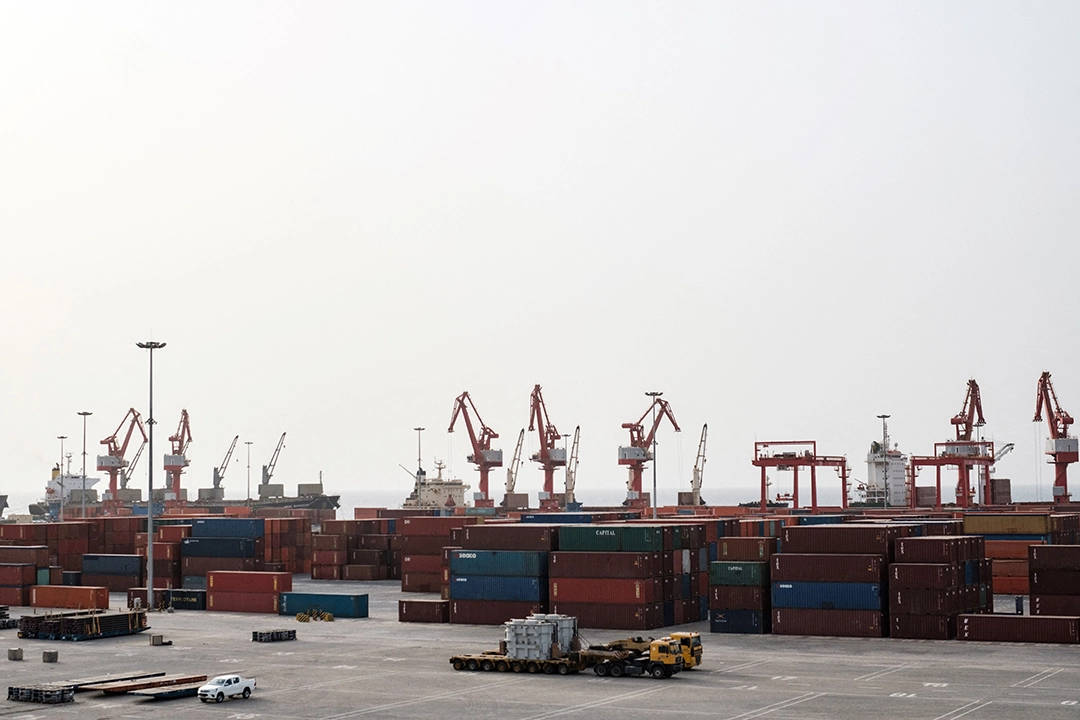
China has invested $50 billion in African port infrastructure since 2013 and Beijing has either financed, built, has a stake in, or controls operations of an estimated 78 trade ports in 32 African countries. These investments, from the Mediterranean Sea to the Atlantic and Indian Oceans, are part of China’s Belt and Road Initiative, include port enhancements and improvements to railways and industrial zones.
This has helped increase continental trade with China, but analysts have warned that high debt tied to murky deals risks African sovereignty and the possibility of Beijing intertwining its investments with military purposes and intelligence-gathering.
African ports are increasingly using Chinese automation and artificial intelligence systems that require ongoing financial commitments to maintain. Paul Nantulya, a researcher at the Africa Center for Strategic Studies, believes an overreliance on Chinese technical support could cost African nations billions of dollars over time.
“In some cases, concerns have been raised that Chinese firms could gain influence over strategically important infrastructure through equity participation, long-term leases, or operational management agreements,” Nantulya wrote. “Such concerns persist due to lack of public access to agreements and weak oversight.”
Kenya’s Chinese-built Standard Gauge Railway is one example of a Chinese infrastructure deal gone awry. The railway was supposed to be an economic boon for East Africa, stretching from Mombasa and Nairobi all the way to Uganda with plans to link up with Burundi, the Democratic Republic of the Congo, Rwanda and South Sudan. However, the end of its line now sits unused in a cornfield 468 kilometers short of the Ugandan border.
On average, Kenya spends more than $1 billion per year to service its railway debt to China. Kenya’s biggest external debt holder is China Exim Bank, to which it owes $741 million in principal, $222 million in interest and $41 million in penalties for the 2025-2026 budget year, Kenyan Auditor-General Nancy Gathungu revealed in a 2025 report.
Analysis by Italy’s Italia Nel Futuro digital newspaper found that China is possibly using African ports for military purposes. In 2024 and 2025, Beijing’s People’s Liberation Army Navy made at least 15 port calls in Africa, a significant uptick. These trips included stops in Côte d’Ivoire, Kenya, the Republic of the Congo and South Africa.
There is a recent example of China developing an African port purportedly for commercial purposes, then using it militarily. Djibouti’s Chinese-developed Doraleh Port opened in May 2017. Two months later, Djiboutian and Chinese dignitaries celebrated the completion of China’s first overseas military base, a few minutes’ drive from the port. The facility was built for Chinese armed forces, which reportedly have exclusive use of at least one of the port’s berths.
Located 8 kilometers from France’s largest overseas base, Japanese Self-Defense Force facilities and the United States’ Camp Lemonnier, the Doraleh port since 2017 has increased its capacity to accommodate destroyers, frigates, and potentially aircraft carriers, while its permanent garrison has been expanded to accommodate more than 3,000 personnel, Italia Nel Futuro reported. Writing for Italia Nel Futuro, port authority expert Pino Musolino cautioned that the concentration of military presence in and around Djibouti could turn the Horn of Africa into a “superpower contest zone.”
“This militarization complicates regional stability and African agency in security governance,” Musolino wrote.
Other locations identified by Musolino as potentially dual-purpose ports are in Walvis Bay, Namibia; Tin Can Island, Nigeria; Nacala, Mozambique; and Victoria, Seychelles.
The issue of illegal, unreported and unregulated (IUU) fishing complicates Chinese involvement in African ports. Chinese vessels have fished illegally in African waters for decades, and Beijing’s distant-water fishing fleet, the world’s largest, is the world’s worst illegal fishing offender, according to the IUU Fishing Risk Index. Due mainly to illegal Chinese overfishing, West Africa, alone, loses up to $9.4 billion annually and is considered the world’s hot spot for illicit fishing.
Beyond investments in port infrastructure, Beijing is pushing for the adoption of Chinese practices, standards and policy guidelines as it seeks to make partner countries more dependent on Chinese systems than on Western ones. One example cited by Nantulya is the “port-park-city” urban and economic development model advanced abroad by the China Merchants Group, which has projects in Djibouti, Egypt, Morocco, Nigeria, Tanzania and Togo. The model offers significant state-backed investment and flexible financing.
In reality, however, “replicating this model outside China remains difficult due to differences in economic structure, state involvement in the economy, and supply chains,” Nantulya wrote.