

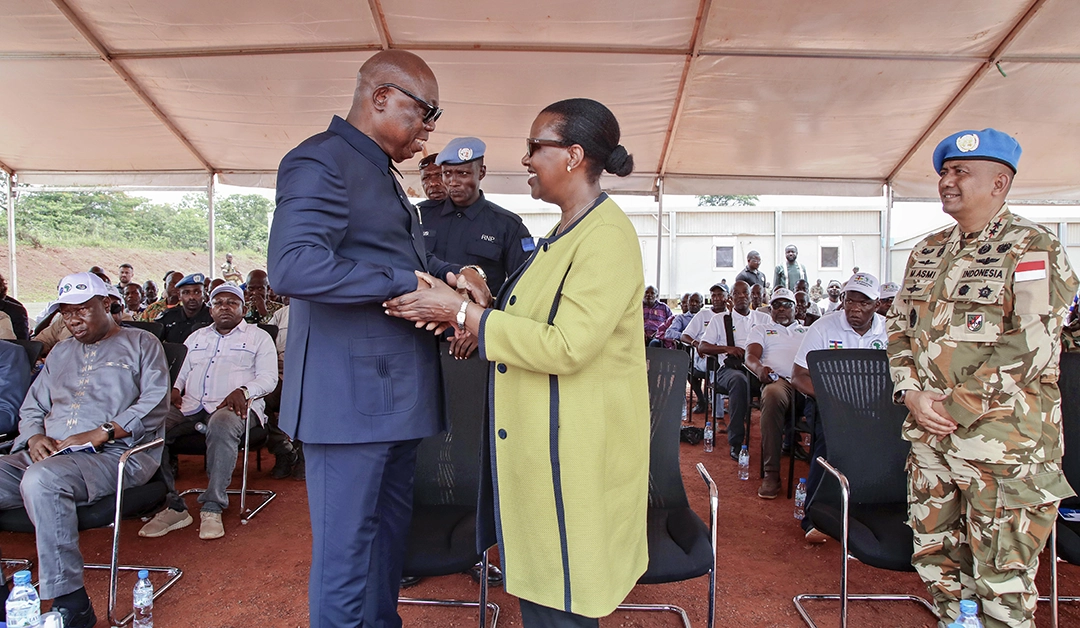
The United Nations has marked a historic milestone with the handover of seven military bases in the Central African Republic to local government and security forces.
During a ceremony on June 10 in Mbaïki, Valentine Rugwabiza, the chief of the U.N. Mission in the Central African Republic (MINUSCA), said the transfer is about much more than brick-and-mortar buildings.
“We are transferring the tasks performed by MINUSCA to national authorities in the zones,” she said. This, she added, includes, “providing security, protecting civilians, supporting civil authorities and maintaining access roads.”
MINUSCA was established in 2014 during a crisis that left much of the CAR in the hands of rebel groups and forced hundreds of thousands of civilians to flee to neighboring countries. The peacekeeping mission includes 16,000 uniformed personnel and has overseen the implementation of a peace agreement signed by 14 rebel groups and the government. A disarmament process has seen more than 5,000 combatants lay down arms and begin returning to civilian life.
A peaceful national election in December 2025 was hailed as an important milestone for the country.
MINUSCA is now working to shrink its footprint. Out of approximately 100 bases, 21 have been closed this year, and the mission plans to transfer an additional 27 to CAR authorities by the end of 2026, broadcaster Radio France Internationale (RFI) reported. MINUSCA also faces budget cuts of 15%.
But Rugwabiza insisted that peacekeepers will continue their work. The U.N. said its future presence in the country will prioritize “mobility” with more peacekeepers on long-range patrols and a strengthened rapid deployment capacity.
“Passing the torch does not mean the departure of MINUSCA,” she said. “Reconfiguring does not mean absence.”
Some civilians expressed concern at the departure of peacekeepers from places far from the national capital where they are vulnerable to attacks by armed groups.
“For a decade, the U.N. presence reassured us,” Yowan Mambissi, a resident of Mbaïki, told RFI. “We ask the security forces to quickly take charge, which is even more important since, in recent days, we have seen a resurgence of acts of banditry that must stop.”
Advocacy groups warn that the country remains at grave risk due to internal clashes by rebel groups and spillover from the civil war being fought in neighboring Sudan. On June 30, fighters from Sudan’s Rapid Support Forces and allies from CAR’s Seleka rebel group attacked a MINUSCA base near the border in Am Dafock. About 16,000 displaced people had gathered at the base for protection. The attack left at least three people dead and wounded three U.N. peacekeepers from Zambia.
There are also serious questions about the ability of the CAR Armed Forces (FACA) to take over security responsibilities. The FACA has been criticized for human rights abuses as well as its close relationship with Russian mercenaries and members of certain rebel groups.
At the handover ceremony in Mbaïki, citizens expressed skepticism and fear relating to what would replace the U.N. force.
“The appeal I would make to authorities is to watch over us,” Ulrich Mambaye, a Mbaïki resident told France 24. “If they don’t make an effort to send armed forces here to Mbaïki, we will always suffer.”
During her speech, Rugwabiza struck an optimistic tone and touted the significant but fragile gains being made in the country.
“The Central African Republic has made remarkable and tangible progress towards lasting peace and security,” Rugwabiza said. “These gains must now be preserved and consolidated.”