

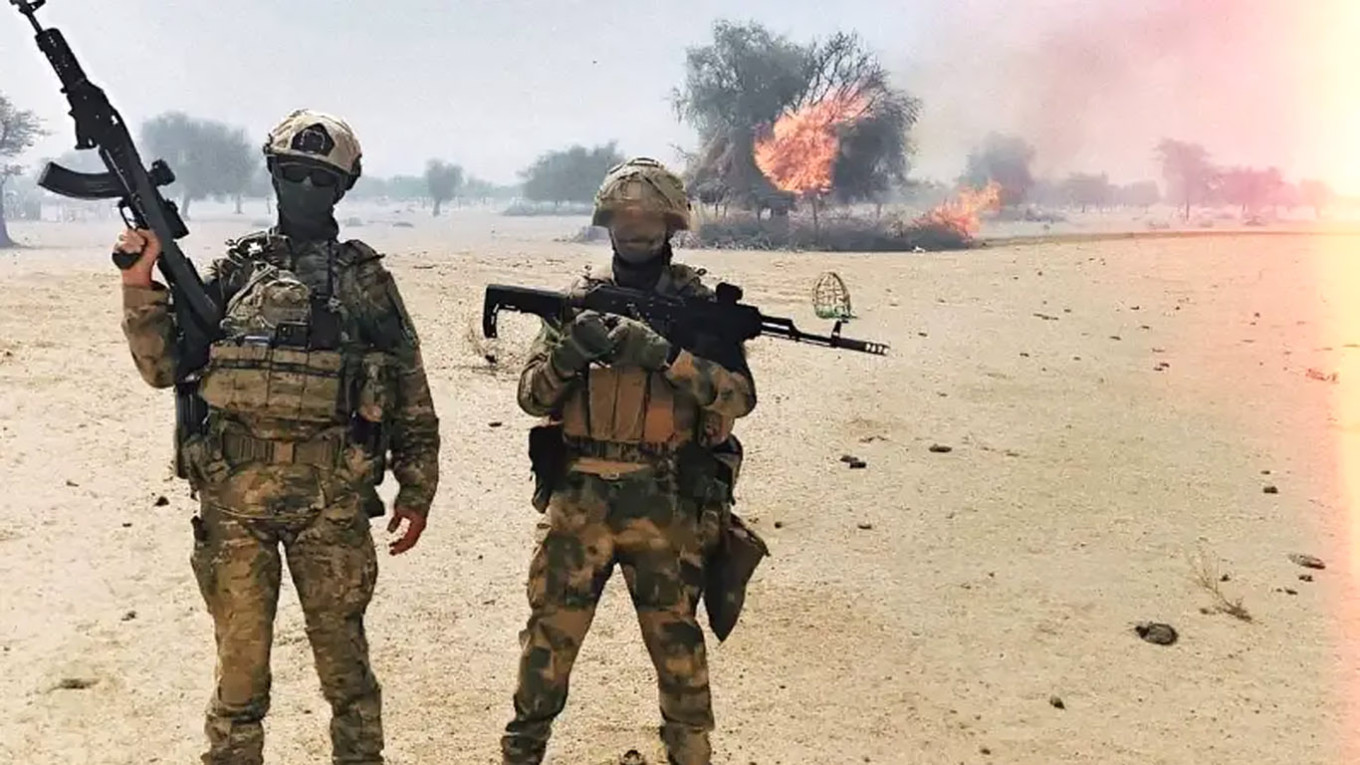
Tuareg herders Ousmane Ag Sidi and Abdoulwahab Ag Mahamad were working in and around Zahro, a village on the Niger River in northern Mali. They had no known ties to terrorist groups. On June 23, they left the village and encountered members of a Malian Army patrol and their Russian partners from the Africa Corps.
After the patrol left, residents were shocked to discover a gruesome scene: The men had been shot dead, and Ag Sidi’s body was dismembered, his arms and legs displayed in the shape of a swastika.
Tilla Ag Zeini, head of the local human rights organization Collective for the Defense of the Rights of the People of Azawad/Northern Mali (CD-DPA), decried the summary executions for which the Russian mercenaries have become notorious.
“It’s a horrific scene, it’s extreme barbarity, nothing can justify this atrocity,” he told Radio France Internationale. “It violates international humanitarian law, it violates the principles of war. The aim is to terrorize the population, to create a sense of fear.”
Brutality has been a feature of the Russian military presence in Mali since Wagner Group mercenaries first arrived at the request of the country’s military rulers in December 2021. Accusations and evidence of civilian massacres, rape, torture and other human rights abuses have followed the Russians since they rebranded as the Africa Corps two years later.
On April 25, the Azawad Liberation Front (FLA) and Jama’at Nusrat al-Islam wal-Muslimin (JNIM), a collective of Sahelian terrorist groups that is affiliated with al-Qaida, launched coordinated attacks across Mali with the goal of overthrowing the ruling junta. On April 26, FLA fighters drove Africa Corps mercenaries out of the strategic town of Kidal without a fight.
Africa Corps and Malian forces killed at least 278 civilians in the north between June and December 2025, according to the CD-DPA annual report.
“In the past, the Malian army perpetrated several massacres of civilians. But this is the first time we have seen severed heads and dismembered bodies,” said a former elected official from the Timbuktu region who spoke anonymously to French newspaper Le Monde for a June 27 article. “The Russians have imported their barbaric methods to Mali, on the orders of the junta.”
Africa Corps fighters also regularly kill livestock, the primary means of subsistence for seminomadic communities. About 300 sheep were found slaughtered by a hail of bullets after a joint Russian-Malian patrol passed through the town of Aguelhok in mid-June.
“This scorched earth strategy has only one goal: to terrorize populations and force them into exile in neighboring countries. It is state terrorism,” FLA spokesperson Mohamed Elmaouloud Ramadane told Le Monde.
Like Wagner before it, the Africa Corps has had few successes in Mali. Its vicious tactics have done nothing to slow the spread of terrorism.
“The only result is an increased desire for vengeance and, therefore, a rise in overall violence,” the former Timbuktu region official said.
Ramadane said there is no difference between the Wagner Group mercenaries and the Russian soldiers of the Africa Corps.
“They have the same behavior, the same methods and the same criminal mentality,” he said. “They just changed their hats. These are not soldiers trained in the laws of war, just mercenaries who have been regularized by the Russian Ministry of Defense.”
Lou Osborn, an investigator with the journalism collective Inpact, said that by rebranding and relaunching the Wagner Group, a private military company, as the Africa Corps, Russia has given up any sense of plausible deniability it once claimed.
“The entire Africa Corps chain of command is made up of GRU [Russian military intelligence] members answering directly to the Kremlin,” she told Le Monde.
“No one believed it, but one of the advantages of Wagner was that the Kremlin could blame its leaders if something went wrong by saying: ‘It’s not us, it’s them.’ With Africa Corps under the direct authority of the Ministry of Defense, that argument no longer works.”