

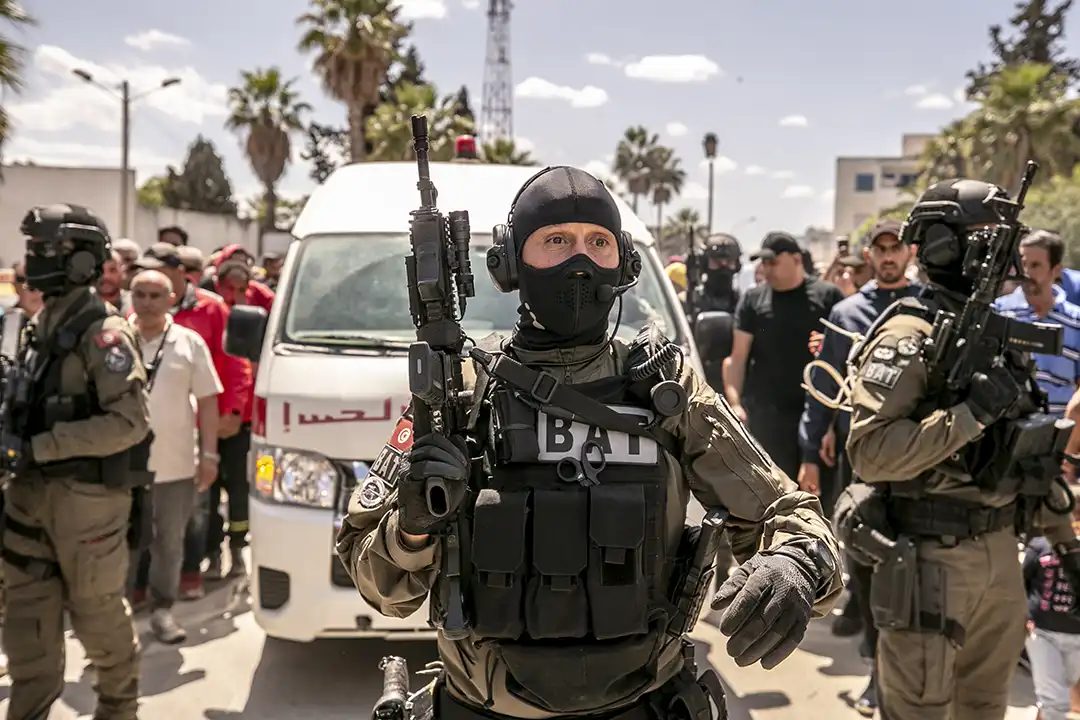
The United States government on September 30 delivered about $1 million worth of counterterrorism equipment to Tunisia to help train and certify law enforcement officers in crisis response and specialized security skills.
The U.S. Embassy in Tunisia did not provide equipment details, but the transfer is part of a counterterrorism assistance program that provides training and equipment grants to law enforcement, helps partners address security challenges and deters terror operations. The delivery was made amid increased U.S. military and logistical support for Tunisia. The U.S. made a similar, $1.4 million counterterrorism equipment handover in January.
That month, Tunisia also received a U.S. C-130 military transport aircraft. In June, the U.S. government sent Tunisia 48 armored vehicles, or Humvees, which transport troops, conduct medical evacuations and perform combat patrols, and are known to be reliable in extremely harsh environments. They are expected to help combat smuggling and militant activities along the borders with Algeria and Libya.
In June, the U.S. provided Tunisia with an advanced radiation detection system to be used at the port of Radès, the country’s largest port.
Tunisia has not had a major terrorism attack since May 2023, when a gunman killed two worshippers and three security officers on the island of Djerba at the country’s oldest synagogue. However, the terrorism threat persists.
Tunisian forces on January 3 stopped an attack near a weekly market, killing the ringleader, Seddik El Abidi. He was a Tunisian native and a member of the Jund al-Khilafa, or Soldiers of the Caliphate, battalion, an offshoot of the Islamic State (IS) group, the news agency Tuniscope reported. Authorities arrested an accomplice and later detained 10 people linked to the plot.
Four weeks later, authorities dismantled a four-member terrorist cell near the Tunisian-Algerian border. All four members were killed, including a man who detonated a suicide vest after refusing to surrender. Tunisia also faces border insecurity on the Libyan side.
The borders pose risks such as weapons smuggling, low-grade insurgencies and militant infiltration into mountainous western zones. Groups linked to al-Qaida and IS have a minimal presence in Tunisia, but authorities still face threats from individuals radicalized online and must monitor and process former foreign fighters who joined extremist groups in Iraq, Libya and Syria.
Tunisian Defense Minister Khaled Sehili in July expressed satisfaction with the level of military cooperation between Tunis and Washington, which he described as “deep, diversified and constantly developing.”
Speaking to Gen. Dagvin Anderson, commander of United States Africa Command (AFRICOM), Sehili said the countries’ bilateral strategic partnership is not limited to logistical and technical support for the armed forces, but also includes training, education and joint exercises.
Sehili also expressed Tunisia’s “interest in further developing this collaboration, exploring new opportunities in the transfer of defense technologies and expanding cooperation in the strategic and intelligence sectors,” according to a report by Italy’s Nova News online platform.
Anderson praised the countries’ strategic partnership and noted “the skills and training capabilities of the Tunisian army demonstrated during the African Lion 26 exercise,” Nova News reported. African Lion is AFRICOM’s largest annual joint exercise. Tunisia co-hosted this year’s iteration in April.
A new security cooperation focus between Tunisia and the U.S. is the fight against drug trafficking and transnational crime. A delegation of 14 Tunisian interministerial officials from the security, education and healthcare sectors is participating in a U.S. exchange program.
The group will travel to Boston, Massachusetts; Detroit, Michigan; Helena, Montana; and Washington, D.C., to compare experiences and methodologies. There will be a focus on cooperation between law enforcement, judicial authorities, prevention services and rehabilitation centers.
In Detroit, the program will include studies on coordination between various levels of law enforcement; joint investigations into drug trafficking at the U.S.-Canada border; and partnerships to investigate, prevent and battle addiction, Nova News reported. Tunisia has made several significant ecstasy and hashish seizures in recent years.