

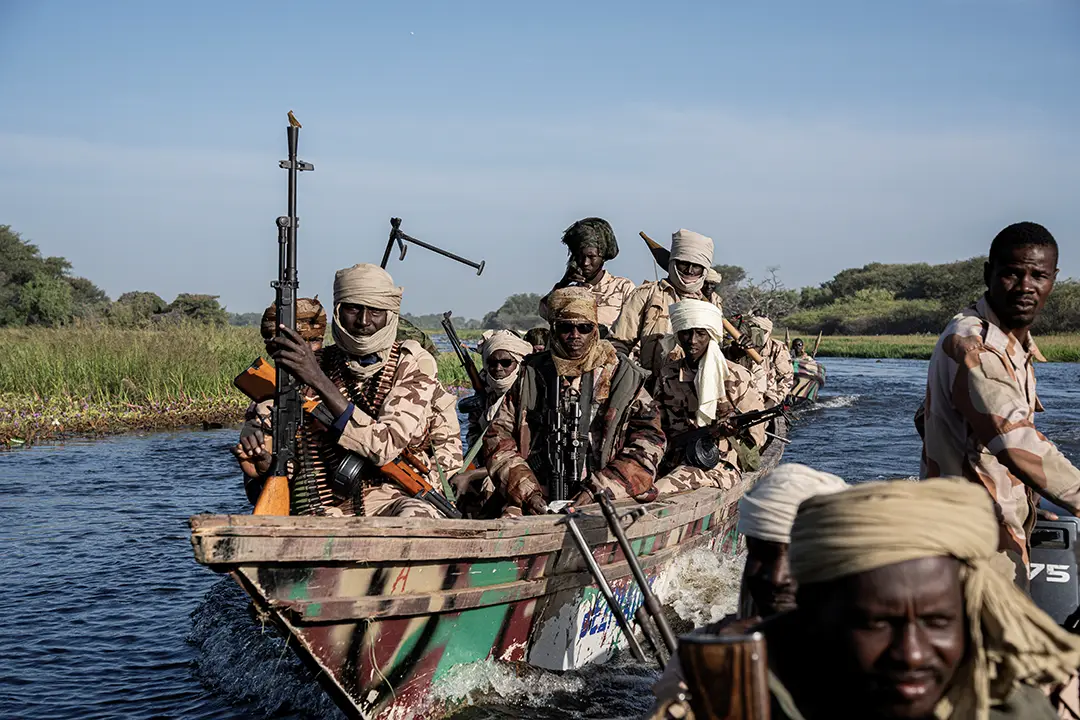
Villagers in the Marte Local Government Area of northeast Nigeria’s Borno State entered the bush on October 1 to collect firewood. At least 18 of them never walked out. They were killed by members of Boko Haram, which, alongside the Islamic State West Africa Province (ISWAP), is taxing and surveilling people throughout the Lake Chad Basin.
The rival terror groups have increasingly targeted civilians as they seek to expand their influence and dominate regional trade. The basin has numerous waterways, tiny islands and an agricultural corridor that locals, including more than 3 million internally displaced people, use for travel and farming.
However, Aliyu Mai Borno, of the Southern Borno Progressives Union, said much of the area has fallen outside effective government control.
“Marte is a strategic location that has been completely overrun by ISWAP and Boko Haram terrorists,” Borno told the Truth Nigeria digital news outlet. “The people are living in makeshift shelters in IDP camps under strict security watch. Outside the camps, there is nobody. There is no economic life left inside. Those who were killed in Marte were innocent victims living in these camps who had no choice but to venture out to survive.”
Shehu Usman Dikwa, a local trader, said movement itself is taxed.
“It is completely illegal to go to a farm or move through the bush without paying taxes to the terrorists,” Dikwa told Truth Nigeria. “Traders and travellers like me have to pay heavy taxes just to secure a gate pass to move along these roads.”
For locals who won’t or cannot pay, or are suspected of reporting the terrorists’ movements, “the punishment is immediate execution,” Dikwa added.
Last year, farmers in Dumba, in far northeastern Borno State, were cultivating land under the Lake Chad River Basin Authority, and security agencies, including the Multinational Joint Task Force (MNJTF), had established safe areas where they could operate under military protection.
Unbeknownst to authorities, however, the farmers decided to pay levies to ISWAP for access to farmland within the terrorist’s territory. Despite the agreement, ISWAP fighters killed 40 of the farmers in January 2025.
“The attack coincided with inter rival clashes between Boko Haram and ISWAP factions, as the terrorists likely suspected that the farmers had compromised their presence,” security analyst Zagazola Makama wrote on his website www.zagazola.org. “This massacre exemplifies the inherent risks of trusting terrorist factions, whose loyalties shift and whose actions are driven by opportunism rather than goodwill.”
At least 500 farmers and their families fled the area after a follow-up attack on rescue teams consisting of the Nigerian Army, the Civilian Joint Task Force and victims’ families who were trying to retrieve bodies.
According to Zagazola, the farmers had negotiated a second deal with terrorists but did not realize they were dealing with Boko Haram. On the evening of the first attack, ISWAP learned that some of the farmers were helping Boko Haram members move their livestock.
“A survivor recounted how ISWAP fighters approached the group and questioned them about tax payments,” Zagazola wrote. “Upon confirming the farmers’ paid the Boko Haram and not ISWAP, the militants unleashed a barrage of gunfire, leading to the tragic loss of life while many escaped with [bullet] wounds. In the aftermath of the attack, many farmers’ wives were released to return back to Baga where they relayed [the] harrowing situation to the security authorities.”
ISWAP collects an estimated $41.5 million annually by extorting fishing communities on Lake Chad, according to the Daily Telegraph newspaper. The group uses artificial intelligence in its communications, and drones and other advanced weaponry to attack other terrorists and state forces.
“The rivalry between these factions has turned civilians into pawns in their conflict for dominance, further destabilizing the region,” Zagazola wrote.
On September 28, 2026, ISWAP killed 15 people in Cameroon’s Far North Region after residents received alerts of terrorist activities from the MNJTF and Cameroonian gendarmes. Truth Nigeria obtained an ISWAP letter warning that civilians helping government sources would be treated as enemies. The group is known to kill suspected informants publicly.
In the Far North, Boko Haram, ISWAP and other armed nonstate groups regularly raid the departments of Logone-et-Chari and Mayo-Tsanaga. The deadly attacks involve abductions, shootings, and looting of food and livestock.
“People are afraid to go farming,” Wasa Hassan, a local community health worker, told Doctors Without Borders. “Kidnappings for ransom have become common, and fear dominates daily life.”