

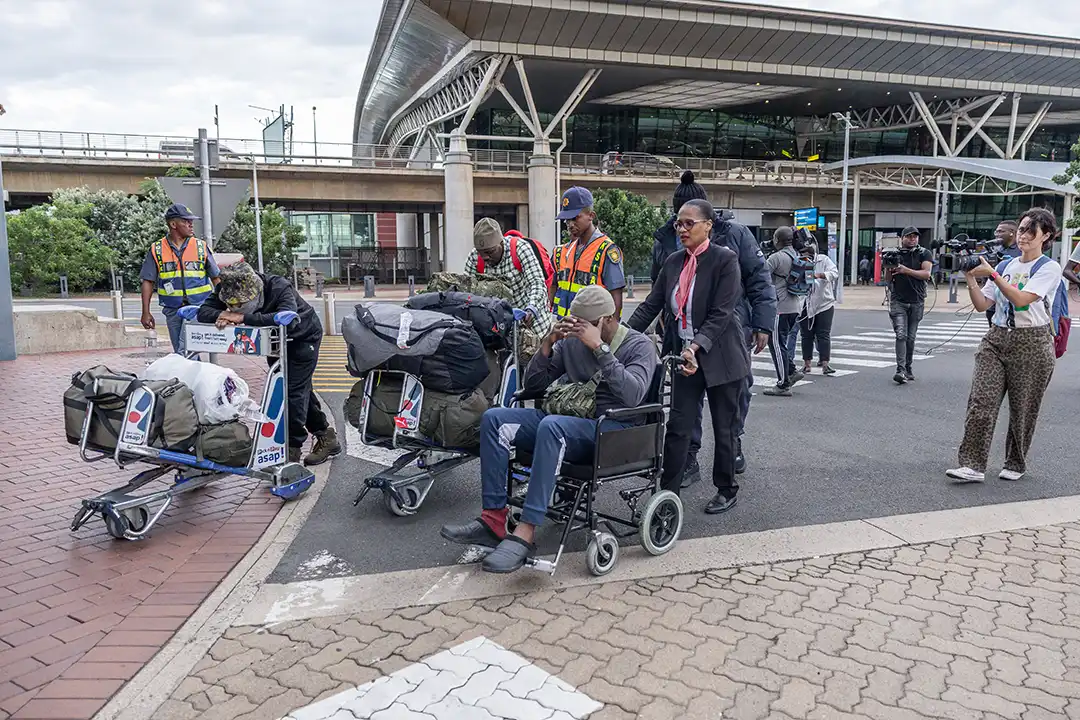
After being forced to fight in Russia’s war against Ukraine, Lifa Miya returned home to South Africa in September with several painful reminders of his ordeal: a prosthetic leg, nightmarish memories and numerous pieces of shrapnel that doctors left inside his body.
The 40-year-old from Durban considers his story a cautionary tale for anyone from Africa who gets a lucrative job offer in Russia.
“I left with my two legs, I returned with one and horrible tales about the horrors of war we encountered,” he told TimesLIVE, a South African online newspaper. “I consider myself lucky, there are many others who never made it back.”
Miya and 19 fellow countrymen flew to Russia on July 8, 2025, and signed contracts written in Russian, a language they could neither read nor understand. Recruited by Duduzile Zuma-Sambudla, then a member of Parliament and the daughter of former President Jacob Zuma, the men had been promised elite security training to be bodyguards for the MK political party.
“Initially, she pretended to be going to Russia to receive us. But later we learned she had never left South Africa, even though she pretended to be on the front line in our WhatsApp chat group,” one of the returnees told Al Jazeera. “That’s how we ended up in the trenches.”
Russia has recruited tens of thousands of foreign fighters for its war on Ukraine, according to multiple international human rights groups, describing many of the cases as human trafficking. Investigations have concluded that thousands of Africans have been deceived and coerced into fighting for Russia with false promises of jobs or training.
In a report released on October 26, the United Nations Independent International Commission of Inquiry on Ukraine said that Russian authorities “have trafficked persons from 29 countries, using deception or coercion, to recruit them in the Russian armed forces.”
Zuma-Sambudla faces a police investigation after a complaint of human trafficking. She was forced to resign from Parliament as the MK Party attempted to distance itself from the story.
Thulani Mahlangu, a spokesperson for the returnees’ families, alleged that Zuma-Sambudla and her associates were paid about $845,000 by Russia’s Wagner Group to recruit the men.
“Our children were sold off,” one parent from the group told Al Jazeera. “They were promised jobs, but instead they were used.”
Two of the men died. One returned in a wheelchair. Miya lost his left leg and carries the emotional scars of surviving multiple drone attacks.
It was December 2025, and Miya had deployed with an artillery unit in a Russia-controlled part of Ukraine’s Donbas region when he was caught in a drone strike that shattered both of his legs and left him with severe shrapnel wounds.
“When I was injured I had a spade in my hands and my service rifle over my shoulders, being part of a team that dug frontline trenches,” he said. “When people screamed ‘drone’, I realised it was too late to dive for cover. I aimed my rifle at it and fired at it. I remember hitting it, but it still fell not far from my feet.
“Next I was taken in an ambulance, with one of my feet badly mangled and I couldn’t feel anything on the other.”
After medics loaded Miya into a transport truck, a Russian man gave him cigarettes, urged him to smoke so that he would not lose consciousness and repeatedly slapped and hit him to keep him awake.
Miya was treated by doctors at a field hospital in occupied Ukraine. When he awoke in a St. Petersburg hospital after a four-day coma, doctors told Miya that he had nearly been declared dead four times.
Before being allowed to leave, Russian military authorities forced him to travel back to Donbas, near the active war zone, so that commanders there could review his medical records and sign his contract release papers.
Miya hopes that sharing his story will ensure that no more Africans will suffer his fate.
“We used to see dead bodies every day, sometimes we were forced to nap next to dead bodies,” he said. “In fact, in a war zone, there is no time to sleep. It’s war day and night.”