

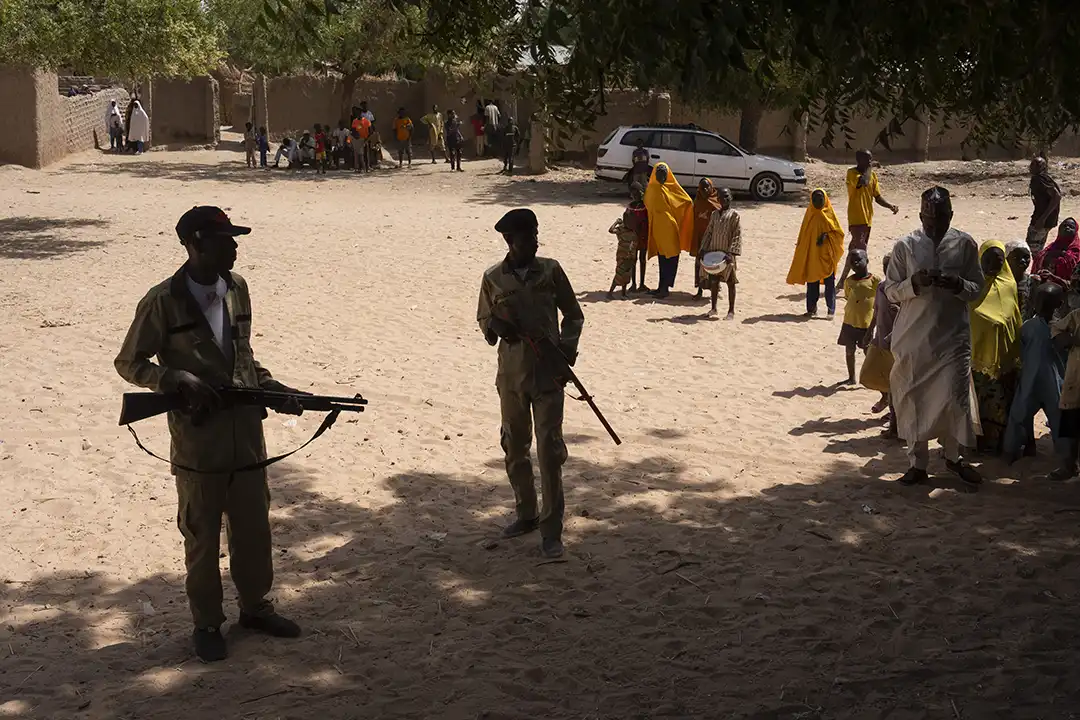
The Nigerian government’s Terrorist Prevention Act reclassified violent bandit groups, criminal gangs and kidnapping syndicates as terrorists in 2022. The goal was to allow state and federal security agencies to deploy tougher counterterrorism and military measures.
But today, Nigeria has a festering bandit crisis that increasingly is intertwined with extremist militant activities, as gangs cooperate with established terrorist groups and blur the lines between crimes of opportunity and conflicts of ideology.
“What began as sporadic attacks has now morphed into coordinated campaigns of terror affecting entire communities,” Nigerian scholar Onyedikachi Madueke wrote for the Conversation.
With its roots in tribal conflicts between farmers and nomadic herders over land and limited resources, the crisis dates to 2010. In the years between 2010 and 2023, there were 13,485 deaths linked to banditry in the seven states that comprise Nigeria’s north-west region, according to conflict monitor ACLED.
And the crisis shows no sign of slowing. In 2025, the country recorded 599 banditry incidents and 2,742 casualties, nearly doubling totals from the previous year, according to researchers at Nigeria-based Nextier.
An estimated 30,000 gang members roam across huge swathes of unpoliced territory in northern Nigeria, burning entire villages and killing, raping and torturing civilians. Often riding motorcycles into villages to loot and kidnap, bandits do not hesitate to kill anyone who resists. Groups are sustained by these raids and other profitable criminal ventures, such as arms trafficking and cattle rustling.
“Insecurity is now reshaping daily life in rural Nigeria. Families are abandoning their homes. Food supply chains are being disrupted. School attendance is falling. The rise in banditry is fueling poverty, eroding trust in the state, and contributing to emigration in Nigeria,” Madueke wrote.
Some experts point to Zamfara and Sokoto states as the epicenter of violence, where armed groups tap into gold, copper and lithium smuggling and sustain their arsenals with raids on state armories. Nigeria’s vast, unguarded border with Niger provides critical access to Sahelian smuggling corridors and terrorist groups affiliated with al-Qaida and the Islamic State.
“The crisis — characterized by criminal insurgency, warlordism and intercommunal violence, and commonly subsumed under the broad label of ‘banditry’ — has drastically escalated over the past several months,” the Soufan Center research organization wrote in an August 2025 intelligence brief.
Often gangs and terrorist groups find alignment in overlapping goals and territories, using the same ungoverned spaces to hide out, keep abductees and attack security forces. Borno State-based Boko Haram, also known as Jama’atu Ahlis Sunna Lidda’awati wal-Jihad (JAS), reportedly has sent military equipment, advisors and bombmakers to bandit allies in Kaduna State in recent months.
Some bandit groups in Northwest and North-Central Nigeria claim to have formed alliances with JAS, the Islamic State West Africa Province (ISWAP) and al-Qaida affiliates in the Sahel. Other Nigerian groups, such as Ansaru, Sadiku and Lakurawa, appear to straddle the definitions of criminal gangs and violent extremists.
“Militant convergence has significantly amplified the threat environment,” the Soufan Center wrote. “Jihadist factions — including al-Qaida-affiliated Ansaru and elements of ISWAP — have cultivated pragmatic alliances with bandit networks, providing tactical training, ideological framing and weapons in exchange for guarantees of safe passage and access to resources. This convergence has expanded operational reach and embedded extremist influence within local conflicts.”
Lakurawa formed and evolved over several years in northern Nigeria as a vigilante militia to defend communities from bandits. But by 2023, it exhibited characteristics of both a criminal gang and a religious group that levied taxes on citizens in return for protection.
Malik Samuel, an Abuja-based researcher at the Good Governance Africa think tank, recently examined the group’s hybrid insurgency and concluded that it is “essentially criminal, not jihadi.”
“Lakurawa gains community acceptance by offering security against bandits,” he wrote in a May 7 report. That acceptance gives the group local legitimacy, and social and religious authority, he said, adding that “authority is then monetised through coercive zakat, levies, cattle rustling, and ransom demands.”
Samuel said that Lakurawa has historical and operational links to al-Qaida and has developed deepening ties with al-Qaida’s Sahel affiliate Jama’at Nusrat al-Islam wal-Muslimin (JNIM) in Kwara State, where it received a “loan” of 100 fighters in early 2026.
“The evolving Lakurawa-JAS-JNIM nexus poses a growing threat, with JNIM establishing a presence in Kwara State and reportedly planning expansion into Benue and Plateau States,” Samuel warned. “This fluid militant ecosystem, enabled by porous borders and dense forest corridors, risks transforming Northwest and North-Central Nigeria into a strategic node linking the Lake Chad Basin and the central Sahel.”