

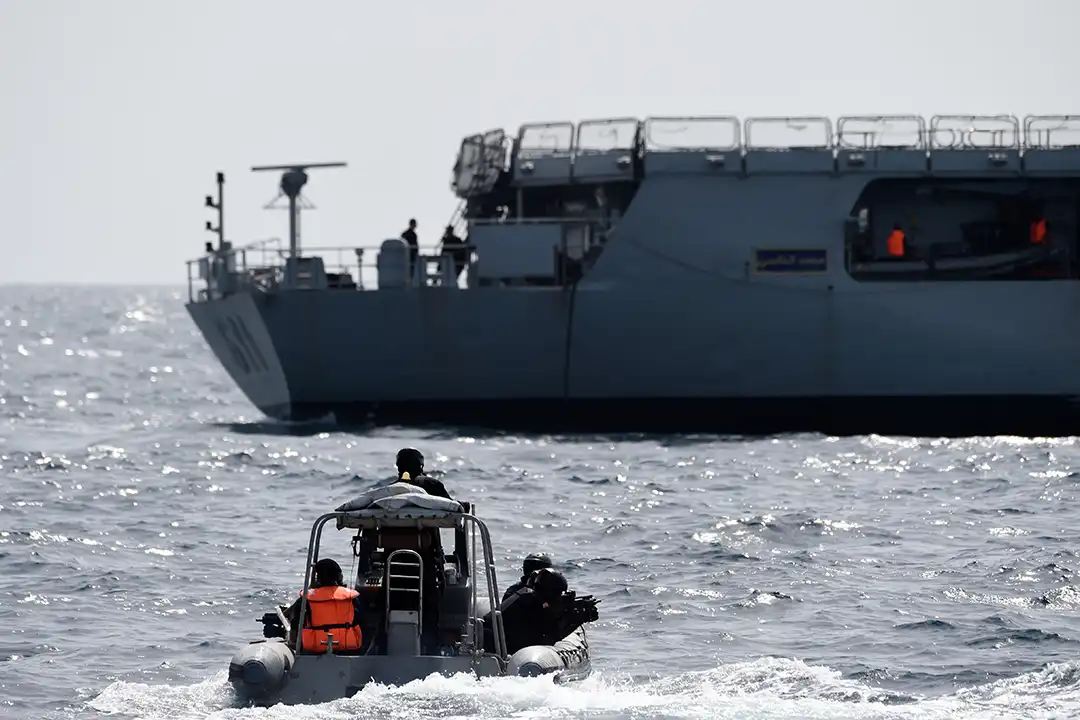
While piracy is down in the Gulf of Guinea, the region remains the world’s hot spot for illegal, unreported and unregulated (IUU) fishing, and is frequently targeted by smugglers, traffickers, oil thieves and other organized criminal groups. The new Combined Maritime Task Force (CMTF) aims to address these threats.
Established on June 1 by Côte d’Ivoire, The Gambia, Ghana, Liberia, Nigeria and Sierra Leone, the CMTF is the first joint, African-led maritime security effort to include a rapid response force. More countries are expected to join the task force, which will patrol 6,000 kilometers of coastline from Angola to Senegal. The force will be headquartered in Lagos and is expected to conduct intelligence, interdiction, maritime patrols, surveillance, search and rescue missions, and other maritime security operations.
“The task force is to complement and fill an important gap in the [Yaoundé] architecture, by providing rapid, kinetic, and 24/7 surveillance capabilities,” CMTF Commander Commodore Mohammad Shettima told ISS Today, an Institute for Security Studies (ISS) publication. Enacted in 2013, the Yaoundé Code of Conduct is a framework that helps West African navies maintain situational awareness and fight maritime crime in the Gulf of Guinea.
The task force is expected to eventually include 1,500 personnel. Its fleet will feature air and surface assets, and electronic maritime surveillance capabilities. According to the ISS, Nigeria is the only country so far to contribute to the fleet, with one helicopter, two vans, two pickup trucks, three ships and three military trucks. The force will work closely with the West Africa Regional Maritime Security Center and the Central African Regional Maritime Safety Center.
“That Nigeria has provided resources to kick-start CMTF operations is a hopeful sign,” ISS researchers Martin Ewi and Timothy Walker wrote on the institute’s website. “However, much more is needed, and the task force must demonstrate value as soon as possible to sustain momentum and increase regional participation.”
The task force is the result of five years of discussions among the African Union, the Economic Community of West African States, the Economic Community of Central African States and the Gulf of Guinea Commission. The ISS, as a neutral partner, facilitated the talks with five years of engagement with all parties.
“Despite multiple regional initiatives, there have until now been gaps in enforcement and the ability to coordinate physical responses to complex maritime threats in the Gulf of Guinea,” Ewi said on the ISS website. “The CMTF is a commitment by regional states to take ownership and responsibility for their marine environment and its security.”
According to Ewi and Walker, implementation of the Yaoundé Code also has been hamstrung by insufficient political will and the failure of member countries to uphold their responsibilities. These factors could undermine the task force if left unaddressed. The researchers suggested the force could seek support from the AU and United Nations.
“As the CMTF establishes the necessary political, legal and operational foundations, external partners may continue to support training, funding and technical assistance,” Ewi and Walker wrote on the ISS website. “But the long-term goal is for the region’s states to provide the required capabilities. This will reinforce African ownership and leadership of the initiative.”
The researchers highlighted Indian Ocean efforts such as the Combined Task Force 151, which operates under the Combined Maritime Forces, and European Union Naval Force Operation Atalanta as examples of collaborative maritime security platforms that built trust while sharing information and operational practices.
A coalition of nations formed the Combined Task Force 151 in January 2009 to conduct counter-piracy operations in the Gulf of Aden and off the Somalia coast. It consists of naval ships and assets from 30 nations and covers 2.85 million square kilometers. Operation Atalanta is a counter-piracy operation in the Horn of Africa and Western Indian Ocean, including the Seychelles, Mauritius and Comoros. Launched in December 2008, it covers 8.7 million square kilometers. Both forces have helped curb piracy in Somalia.
“The CMTF shows that Gulf of Guinea states are ready to adapt” principles used by operations “to an African-led initiative,” Ewi and Walker wrote. “External partners can still play an important supporting role through training, technology transfer, legal reform and providing specialized capabilities such as satellite surveillance. But this support should complement rather than substitute regional responsibility.”
The researchers wrote that garnering “continuous political endorsement from the UN, AU and other international, continental and regional institutions is vital” to the task force’s success.