

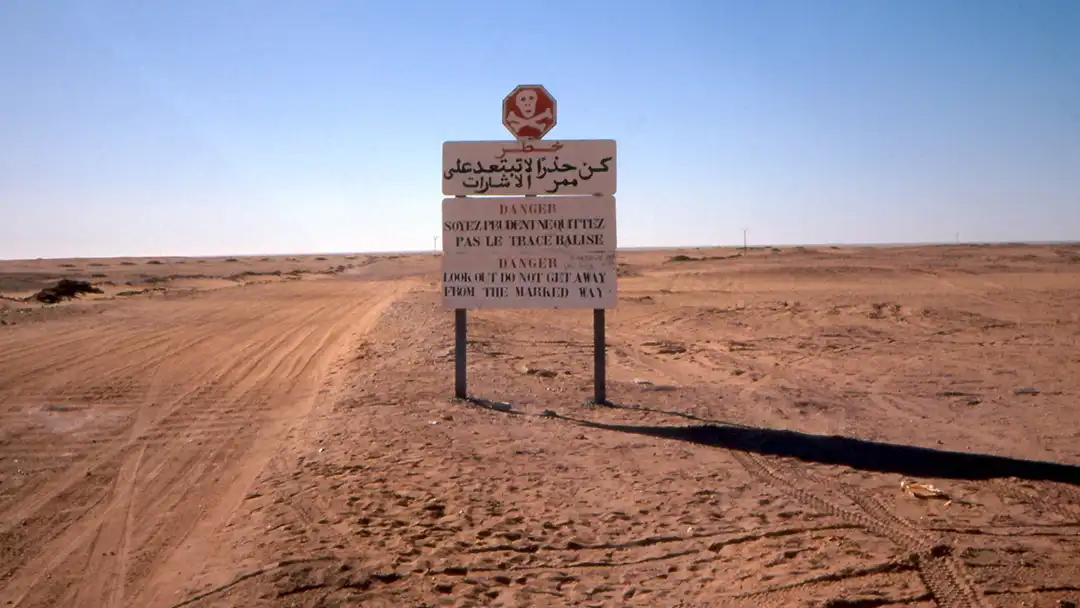
In remote southern Algeria, the Sahara Desert is known for its inhospitable conditions. In the summer, temperatures regularly exceed 51 degrees Celsius. Annual rainfall is under 20 millimeters. Vast fields of sand and extreme heat mean that there is very little life present, but soon that will change, as the government announced plans to build a prison there to hold convicted drug lords and traffickers.
Algeria’s Supreme Security Council, chaired by President Abdelmadjid Tebboune, ordered the “conversion of a barracks belonging to the People’s National Army in the Grand Sahara at Tanezrouft, in the Bordj Badji Mokhtar area in Algeria’s far south, into a high-security prison for drug barons and traffickers.”
The council also decided to create a special security agency to combat the country’s worsening illicit drug trade, it said in a September 2 statement.
“This significant decision means that the Algerian state has decided to move from legislative deterrence to punitive deterrence in its war on drug barons and the illicit trade in psychotropic pills, because the issue of drugs has become very serious and threatens civil peace,” security expert Mabrouk Kahi told The New Arab website.
Algeria has suffered from a sharp rise in drug trafficking in recent years. In a population of about 46 million there were 3 million drug addicts in 2024, according to figures released by the National Office for the Fight Against Drugs and Drug Addiction.
Drug seizures have been on the rise in scale and frequency. On August 21 in Oran, police intercepted more than 10 million capsules of pregabalin, a psychotropic substance, along with 33 kilograms of cocaine in what was described as one of Algeria’s largest-ever drug seizures.
Authorities recently arrested two Algerian drug kingpins who were leading major criminal networks in France. The men were thought to be hiding in Algeria to take advantage of the country’s poor diplomatic relations with France.
Abdelatif Mehdi Laribi, regarded as the founder of the DZ Mafia, was arrested on July 20 under an international warrant issued by two investigating magistrates in Marseille. His cartel has established itself as one of the most powerful criminal organizations and is involved in large-scale drug trafficking and money laundering.
“We are compelled to protect citizens from these scourges,” Tebboune said in an October 4 interview with several Algerian news outlets. He reiterated that the government will apply the death penalty for major drug offences. “It has become a war, a war against Algeria.”
Kahi said Algeria’s plan for the Tanezrouft desert could include more than one prison.
“There was a need to build prisons in the far southwest, in the areas of Bordj Badji Mokhtar, Tinzaouatine and Ain Guezzam, in the far south of the country, as a deterrent option, especially as these areas are relatively isolated, and establishing prisons there would spread fear among consumers and even traffickers,” he said.