

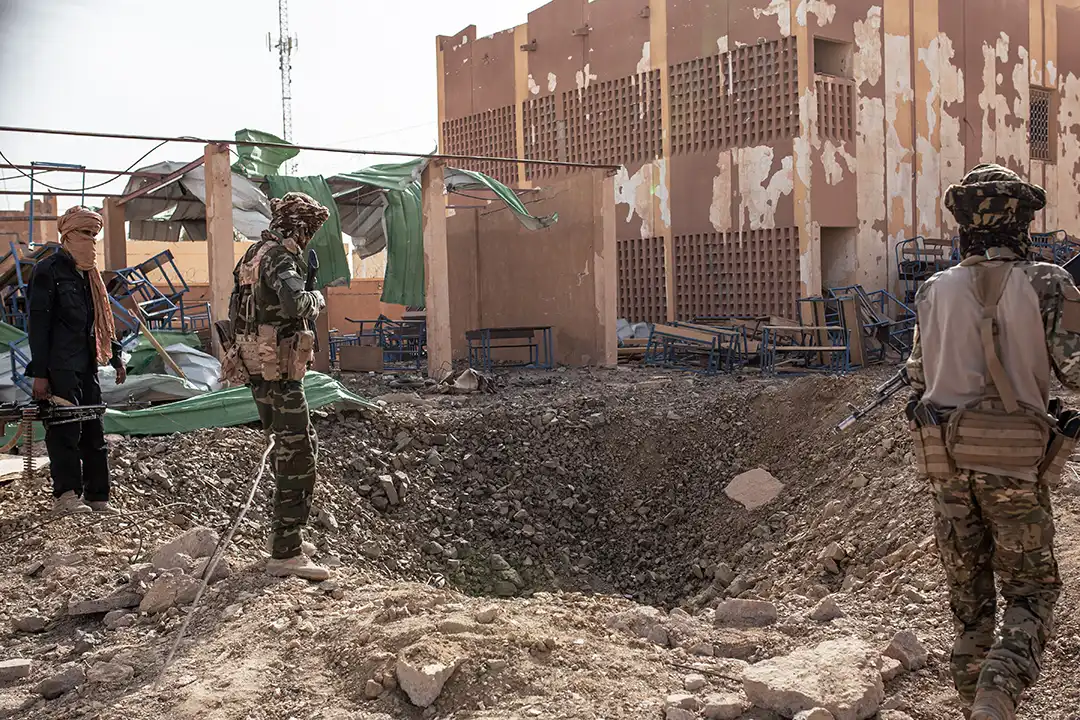
Images out of northern Mali show attacks by or wreckage from Russian-operated drones targeting Tuareg separatists, terrorists and civilians alike. Experts say the images are evidence that Russia’s Africa Corps mercenaries have taken control of the ruling junta’s air campaign and may be committing war crimes.
According to the Armed Conflict Location and Event Data (ACLED) project, Africa Corps and the Malian junta killed 89 civilians in 49 airstrikes between April and August, more than double the number from the same period the year before.
The attacks often involve strikes on civilian vehicles or commercial activity. Video footage from the attacks is broadcast on Mali’s national television and reported as attacks on terrorists, according to open-source researchers at Bellingcat, an investigative journalism collective.
As part of its agreement with Mali’s ruling junta, Africa Corps operates the aircraft and drones it has supplied to fight insurgents.
In a separate investigation titled “Who Is Responsible for Mali’s Air War?” The Sentry attributed some drone attacks directly to Africa Corps’ Russian commanders. That report established a line of command beyond Malian military leaders’ decision-making. Bellingcat and Jeune Afrique supported that conclusion by examining satellite images and drone footage.
“While Bamako describes a sovereign counterterrorism campaign, targets are in fact approved by a foreign power,” The Sentry researchers wrote.
Researchers said the drone operators seem to be using a “guilt by location” method of selecting targets based on where someone is, what they are doing, and even their appearance.
“What we have seen is a huge expansion in the way the Malian authorities define who is considered a legitimate target,” Yvan Guichaoua, a senior researcher at the Bonn International Centre for Conflict Studies, told Bellingcat.
A recently broadcast video showed a drone attack in the community of Amasrakad in 2024. While the junta claimed the attack targeted terrorists, a witness told investigators with Bellingcat and Jeune Afrique that the strike killed 13 civilians, including several children, who were sheltering in a tent from an earlier strike on a nearby truck. The man told the investigators that the attack prompted him to join the Azawad Liberation Front (FLA), which the Malian junta and its Russian backers continue to target with both drone attacks and ground assaults.
More recently, videos and images posted to social media have provided more evidence that Africa Corps is running Mali’s drone campaign in the north using Russian-made kamikaze drones modeled after Iran’s Shahed-136 drones.
In July, footage of drone wreckage in Inafarak consistent with Shahed-style systems turned up on a Telegram channel affiliated with Africa Corps captioned: “Now the Azawadi ‘khokhols’ will be seeing Gerans all the time,” using a slur for Tuareg rebels and the name of the Russian-made version of the Shahed-136.
Also in July, France 24 Observers confirmed images provided by the FLA show a piece of wing from a Russian-made Lancet, a pilot-operated loitering munition that Russia had previously used in Ukraine. The drone had been used to attack a civilian vehicle in Mali’s Timbuktu area.
Vincent Tourret, a researcher at the French Institute of International Relations, told France 24 that Africa Corps used the Lancet, which was developed in 2020 to attack Ukrainian armor, against the FLA’s unarmed vehicles.
Another Shahed-style long-range Russian drone, the Garpiya-A1, has also appeared on the Malian battlefield.
Africa Corps has increased attacks against civilians in the north since July, according to Human Rights Watch. In recent months, attacks have targeted health facilities and public markets, killing people indiscriminately in retaliation for high-profile attacks by FLA and Jama’at Nusrat al-Islam wal-Muslimin (JNIM), both in Kidal and in Bamako.
Africa Corps’ use of low-cost, kamikaze drones rather than Mali’s Turkish-made Bayraktar TB2s gives the junta the capability to make long-range attacks beyond the TB2’s range, according to drone expert Léo Jarry with Tungsten Strategies.
“The fact that these systems are relatively cheap and expendable changes the risk calculation for operators,” Jarry told Bellingcat and Jeune Afrique. “They can be used more freely, potentially forcing insurgents in northern Mali to adapt their behavior to a new aerial threat.”
The risk to civilians rises, however, because the Shahed-style drones cannot verify their targets during flight, making their final impact less accurate. The drone’s large warhead also increases the potential for civilian casualties.
“In Mali, where armed groups are highly mobile and frequently operate among civilian populations, any gap between target identification and impact creates a risk of striking the wrong target,” Jarry said.