

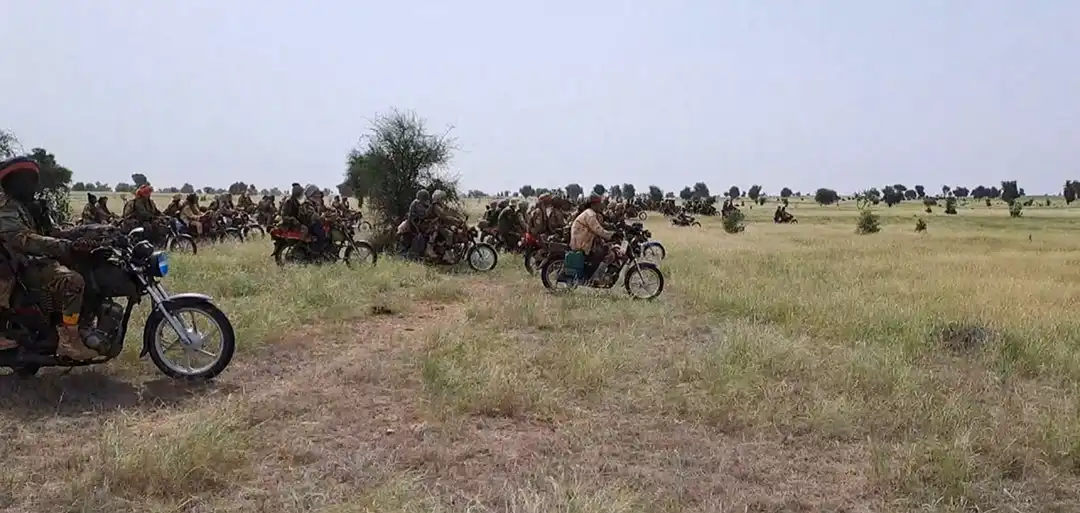
Rival terrorist groups linked to al-Qaida and the Islamic State have clashed over the last several weeks in the Liptako-Gourma tri-border region that encompasses the frontiers of Burkina Faso, Mali and Niger.
In an August report to the United Nations Security Council, an independent panel of experts called the clashes “the most intense direct confrontation globally” between the two groups.
Jama’at Nusrat al-Islam wal-Muslimin (JNIM) and the Islamic State Sahel Province (ISSP) are waging a turf war across multiple fronts in the Sahel. The rival groups operate in similar fashion to organized crime families that fight over territories and illicit trade networks, while extorting money and resources from civilians.
Thousands of militants met in two separate confrontations in northeastern Burkina Faso in August and October, resulting in the deaths of hundreds of fighters from both sides. International conflict monitor ACLED described each battle as the deadliest encounter between the groups to date.
“A pitched battle with a significant number of deaths on both sides means increased dogmatization of its fighters, and therefore even greater violence in the areas concerned,” Wassim Nasr, a senior research fellow at The Soufan Center, told Deutsche Welle for an October 21 article. In a recent report, he wrote that JNIM and ISSP are fighting over “the same potential living space and the same recruitment pools” in a “race for control of the borders between the three countries.”
The groups operate parallel economies and extort taxes from civilians in return for promises of protection. Although JNIM has been responsible for abuses against civilians, it tends to focus attacks on state security forces and Russian mercenaries while trying to build alliances with tribal leaders.
ISSP is known for a more hard-line, transnational stance and has a history of targeting civilians who do not cooperate. Both groups prey upon local grievances to recruit from communities in remote parts of the Sahel that have typically lacked a government presence.
Speaking before the Security Council in July, Leonardo Santos Simão, the head of the U.N. Office for West Africa and the Sahel, said the two terrorist groups present a constantly moving and evolving threat.
“Drug production, trafficking, and consumption are increasing rapidly, particularly in coastal states where authorities are carrying out numerous seizures,” the U.N. said. “Young people are the primary victims, but some armed groups are also reportedly using these substances for their fighters.”
JNIM and ISSP began fighting in mid-2019 and have engaged in around 320 battles that have killed more than 2,200 fighters, according to ACLED’s West Africa senior analyst Héni Nsaibia. Territorial battles had been confined to Burkina Faso and Mali but have expanded into Niger’s Tillaberi and Dosso regions and Nigeria’s Kebbi state since April 2026.
“Strategically, JNIM has emerged as the more successful group, consolidating its position across large parts of Mali and Burkina Faso while expanding from the central Sahel into coastal West Africa,” Nsaibia said in a September 17 statement. “However, at the tactical level, ISSP has come out victorious in several of the most important battles between the groups in recent years.”
With control over the Liptako-Gourma at stake, ISSP has fought to extend its presence beyond its stronghold in Menaka, Mali into Niger and as far as the Nigerian border, as it transfers fighters, equipment and expertise with the Islamic State West Africa Province based in the Lake Chad basin.
As Nigeria prepares for a January 2027 presidential election, ISSP is trying to influence bandit groups ideologically and obtain their support in establishing a foothold in the northwest part of the country, analyst Charlie Werb said.
“These efforts come as ISSP vies for control with its main rival, JNIM, whose presence in the area has similarly grown over the past year,” he wrote in a November 4 article on his website, The Africa Insight. “The next president’s tenure is likely to be marked by the continued expansion of these jihadist groups in the northwest.”