

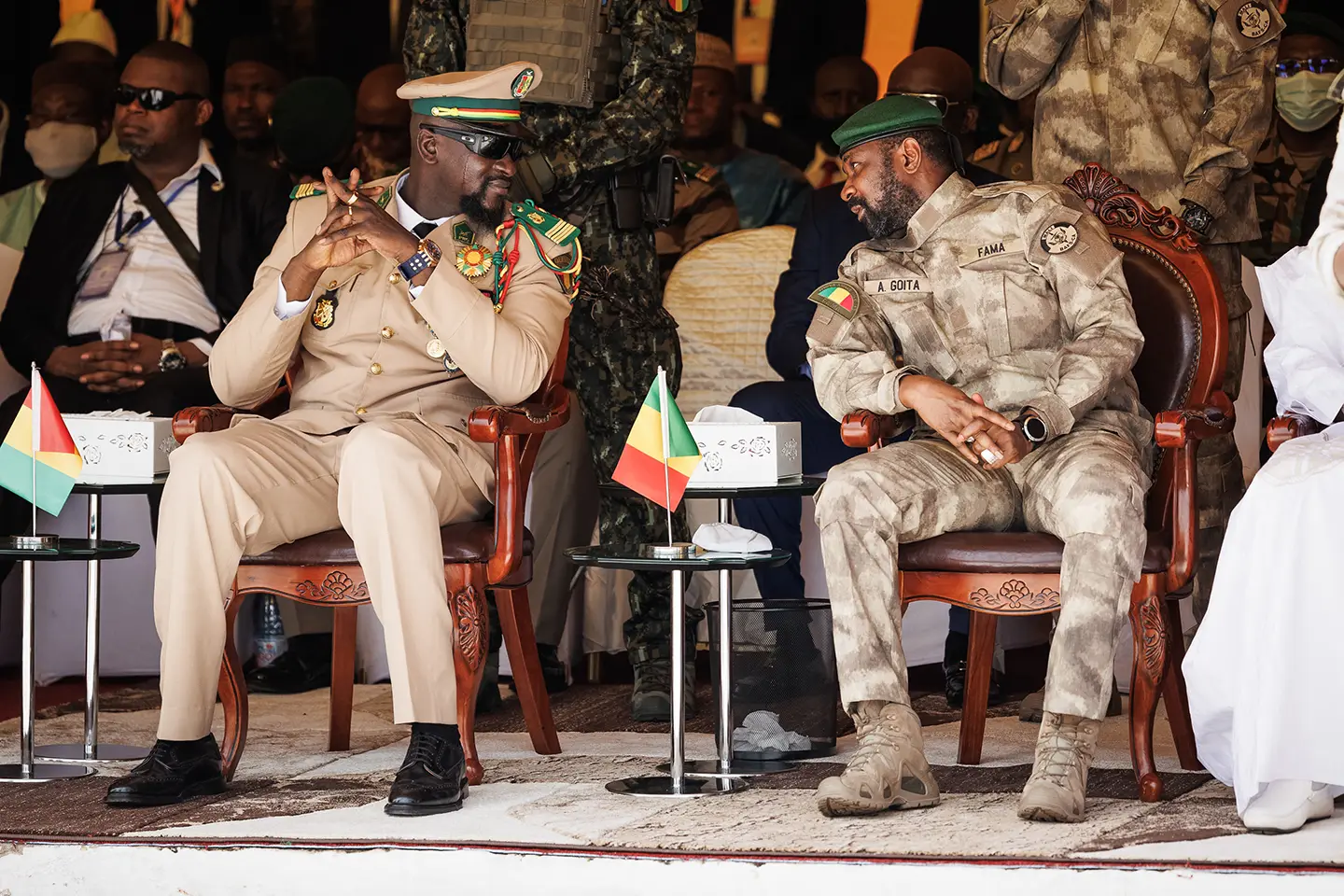
Military leaders in Burkina Faso, Mali and Niger overthrew democratically elected governments, arguing that those governments had failed to suppress long-running insurgencies that junta leaders claimed they could put down. Years later, however, experts say that those juntas, like others before them, are failing their citizens in multiple ways.
“A coup is not necessarily the most effective way to cure economic and political ills,” economist John Mukum Mbaku recently wrote for The Conversation. “Positive change comes instead through institutional reform, structural economic changes and engagement with civil society.”
Mbaku argued that coups do four things that ultimately undermine the societies they claim to be trying to save:
- Threaten peace by worsening intergroup conflict
- Undermine business creation and efforts to relieve poverty
- Encourage the abuse of vulnerable groups and ethnic or religious minorities
- Destroy the rule of law and efforts to strengthen democracy
Mali provides an example of a junta making intergroup conflict worse. Since taking control of the government, the junta led by Col. Assimi Goïta has focused much of its energy on conquering the Tuareg population in the country’s north.
“Since Day 1, the priority of the junta has been taking back the north,” analyst Wassim Nasr told ADF in an interview. “For them it’s more political than anything. It’s a populist priority to take back the north.”
Goïta’s government, which is dominated by ethnic Bambaras, tore up the 2015 Algiers Accords peace agreement with the Tuaregs that granted the northern regions a degree of autonomy. The focus on establishing control over the north has led to human rights violations by the government and fighters with Russia’s Africa Corps, while Mali-based terrorists with Jama’at Nusrat al-Islam was-Muslimin (JNIM) continue to spread across the Sahel.
Mamadi Doumbouya, the leader of Guinea’s 2021 coup, argued in a 2023 speech at the United Nations that coups such as the one he led are a way to improve a country’s economic conditions by removing corrupt leaders.
“The evidence suggests otherwise,” researchers Giovanni Carbone and Alessandro Pellegata wrote for Diplomacy in Africa.
Economic growth in Sub-Saharan African countries after a coup drops from an average of nearly 4% before the coup to barely 1% after the coup. The per capita gross domestic product drops even more sharply, from a 1.3% gain pre-coup to a loss of 1.5% post-coup, reflecting the disruption and uncertainty that coups create, according to the researchers.
“The regimes [that] soldiers establish after coups perform worse economically than democracies,” Carbone and Pellagata wrote. “Military coups are not a shortcut to development. They disrupt governance, undermine economic performance and erode democratic institutions. Even when elections return, the damage often lingers.”
Across the Sahel, junta leaders have delayed or denied elections, throttled independent media, banned opposition political parties and arrested political opponents. In Niger, for example, the junta led by Brig. Gen. Abdourahamane Tchiani in 2023 announced a three-year plan to return to democracy by 2026. In 2025, however, Tchiani announced that elections would be delayed until 2030.
That’s more than double the average of 2.4 years between a coup and the return to democracy for 33 coups over the past 36 years in Africa, according to Carbone and Pellagata. But conducting elections doesn’t guarantee a return to actual democracy, they noted.
“Some military leaders used elections to legitimize their rule, winning contests that lacked genuine competition,” the researchers wrote. “Others handed over power but left behind weakened institutions and constrained political space. The promise of ‘restoring true democracy’ often proved hollow.”
For that reason, Mbaku argued in The Conversation, coup leaders must not be allowed to stand for election, as Gabon’s coup leader and current president Gen. Brice Oligui Nguema did in April 2025. Rather, coup leaders should be denied any power after a nation returns to some semblance of democracy, Mbaku argued.
Nations looking to avoid coups must create strong laws that punish such actions while also developing democratic norms that reject the idea of military rule, he added.
“Countries that have avoided military coups have generally developed strong constitutions and institutions,” Mbaka wrote. “They have credible elections and professional armed forces accountable to civilian authority.”