

In Sierra Leone, the illegal activities of foreign industrial trawlers are decimating fish stocks and threatening the livelihoods of artisanal fishermen. Their average catches are down about 40% in recent years, according to Sierra Leone’s Fishermen’s Union.
“The illegal fishing is too much,” union President Thomas Turay told the BBC. “The sea belongs to us, but for the foreign trawlers, they come at night and violate the seven-mile exclusion zone, they come right into the shore here.”
Turay spoke from Tombo harbor near Freetown. He pointed to several industrial trawlers on the horizon, just outside the exclusive economic zone. At night they come closer to shore, often to fish and damage fishing nets set by local fishermen. It can cost $250 to replace one net.
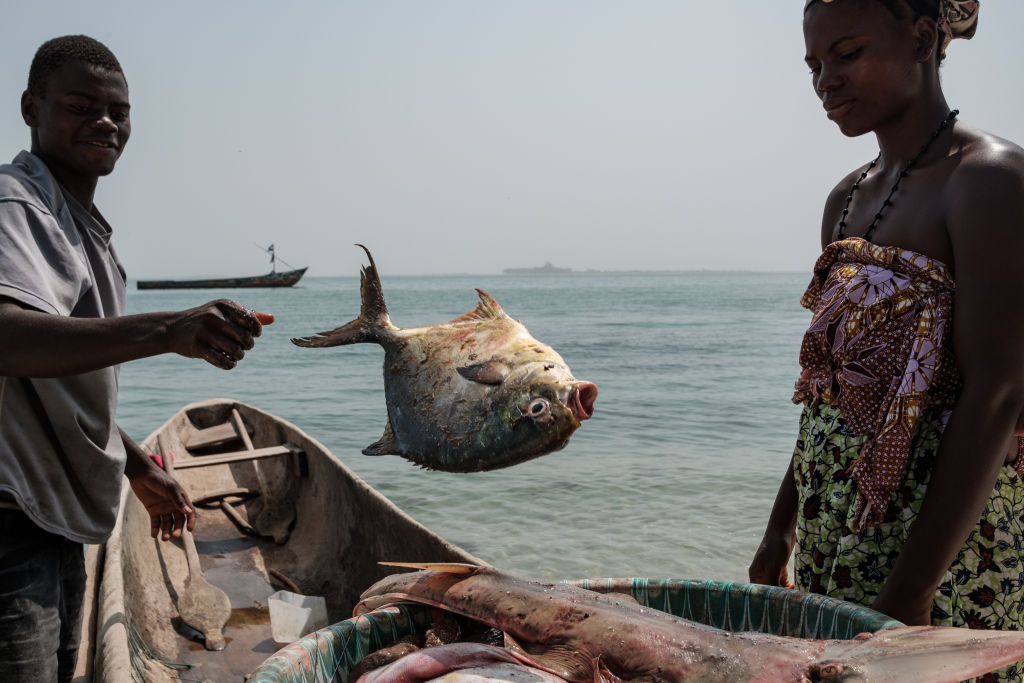
Fishermen on Sherbro Island, about 110 kilometers south of Freetown, typically trawl for barracuda, mackerel, rays, snapper and sardines, as generations have before them. They say the presence of foreign fishing vessels is increasing.
“We cast our nets in the evening and return to shore,” fisherman Musa Gassimo told the BBC. “In the night, the trawlers have come and [deliberately] cut the lines.”
Throughout West Africa and around the world, Chinese trawlers are the worst illegal, unreported and unregulated (IUU) fishing offenders, according to the IUU Fishing Risk Index. Due mainly to the activities of Beijing’s distant-water fishing fleet, Sierra Leone loses $50 million annually to illegal fishing. West Africa, the world’s hotspot for illegal fishing, loses up to $9.4 billion annually.
Illegal fishing has led to more than 300,000 losses in artisanal and traditional fish-related jobs in West Africa, according to an October 2025 policy brief published through the China Global South Initiative. Seven African environmental experts wrote it.
Besides damaging the equipment of artisanal fishermen, Chinese vessels commonly engage in bottom trawling, which involves dragging a net along the sea floor, indiscriminately scooping up all manner of marine life. This kills juvenile fish, leading to declining fish stocks, and destroys ecosystems. Around the region, Chinese bottom trawlers catch an estimated 2.35 million tons of fish per year, accounting for 50% of China’s total distant water catch and worth $5 billion, the Environmental Justice Foundation reported.
The Chinese vessels also fish with explosives, use improper gear and fly “false flags” and “flags of convenience.” False flagging is when a tanker claims registration with registries that do not exist or have been shut down. According to the Lansing Institute, more than half of the global cases of false flag registration are linked to African jurisdictions.
They also commonly practice “saiko,” the illegal transshipment of fish at sea, and use shell companies that make it difficult to investigate and prosecute ships. Shell companies are created to hold funds and manage another company’s or individual’s financial transactions. They look like a real company but exist only on paper.
Turay said corruption fuels the scourge.
“Government authorities are afraid to help the local fishermen,” he told the BBC. “I know that somebody who is doing this illegal business has the money to bribe and pay.”
Sheku Sei, director at the Sierra Leone Ministry of Fisheries, disputed Turay’s allegation, saying that all international vessels now must have transponders that track their movements and that government inspectors frequently check them. Illegal fishing trawlers are known to switch off their transponders to avoid detection, but Sei told the BBC that does not happen in Sierra Leone.
Sierra Leone’s government has battled tax evasion in the maritime sector in its efforts to eliminate illegal fishing. It has also invested in at least six boats to patrol coastal inshore waters and in radio equipment, electronic tablets and Android phones to help monitor and control the fisheries sector.
The China Global South Initiative’s policy brief offered several recommendations to deter illegal Chinese fishing, including:
1. Impose stricter penalties on fishing companies that collaborate with Chinese trawlers to circumvent laws.
2. Update fisheries and water resource policies.
3. Invest in naval and coast guard capabilities.
4. Develop regional real-time monitoring systems using satellite data and automatic identification systems.
5. Establish public reporting systems that allow civilians to anonymously report illegal activities.
“By democratizing the response to this problem, civil society leaders can diversify oversight away from a small group of corrupt actors and elite gatekeepers,” the African environmental security experts wrote in their 2025 policy brief.