

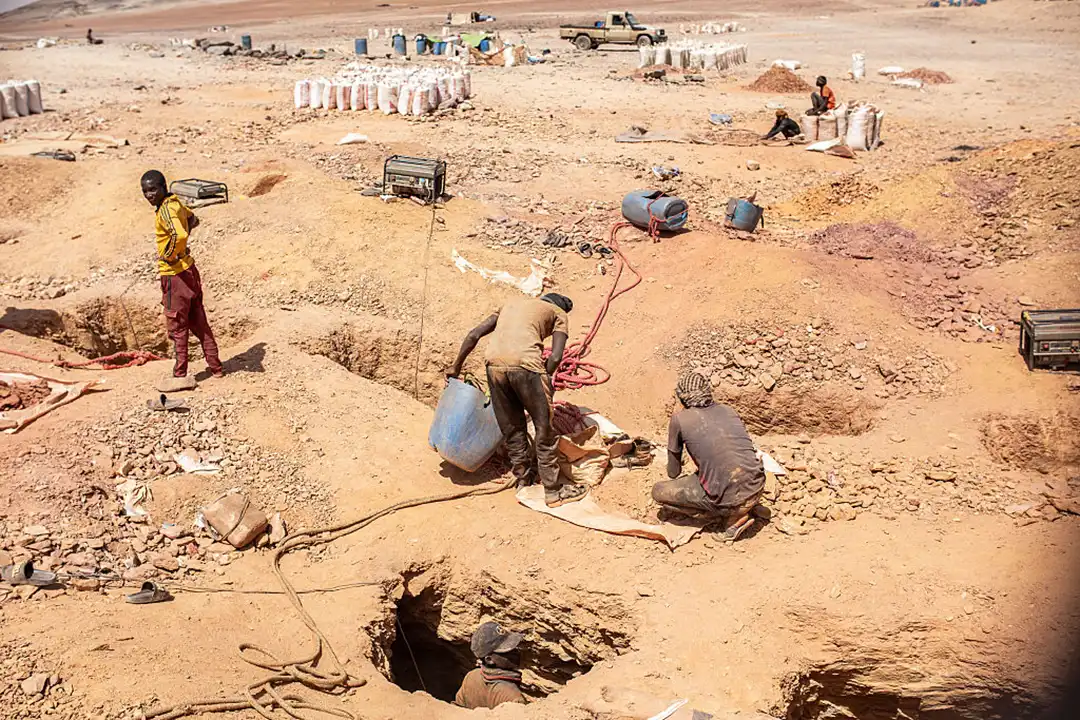
Terrorist groups increasingly are targeting roads, communities and commercial hubs within a 10-kilometer radius of mines in the Sahel, according to a new report by conflict monitor ACLED.
Jama’at Nusrat al-Islam wal-Muslimin (JNIM), a coalition of extremist groups affiliated with al-Qaida, is the dominant rogue actor in the Sahel’s mining sector. It competes for access to and control over mines with the Islamic State Sahel Province (ISSP) and with the governments of Burkina Faso, Mali and Niger and their Russian partners, the Africa Corps.
“As militant groups expand into new territories, violence often spreads beyond the mines, affecting routes, communities and economic activities linked to extraction,” ACLED West Africa Senior Analyst Héni Nsaibia wrote in the July 22 report. “What may begin as attacks on mining personnel, infrastructure or transport can develop into broader competition over movement, territorial control, local authority and access to resources.”
With the Burkinabe junta having the least territorial control, it is no surprise that Burkina Faso is the Sahelian country with the highest number of mining-related violent incidents — 75% of those recorded by ACLED between January 2015 and June 2026, compared to 15% in Mali and 10% in Niger.
“By 2025, Burkina Faso’s share had fallen to 54%, while Mali and Niger accounted for 29% and 18% of recorded incidents, respectively,” Nsaibia wrote. “This shift does not reflect a decline in mining-related violence in Burkina Faso but rather points to the growing spread of mining-related conflict across the central Sahel.”
Lucia Bird Ruiz-Benitez de Lugo, director of the West Africa Observatory at the Global Initiative Against Transnational Organized Crime, said that regardless of whether a terrorist group directly controls a mine, it levies an in-kind tax. Thus, gold miners pay with actual gold instead of money.
“We’ve seen through raids on bases, particularly of JNIM, that groups can sometimes have really quite significant volumes of gold in these bases,” she said during a July 23 ACLED webinar. “It’s a way of storing wealth until it’s needed, and it’s used to purchase operational resources.”
The international spike in prices has resulted in a gold rush in the Sahel and provided additional fuel for expanding terrorism.
“Mining areas attract armed groups for reasons that go well beyond access to mineral resources as a source of financing,” Nsaibia said. “Artisanal mining areas, in particular, concentrate economic activity, mobile populations, transport links, equipment and commercial supply chains that can support militant operations.”
While controlling a mining area allows terror groups to generate revenue through taxation and the extortion of protection payments, it also creates opportunities to recruit fighters, gather intelligence and assert influence. Nsaibia said mining areas are extremely valuable as multifunctional spaces for terrorist groups to support their militant activities, governance and logistics.
“In some areas, JNIM has transformed artisanal mining sites into semi-permanent bases where fighters can alternate between civilian and combatant roles, blend in among miners, store weapons and equipment, and sustain operations with a lower risk of detection,” he said. “Mining activities can also provide access to materials with operational value, including commercial explosives, detonators, chemicals, fuel, and motorcycle spare parts.”
Nsaibia said it is unlikely that mining-adjacent conflict will remain confined to the central Sahel, as terrorist groups are making a sustained push to surround countries in coastal West Africa.
“JNIM’s expansion toward the borders with Senegal, Guinea, Ivory Coast and Ghana raises the risk that patterns already observed in the central Sahel will spread farther south to coastal West Africa,” he wrote. “The entrenched presence of JNIM and ISSP in northwestern and north-central Nigeria will likely push these groups to engage with local mining economies, creating new opportunities to exploit, tax, and extort artisanal mining activities in these regions.”