

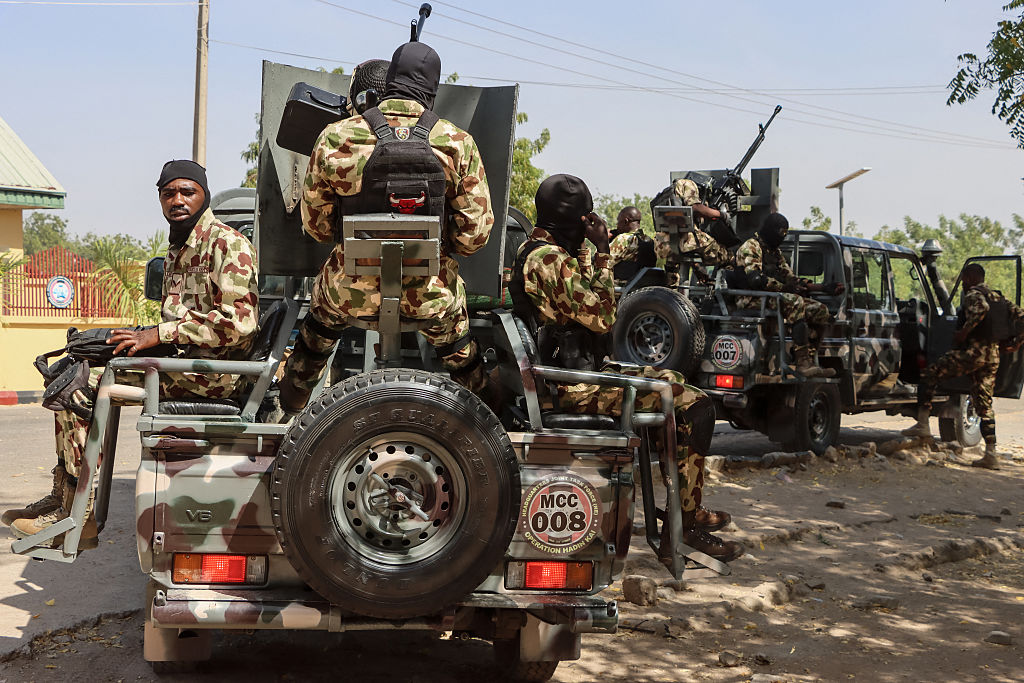
New reporting sheds light on the painstaking intelligence collection, surveillance and cooperation that helped take out a top Islamic State group operative in Nigeria in May.
Nigerian security analyst Zagazola Makama covered the events surrounding the May 16 joint Nigerian-United States mission in the Metele area of Borno State that resulted in the death of Abu-Bilal al-Minuki, second in command of IS globally. Through interviews with Nigerian security officials and on-the-ground sources, he was able to piece together a picture of how the terrorist was tracked and killed.
Makama said the mission was months in the making and involved close collaboration among Nigeria’s Department of State Services, National Intelligence Agency, Defence Intelligence Agency, military intelligence elements under Operation Hadin Kai, and U.S. Africa Command. He pointed to the use of human intelligence, signals intelligence, surveillance, technical monitoring, battlefield observations and detainee exploitation to build a picture of al-Minuki’s movements in real time.
He said interagency and intergovernmental cooperation were key.
“What distinguished this operation was the ability of these agencies to move beyond parallel intelligence collection and operate within a synchronized framework where information from different sources was continuously merged, analyzed and acted upon,” Makama told ADF in an email.
Intelligence professionals found that al-Minuki traveled between Kano, Damaturu, Maiduguri and other locations while maintaining contact with multiple Islamic State West Africa Province (ISWAP) associates and commanders. While under surveillance, he met with an ISWAP operative named Ismail Dan-Hajia and another associate named Umar. They reportedly linked up with Ibrahim Ayuba, also known as Abu Ayuba, an ISWAP commander operating out of the notorious area southwest of Maiduguri sometimes called the Timbuktu Triangle.
The breadth of the terrorist commander’s activities quickly became clear. Analysts found that al-Minuki was involved in propaganda operations, financial transfers, weapons acquisition, explosives manufacturing and the use of drones by terrorists across West Africa.
“Al-Minuki functioned not merely as a battlefield commander but as a strategic coordinator inside ISIS’s broader international network,” Adekunle Yusuf wrote for Nigeria’s The Nation newspaper.
Makama said the fact that operatives spent time in metropolitan areas reveals an effort to recruit urban youth and to develop ISWAP logistical support networks. Officials also were able to identify a Maiduguri building the terrorists used. Intelligence officials chose to bide their time to gather more information about ISWAP networks.
“Rather than immediately acting on early intelligence, security agencies reportedly chose to maintain surveillance over an extended period in order to better understand the broader network, identify additional associates and map operational relationships,” Makama wrote. “This patience ultimately enabled investigators to develop a far more comprehensive understanding of the network surrounding al-Minuki.”
Makama reported that the May 16 early morning raid killed not only al-Minuki, but Abu Huraira, his son-in-law and a key field commander; Ba Yuram, an operative responsible for logistics and weapons acquisition networks; and Mallam Haruna, believed to be al-Minuki’s personal security chief.
Nigerian battle damage assessments revealed that the mission destroyed vehicles, logistics hubs, supply depots and other facilities associated with ISWAP.
He believes the event will have a symbolic and practical impact on the terror group’s ability to launch attacks.
“From a symbolic perspective, the elimination of a senior figure such as Abu-Bilal al-Minuki demonstrates that even the most protected terrorist leaders remain vulnerable to sustained intelligence-driven operations,” he wrote. “From a practical standpoint, intelligence assessments suggest that the operation disrupted a significant portion of ISWAP’s command structure.”
Observers are optimistic that the mission will have a ripple effect across the region.
“The strike instantly reshaped the security conversation across West Africa,” Yusuf wrote for The Nation, adding, “[It] has been cast in official circles as a defining moment in West Africa’s long and grinding war against extremism. It is the kind of operation that governments tend to present as turning points: precise, coordinated, decisive, and historic.”