

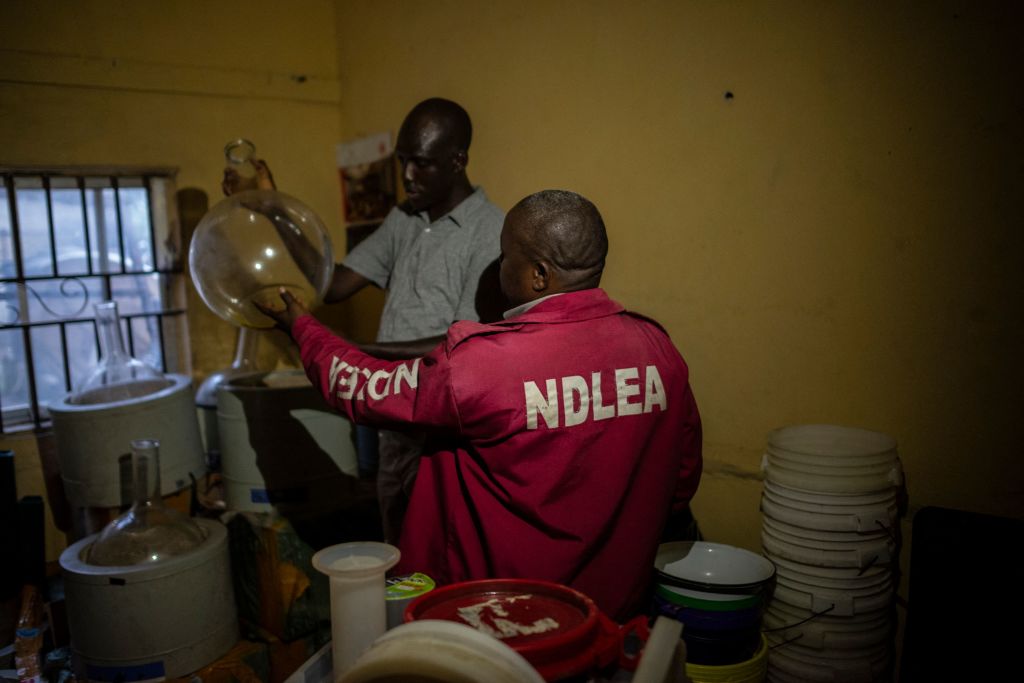
Mexican drug cartels have expanded and are increasingly producing methamphetamine in Africa. This was highlighted in mid-May when Nigerian authorities arrested three Mexican nationals and six others at an industrial-scale methamphetamine laboratory in Ogun State’s Abidagba forest. Officials seized chemicals and drugs worth $363 million.
The arrests came amid warnings that Mexican cartels were funding continental terrorists, armed groups and criminal groups that help them produce and move the drugs. Analysts say these links are strengthening. Oluwole Ojewale, an organized crime expert with the Institute for Security Studies in Senegal, noted that the Nigerian bust occurred near Lagos, the Nigerian capital and a major port city. He said the flow of drugs into West Africa follows a trans-Atlantic route originating in Mexico and other Latin American countries.
“This is not [unique] to Nigeria,” Ojewale told Deutsche Welle (DW). “This is happening along the Gulf of Guinea and to the Cape routes in South Africa, in which these drug cartels coming from Southern America, coming from Mexico, have found a soft spot in which they are exploring. It points in the direction of a deep-seated cartel.”
The Mexican Sinaloa cartel is known to operate in West Africa, and also in Kenya and South Africa. The Jalisco New Generation Cartel (CJNG) also is active on the continent. West Africa historically has been a transit hub for cocaine, but Ojewale said the addition of local production facilities means criminal markets are diversifying amid growing demands for illicit materials, contraband and drugs that increasingly are being consumed locally.
“There is also the rise of criminal groups that have to be high on something to be able to carry out their heinous operations, coupled with the fact that porous security and maritime security is probably serving as an enabler for this, coupled perhaps with other socio-economic realities like unemployment,” Ojewale told DW.
Analysts say the cartels manufacture drugs in West Africa to eliminate logistical costs and avoid maritime interdiction. They often operate in rural, heavily forested areas to avoid drones and other aerial surveillance and to help contain the heavy odor associated with meth production. They typically provide their own drug makers. Organized crime researcher Julian Rademeyer told Al Jazeera that this amounts to Mexican cartels “franchising” their operations.
Mexican cartels pay local terrorists armed groups and criminal gangs a tax to allow “the free flow of the drugs” into northern Africa before they reach Europe and the Middle East, Ojewale told DW.
However, security expert Andy Mashaile, a retired Interpol ambassador, told South Africa’s SABC News that cartels are increasingly smuggling raw materials through West Africa to manufacture drugs in South Africa.
Days before the Nigeria bust, South African authorities arrested four Mexican nationals among 11 people at an elaborate crystal meth production facility in a small farming town in North West province. Authorities seized 481 kilos of methamphetamine, containers of chemicals and firearms. It was the fourth drug laboratory discovered in South Africa with alleged Mexican links.
In 2024, South African police raided a facility worth up to $110 million on a farm in Limpopo and another one worth up to $6 million near Tshwane. Last year, five Mexican nationals were arrested at a crystal meth laboratory on a farm in Volksrust, where authorities seized drugs worth $20 million.
Increased local production has coincided with increased meth consumption. This is due to high youth unemployment rates, law enforcement gaps, the drug’s high potency, low cost and other factors. South Africa is considered one of the world’s largest consumer markets for crystal meth, and meth use has risen in Kenya since 2020, according to a 2025 report by the Eastern and Southern Africa Commission on Drugs.
In Nigeria, increased meth use has been linked to homicides and other violent crimes, particularly in smaller communities where it is produced.
“In the final analysis, the communities in those places bear the direct brunt of the activities, both of drugs and the violent activities that they actually enable in those communities,” Ojewale told DW. “This impact spreads into the social fabric and leads to the breakdown of family life, the breakdown of businesses and the complete obliteration of [other economic activities] in those communities. It’s a chain effect of how these communities become unstable.”