

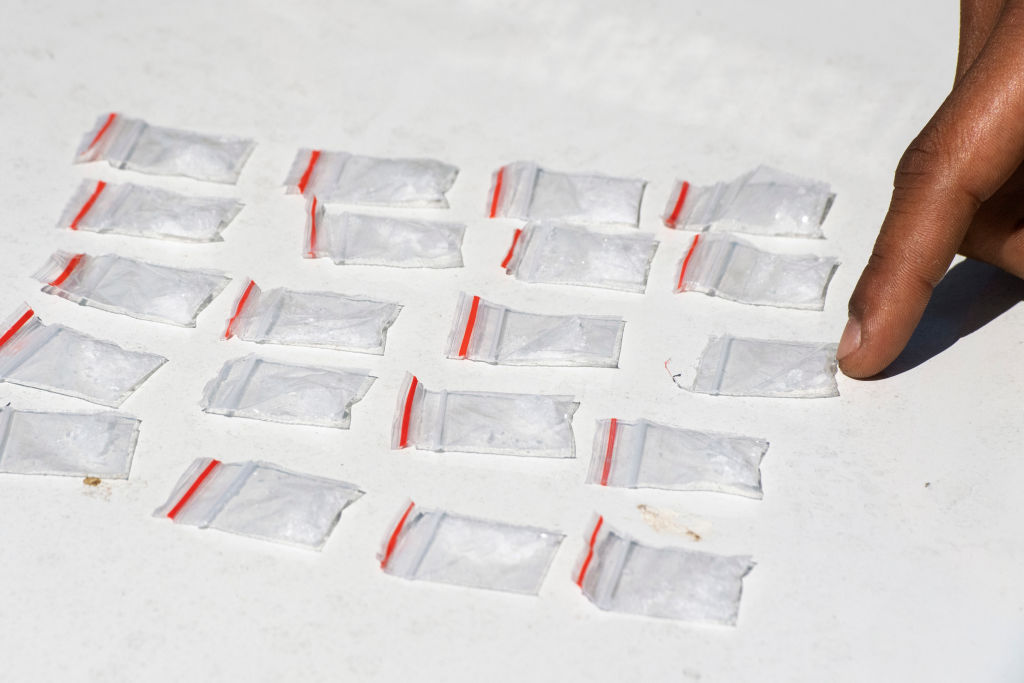
Four Mexican nationals were among 11 people arrested at an elaborate crystal methamphetamine production facility in a small farming town in South Africa’s North West Province in mid-May. Authorities seized 481 kilograms of meth and estimated the drug laboratory to be worth at least 1 billion rand ($61 million). Authorities could not locate the property’s owners.
According to the South African Police Service, it was the fourth drug laboratory discovered in South Africa with alleged Mexican links.
South Africa is considered one of the world’s largest consumer markets for crystal meth, locally known as “tik.” Observers such as local anti-crime activist Yusuf Abramjee said the incident raises concerns about transnational criminal syndicates using South Africa as a drug manufacturing, distribution and transit hub.
“The alleged Mexican links should absolutely concern South Africans,” Abramjee told South Africa’s Independent Online (IOL) news platform. “Mexican cartels are globally known for operating highly sophisticated narcotics networks with access to chemicals, logistics, money laundering channels and violent enforcement structures.”
Lisa-Maré Schickerling, the Democratic Alliance party’s spokesperson on police matters, said recent arrests involving Mexican nationals show that South Africa needs tighter border security, enhanced forensic support and greater international cooperation.
“Mexican cartels are globally known for highly organised and violent transnational drug operations,” Schickerling told IOL. “The fact that this is reportedly the fourth laboratory in South Africa with alleged Mexican links raises serious questions about how deeply these networks may have infiltrated the country, while reinforcing concerns around organised crime, corruption, and weaknesses within law enforcement structures.”
In September 2025, South African authorities arrested five Mexican nationals and uncovered a methamphetamine laboratory and drugs worth $20 million in the rural eastern South African town of Volksrust.
Julian Rademeyer of the Global Initiative against Transnational Organized Crime said the bust was a sign that Mexican drug cartels were “franchising” industrial-scale meth production within the country. Rademeyer told Johannesburg’s 702 Drive talk radio show that Mexican nationals had established the facilities on remote farms in rural communities, and have similar operations in Kenya and Nigeria.
According to Rademeyer, the Mexican nationals arrested in Volksrust were likely scientists sent by crime syndicates, such as the Sinaloa cartel, which has established itself in more than 50 countries, and the Jalisco New Generation cartel.
The Volksrust bust was preceded in July 2024 by the arrest of two Mexican nationals at an industrial-scale meth lab on a farm in Groblersdal, a small town in the Limpopo Province. Authorities discovered large quantities of chemicals used in the manufacturing of illicit drugs, including crystal meth, with an estimated street value of 2 billion rand ($122 million). It was one of South Africa’s largest-ever drug busts.
Katlego Mogale, national spokesperson for the Hawks, the South African Police Service branch that specializes in fighting organized crime, told Reuters that it is not clear whether the Volksrust suspects were manufacturing drugs to distribute in South Africa or elsewhere. The Limpopo Province borders Botswana, Mozambique and Zimbabwe.
Abramjee told IOL the pattern of arrests and drug seizures suggests that organized crime in the country is “increasingly transnational, networked, and financially powerful.” Nirmala Gopal, a criminologist and academic leader at the University of KwaZulu-Natal, agreed.
“Such [drug-producing] operations rarely occur in isolation; instead, they frequently reveal connections to broader criminal organisations or organised crime syndicates,” Gopal told IOL. “The implications of these busts suggest not only the immediate confiscation of illegal substances but also highlight the intricate web of relationships and logistics that facilitate drug trafficking.”
South Africa’s drug market is not limited to meth. In early May, authorities seized 32 bricks of cocaine with an estimated value of more than 13 million rand (about $795,000) in a bus at Durban Harbour. The bus was shipped from a South American country and was due to be delivered to Gauteng, defenceWeb reported.
Drug tests conducted by clinics in South Africa in late 2024 detected fentanyl, a powerful synthetic opioid, in younger people in the Eastern Cape and KwaZulu-Natal. The drug is about 100 times more potent than morphine and 30 times stronger than heroin. It is commonly mixed with cocaine, heroin and meth, and has been found in the country’s wastewater.