

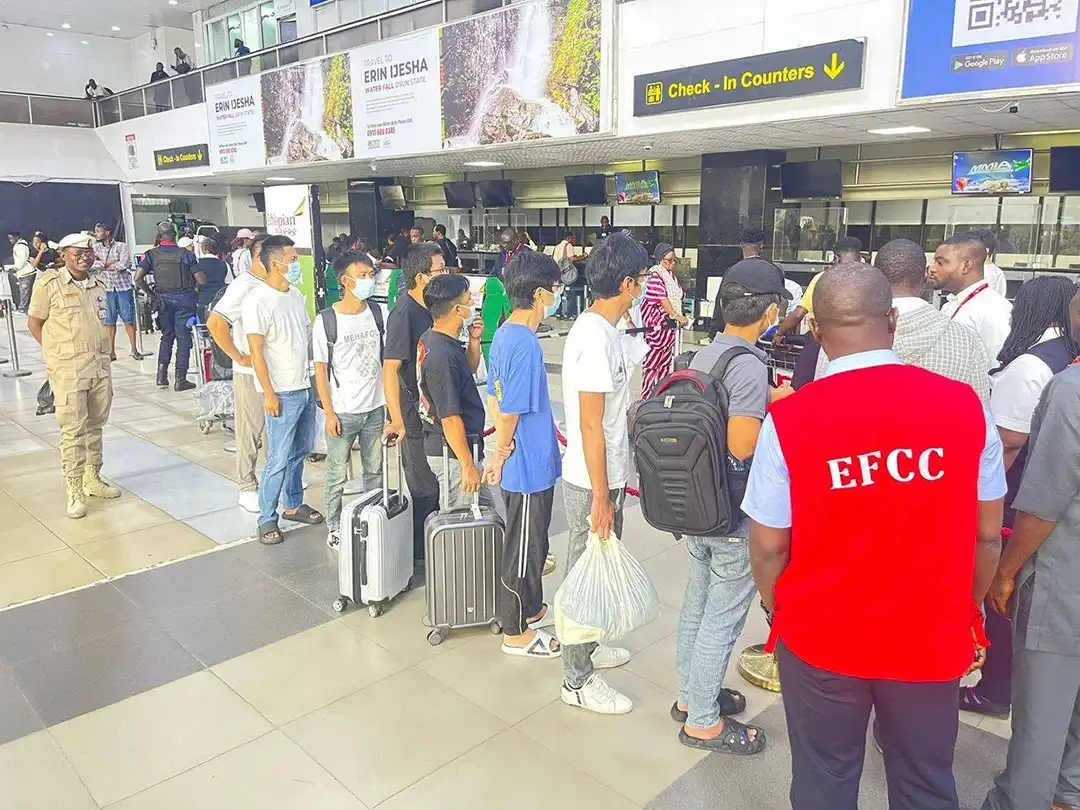
In the wake of Operation Eagle Flush in 2025, one of the biggest, most complex anti-fraud crackdowns in Nigerian history, a federal court in February sentenced Chinese nationals Huang Haoyu and An Hongxu to 46 years in jail for cyberterrorism and internet fraud. They were the kingpins at the center of a massive criminal enterprise in Lagos, according to Nigeria’s Economic and Financial Crimes Commission. The operation resulted in the deportations of 148 Chinese nationals who were convicted of cyberterrorism, internet fraud, romance scams and fake cryptocurrency investment schemes. Huang and An, however, will serve their sentences before being repatriated.
As mass arrests provide further evidence that Chinese criminal syndicates are expanding across the continent, Beijing is selling something of a solution in the form of bilateral law enforcement agreements with many African governments. But experts say China’s policing arrangements protect its own interests, citizens and technology while failing to notably improve public safety.
“Where the crime goes, China’s offer of policing assistance follows, and it’s often accepted,” Oscar Warren, a program coordinator at the Australian Strategic Policy Institute, wrote in an October 16 report. He added: “Beijing is exporting a model of policing that protects governments rather than communities. It uses criminal networks abroad as proxies where a state actor cannot be seen to act. These partnerships give it access to partner forces, reach over diaspora communities, and influence.”
Decades of crackdowns in China have pushed highly organized, violent criminal groups, known as triads, outward to southeast Asia and more recently to Africa, where they now run industrial-scale scam operations, human and wildlife trafficking networks as well as poaching, smuggling and money-laundering efforts.
In 2025, a South African court sentenced seven Chinese nationals to 20 years in prison for human trafficking and forced labor. Ghana also has clamped down on Chinese criminals to tackle illegal gold mining known as galamsey, which has caused widespread environmental and economic damage.
Even when Chinese assistance leads to arrests in Africa, many deported criminals are not prosecuted. François Misser, a Brussels-based journalist who has covered Central Africa since 1981, blamed deep ties between the Chinese Communist Party (CCP) and triads such as the Hongmen Association, 14K-Hau and 14K-Ngai.
“Beijing’s role is ambiguous,” Misser wrote in an August article for the African Desk for Strategic Analysis, an independent research platform. “While it claims to clamp down on criminal networks and sometimes provides support to African governments to help them deal with the problem, it has also given political recognition to the Hongmen.”
According to public records, China has trained police from 33 African countries. Beijing has bilateral policing agreements with at least 24 countries and has embedded officers or runs joint operations in 10 countries, according to the Africa Center for Strategic Studies.
Matt Herbert, a human smuggling expert at the Global Initiative Against Transnational Organized Crime, said China’s policing arrangements on the continent have provided few benefits while raising several concerns.
“Complaints about the utility of Chinese training and the performance of equipment are common,” he said in a 2025 interview with the Institute of Peace. “In turn, the instillation of extensive surveillance networks in a number of African cities, promoted by China as a key policing tool, have not been correlated with a substantial decline in crime rates — with crime in Nairobi actually increasing.”
Authorities have uncovered industrial-scale scam compounds linked to China in at least nine African countries since 2020, and many more are at risk. But Misser warns that foreign policing arrangements are a dubious solution.
“China’s police answer solely to the CCP,” he wrote. “That is authoritarian policing: continuous surveillance, household-level data collection and pre-emptive intervention. Countries that learn from that model risk building forces aimed at their own populations rather than crime, leading to innocent people being surveilled, detained and silenced.”