

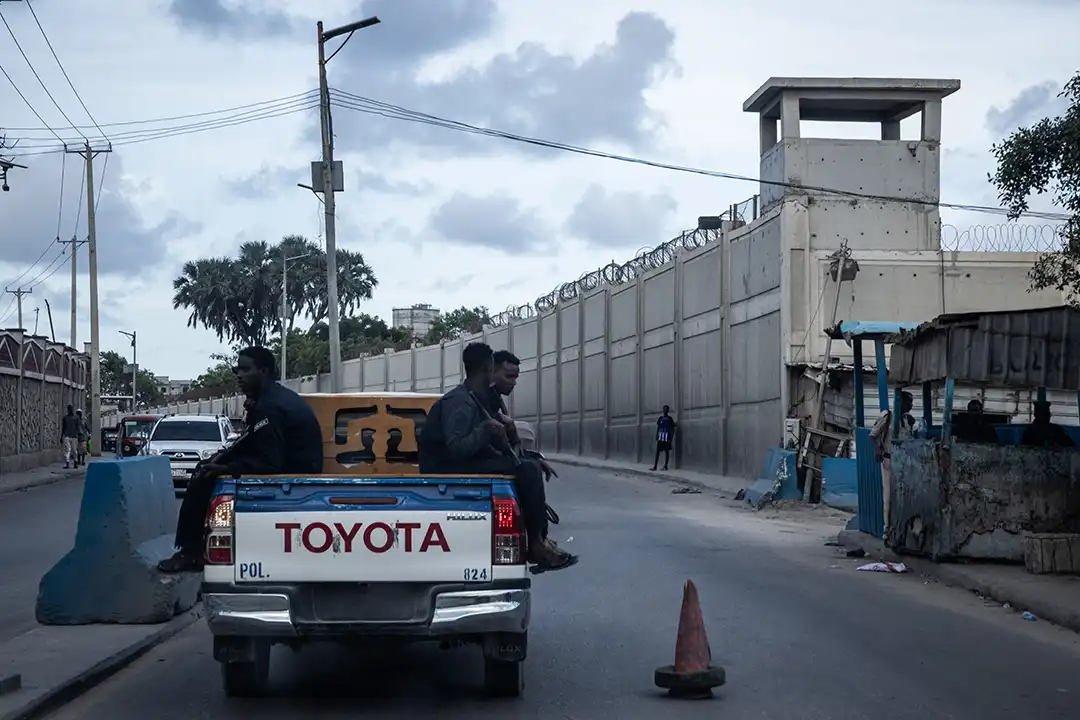
Senior Somali officials say daily life in and around Mogadishu is gradually returning to normal amid the government’s 20-year battle against al-Shabaab.
During a late September gathering of officials at the Ministry of Defense headquarters in Dayniile, Defense Minister Ahmed Moallim Fiqi noted the ability of senior officials to gather without fear of being attacked. Dayniile is a district about 8 kilometers north of Mogadishu, the national capital.
“We remember four and a half years ago, when elections were being held here … mortar shells were raining down like stones around the hall where the election was taking place,” Fiqi said in a report by TRT Afrika.
At the same gathering, Prime Minister Hamza Abdi Barre said he had travelled to the Defense Ministry from his residence without roads being closed for his convoy’s safety.
“We simply moved among ordinary Somali citizens,” Barre said. “At certain points, we stopped. We were caught in traffic.”
This might seem mundane, but for years senior officials in Mogadishu often traveled behind security cordons and armored vehicles on closed roads.
TRT Afrika noted that Mogadishu now hosts large sporting events and cultural gatherings and that restaurants are staying open well after dark. During the 2026 World Cup, senior government officials were seen watching the matches with members of the public. During Independence Day Celebrations on July 1, President Hassan Sheikh Mohamud mingled with young people at Taleex Square — with a far less restrictive security presence.
“These scenes are not simply evidence of improved security,” TRT Producer Nuri Aden wrote. “They are themselves part of the wider struggle against terrorism.”
In other parts of the country, the al-Qaida-affiliated terror group maintains a persistent deadly presence. The terror group on October 26 attacked an estimated 2,000 members of the Somali National Army (SNA) and claimed they had killed 413 Soldiers and wounded 400 more. Somalia’s federal government did not disclose the number of SNA casualties but said more than 70 al-Shabaab fighters were killed.
The SNA forces were attacked as they advanced toward the town of Burhakabo, where Ethiopian forces serving under the African Union Support and Stabilization Mission in Somalia (AUSSOM) handed over a military base to the SNA in August.
Al-Shabaab’s deadly resiliency fortifies the theory that an experienced, well-organized terror movement cannot be defeated by military force alone. Mohamud in September said the government also aims to confront the scourge ideologically and financially.
Analysts say that positively engaging younger populations, especially underemployed young people in areas plagued by insecurity, can help governments stem the spread of radical thought. Al-Shabaab means “the youth,” and Somali officials are increasingly referring to the terror group as “Khawaarij,” after an extremist Islamic sect.
Somalia’s government is portraying al-Shabaab as a movement that has twisted religion while attacking people it claims to defend. Authorities are also registering religious schools and Qur’anic study centers to bring Islamic education into a more cohesive national framework.
As noted by TRT Afrika, a bill before parliament proposes the establishment of a Somali Scholars Council, a national body to unite religious scholars and help counter extremist religious interpretations. The council could promote religious awareness, support peace and reconciliation, improve social cohesion and counter the misuse of religion and extremist ideas, Minister of Endowments and Islamic Affairs Sheikh Mukhtar Robow Ali recently told lawmakers. Robow was once a senior al-Shabaab figure.
Mogadishu has also begun targeting websites, social media outlets and online platforms used to promote terrorist propaganda. Military, security and police are working to prevent terrorists from controlling the narrative around security incidents. Authorities have also targeted financial accounts, communication channels and other systems believed to fund terror operations.
Fiqi said in late September that security efforts have led to a precipitous drop in terror attacks in Mogadishu. He said in a TRT Afrika report that terrorist attacks have declined by 87%, and that the government aims to soon push the rate to beyond 90%.