

In August, a Sudanese airstrike combining aircraft and drones hit a suspected Rapid Support Forces (RSF) convoy 100 kilometers inside Chad’s territory.
The airstrike was one of many the Sudanese Armed Forces (SAF) have conducted along the western border with Chad as well as the southeastern border with Ethiopia, where the rival RSF has launched attacks from the Bahir Dar Air Base and Asosa Airport in the Amhara region.
“Two borders, two governments, one common denominator: the weapons now doing the damage were not built in Sudan, and increasingly they were not paid for in Sudan either,” analyst Hollie McKay recently wrote for Eurasian Review.
Now in its third year, Sudan’s civil war threatens to become a broader regional conflict as countries such as Türkiye and the United Arab Emirates supply weapons to each side.
The SAF has bought Turkish Bayraktar TB2 and Akinci drones to supplement its use of heavy weaponry. The UAE launders gold smuggled out of RSF-controlled territories and supplies the RSF with drones and other weapons — at least once through an airstrip in Chad, according to a United Nations report.
The arrival of Turkish drones in 2024 helped shift the war in the SAF’s favor, allowing it to retake the capital, Khartoum, and neighboring Omdurman, along with RSF-held states such as al-Gezira.
“That arms pipeline has done what it was built to do,” McKay wrote. “It has also given the army a strike range and tempo that its own neighbors are now absorbing.”
The SAF has used those same drones to attack markets and other civilian locations in the RSF-controlled Darfur region bordering Chad. Civilians displaced by the war have fled to Chad, but the border area is also a location for both RSF fighters and SAF-aligned militias to retreat during lulls in fighting. The SAF continues to accuse the UAE of supplying the RSF through Chad.
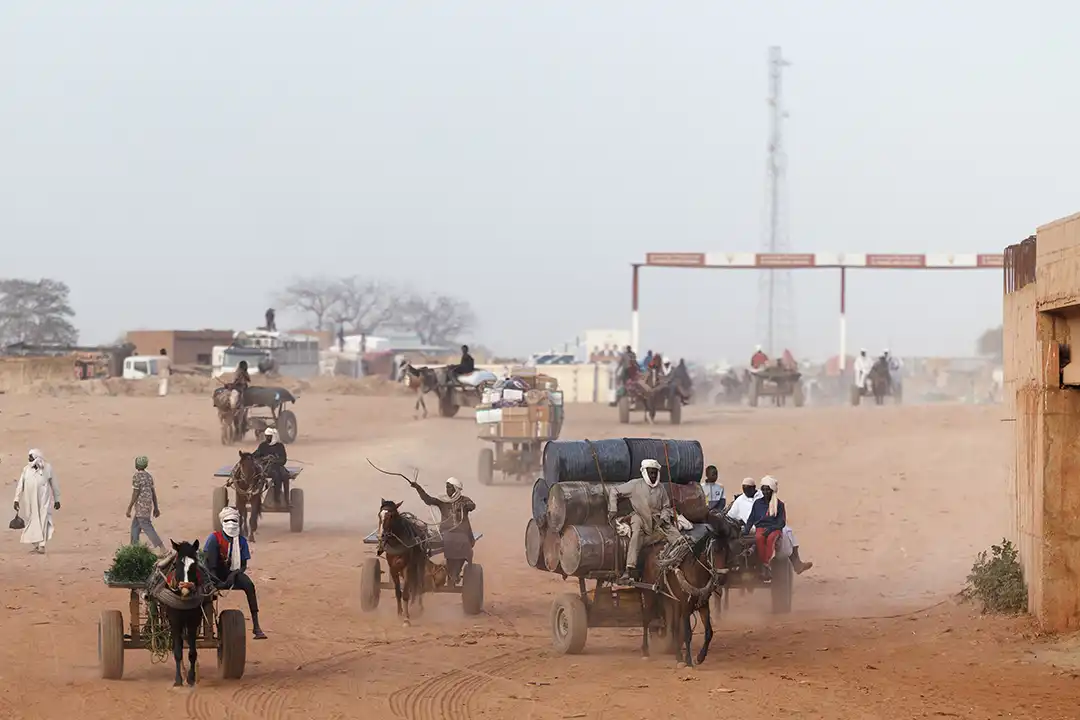
In March, an SAF drone hit a fuel depot at the Sudanese border market of Adikong, about 50 meters from a Chadian security checkpoint. The market is about 7 kilometers from the Chadian town of Adré, which is home to a camp for displaced people. The SAF claimed it was targeting fuel smugglers moving from Chad to RSF-controlled West Darfur. The explosion killed at least 13 Sudanese and Chadian civilians.
On the opposite side of the country, the SAF has used drones to counter incursions into Blue Nile State from across the border in Ethiopia. Sudanese authorities accuse Ethiopia of allowing the RSF to operate from its territory. They say Ethiopia has provided runways for drones at Bahir Dar that target civilian sites in Khartoum, al-Gezira, White Nile and North Kordofan states.
Ad-Damazin is one of several communities housing some of the 50,000 people fleeing RSF attacks on Kurmuk, Geissan and Baw in Blue Nile State.
In August, multiple reports claimed the SAF used an Akinci drone to shoot down another Akinci entering the country from Ethiopia.
“The engagement signals a widening battlespace in which airfields around Bahir Dar or Asosa could support cross-border sorties, Sudanese combat air patrols could extend toward frontier corridors, and neighboring territory could acquire direct operational relevance,” analysts with Defence Security Asia wrote. “That expansion raises miscalculation risks.”