

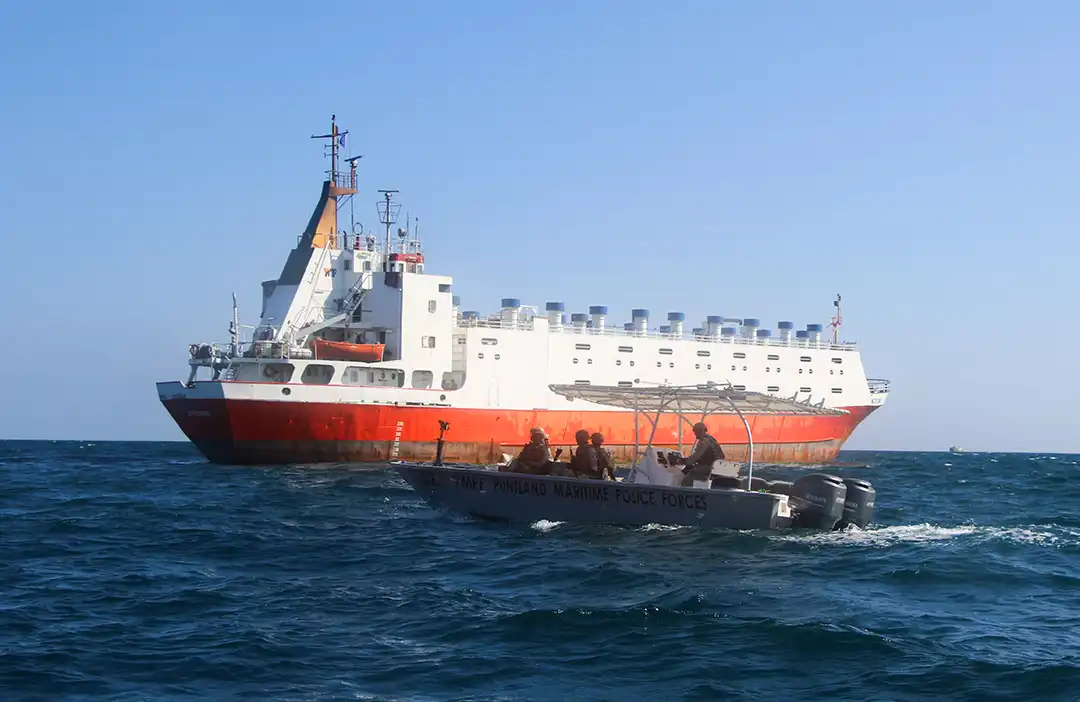
An International Maritime Bureau piracy report noted a recent wave of Somali piracy incidents, which have surged since April. The pirates typically strike in the Gulf of Aden between Somalia and Yemen. While the overall number of Somali piracy incidents is down, analysts say the recent increase shows that the challenge persists.
In the largest attack this year, Somali pirates on April 21 hijacked the Palau-flagged tanker Honour 25 near Eyl, a former fishing town in the autonomous Puntland region that has become a major hub of Somali piracy. Five crew members were killed and five injured during a rescue attempt in September. Analysts believe these marked the first killings committed by Somali pirates in more than 10 years.
“While incident levels are at their lowest in more than three decades, the recent uptick in Somali piracy activity is a reminder that the threat remains,” Bureau Director Michael Howlett said in a defenceWeb report. “Incidents this year have also shown that strict adherence to BMP [Best Management Practices] recommendations remains one of the most effective ways to deter hijacking attempts and protect crews. Continued vigilance is essential to safeguarding seafarers and the vital trade routes on which the global economy depends.”
The scourge is driven in part by Yemen’s Iranian-backed Houthi rebels, whose attacks on ships in the Strait of Hormuz threaten shipping in the Red Sea and Indian Ocean, forcing companies to use lanes around the Horn of Africa. Multiple geopolitical crises in the region have also driven a reshuffling of naval assets, leaving Somali waters more exposed to sea crime.
Increased piracy has coincided with the growing relationship between the Houthis and al-Shabaab, which has ties to Somali piracy. This has resulted in pirate groups using more sophisticated weaponry and technology acquired from the Houthis.
Illegal, unreported and unregulated fishing aggravates the challenge. The fishing town of Bander Beyla, on the Puntland coast, has become a focal point of the renewed piracy crisis. Locals are struggling to make ends meet amid fishing restrictions and the presence of foreign fishing trawlers.
Abdifatah Mohamed, who has spent 20 years fishing off Somalia’s coast, said the activities of foreign industrial trawlers have led to declining fish stocks.
“We’re [fishermen] no match for the foreign trawlers, who possess capabilities far greater than us, which impacts the livelihoods of our families on land,” Mohamed told Al Jazeera. “Some from our community have taken up arms at sea, but deep down I know it’s hurting our community.”
Local authorities in late August restricted fishermen from going to sea amid concerns that pirates were disguising themselves as fishermen; pirates often launch attacks from small dhows and seize fishing vessels, known as “mother ships.”
“Some of the pirates involved in the hijackings are from Bander Bayla and hail from this community,” Abdirizak Said, a local fisherman, told Al Jazeera. He said dozens of locals have been arrested for bringing to pirates food or khat, a shrub chewed for its stimulant-like effect.
“Businesses and stores were even ordered by the [local] government not to sell anything to pirates, and if they do, they’ll be viewed as pirates themselves,” Said told Al Jazeera.
Locals say the fishing restriction, expected to last two months, fuels food and financial insecurity.
“Our families depend on what we catch at sea,” Mohamed said. “Even though our catches have gone down in recent years, it helped provide for our families at home. But it’s like we were being punished for crimes we have nothing to do with, and our families have suffered for it.”
According to the Soufan Center think tank, the resurgence in Somali piracy has not altered the international response, which focuses on deterrence. The center highlighted a new counter-piracy task force proposed by signatory countries of the Djibouti Code of Conduct (DCoC). The countries called for the creation of a regional task force to confront piracy and other crimes in the Gulf of Aden and the western Indian Ocean.
The proposed DCoC Task Force was revealed on August 17 — a day when eight armed Somali pirates boarded the Cameroonian-flagged vessel MV Lutuf, which had two Serbian security guards, about 4 nautical miles off the coast of Somalia.
European Naval Force Somalia Operation Atalanta also continues counter-piracy operations, which typically involve following captured vessels and mother ships. This is sometimes successful. When pirates boarded the Glamor, a merchant ship, in the Gulf of Aden in September, the crew locked themselves in their citadel, an armored safe room. The pirates fled after Operation Atalanta forces, the Indian Navy and a Japanese patrol aircraft responded.