

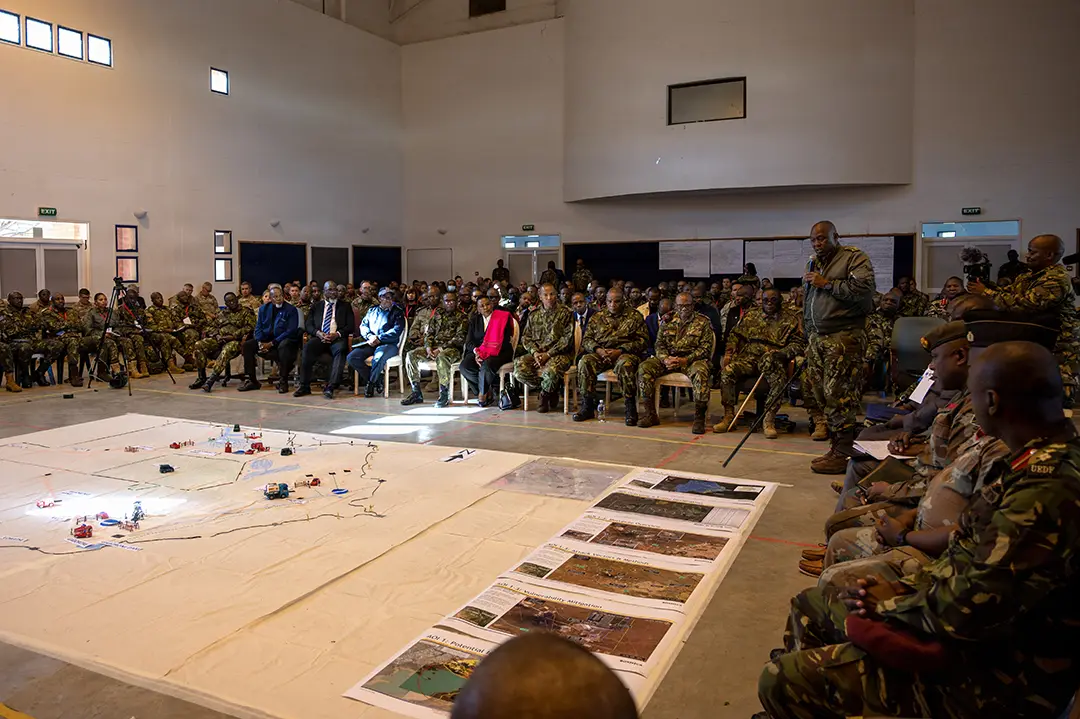
Botswana Defence Force (BDF) intelligence personnel analyzed the threat report as it came in on August 12: Unidentified drones were operating near critical infrastructure.
Fortunately, it was a simulation.
The training was part of Southern Accord, a joint exercise held biennially by the BDF and United States military. The six-day event was aimed at strengthening security in Botswana and Southern Africa through better cooperation and interoperability.
This year’s iteration focused on counterterrorism, counterinsurgency, space and cyberspace domain awareness, crisis response planning, and whole-of-government coordination. It ran from August 10 to 15 with an opening ceremony at Gaborone Technical College, where BDF Maj. Gen. Molefi Seikano said the unpredictable and often asymmetrical security landscape requires synchronized responses and deep-rooted partnerships.
“No single nation, no matter how powerful, can perform these security realities in isolation,” he said. “The challenges of our time require synchronized responses and vibrant partnerships.”
U.S. Africa Command has conducted Southern Accord in Southern Africa since 2010. First held in Botswana in 2012, it provides a platform for participants to share expertise, test operational readiness and strengthen coordination during complex security situations. Botswana and the North Carolina National Guard have worked together through the State Partnership Program since 2008.
“Our partnership with the United States Army, specifically through Central Africa, provides our American counterparts unique insights into the operational realities, cultural contexts and technical innovations in the region,” Seikano said.
On August 11, cybersecurity personnel shared best practices, integrated new techniques and conducted assessments and penetration testing to identify vulnerabilities and replicate tactics adversaries could use to access a network.
J.R. Nabalo, an incident responder with the Botswana Computer Incident Response Team, said he valued the opportunity to reinforce and expand his knowledge base.
“I learned and will incorporate a technique they taught to consolidate information from different sources into one dashboard to help streamline my work,” he said.
Botswana and U.S. intelligence personnel tested their mettle with a series of threat simulations, which were designed to strengthen their analytical skills, information sharing and decision-making. Maj. Kegomoditswe Moeng, a BDF logistics instructor, worked to assess potential threats and their impact on operations in real time.
“I was looking forward to learning a lot about intelligence, especially in joint exercises and operations,” he said on August 12. “I’ve learned a lot from this exercise, and I now have a bigger appreciation for how important intelligence is.”
Another highlight was an August 10 briefing on space-based fundamental intelligence, surveillance and reconnaissance delivered by U.S. Space Force Lt. Col. Devin Zufelt. On August 13, military officials from Eswatini, South Africa and Zimbabwe visited Southern Accord 26 to observe the joint planning process staff exercise in Gaborone.
Botswana and the U.S. have robust defense ties, as evidenced by the recent announcement that the BDF will receive two C-130H Hercules transport aircraft from the U.S., each valued at $12 million. The U.S. also gave the BDF Air Wing a C-130H in June 2024.
“These aircraft showcase the powerful partnership between the United States and Botswana and our shared commitment to advancing peace and security across Africa,” the U.S. Embassy in Botswana said on August 5.
U.S. Air Force Col. Anthony Sullins, deputy exercise director, praised the hard work and collaboration that was on display throughout Southern Accord 26.
“The rigor of this exercise challenged participants to learn new concepts in cyber defense and space operations,” he said during the closing ceremony.
BDF Maj. Gen. Simon Motswana Barwabatsile said the achievements of Southern Accord 26 were a testament to the close relationship enjoyed by both countries.
“Today marks the successful completion of an exercise that has demonstrated our collective commitment with national security, military professionalism, cooperation and partnership,” he said. “Over the past days, we have witnessed not only the strengthening of operational capabilities, but also the upbuilding of trusting relationships founded on trust and shared purpose.”