

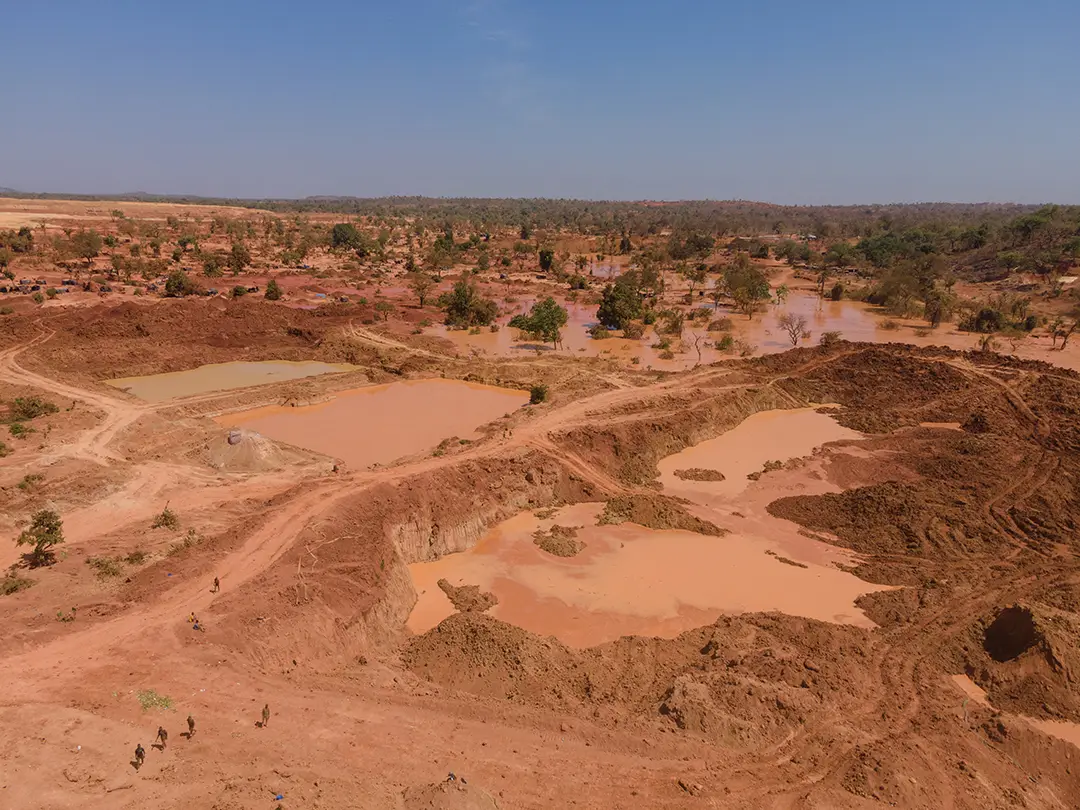
Sahel terrorists are targeting gold mines and surrounding communities in search of revenue, recruits and weaponry such as explosives. In some cases, the terrorists have built bases nearby.
Rather than attack mines directly, Jama’at Nusrat al-Islam wal-Muslimin (JNIM) and Islamic State Sahel Province (ISSP) have staked their claims to nearby communities in different parts of Burkina Faso, Mali and Niger, along with the roads that connect mining areas to each other and to the outside world.
The groups target industrial and artisanal mining areas.
“As militant groups expand into new areas, they rarely focus on mines alone,” Héni Nsaibia, West African senior analyst for the Armed Conflict Location and Event Data (ACLED) project wrote recently. “Instead, they interact with the miners, traders, transport routes, and surrounding communities that sustain mining activity and depend on it for their livelihoods.”
The goal, ultimately, is to exert control over the communities, their resources and the support infrastructure they provide, according to Nsaibia.
Burkina Faso has become the focal point for most mining-related violence, with 75% of all violent events happening within its borders. ACLED examined 44 mining sites across the three countries in the Alliance of Sahelian States (AES). It found that most terrorism happens within 10 kilometers of mines, not within the mines themselves.
Burkina Faso’s northern Inata mine, near the border with Mali, became the first mine terrorists targeted in 2018. The ruling junta closed the mine in 2024. As of June, the mine and the surrounding region are under JNIM’s control, according to ACLED.
“The way JNIM and ISSP are extracting value from the mining sector is indirect. People have to do the mining first,” Lucia Bird Ruiz-Benitez de Lugo, director of the West Africa Observatory at the Global Initiative Against Transnational Organized Crime, said during a recent International Land Coalition (ILC) webinar.
JNIM and ISSP then extract payments, either as taxes or extortion, from miners and other community members, often in gold, which can be stored and laundered later to make quick cash.
“We’ve seen through raids on bases, particularly of JNIM, that groups can sometimes have really quite significant volumes of gold in these bases,” Ruiz-Benitez de Lugo said.
Many mining communities lie along border regions, such as Mali’s western Kayes region with Senegal, where 80% of its gold is mined. Burkina Faso’s southern boundary with Ghana also has become a source of revenue for JNIM as Ghanaian miners send their gold into Burkina Faso for processing, according to Ruiz-Benitez de Lugo.
The Liptako-Gourma region, where Burkina Faso, Mali, and Niger meet, has long been a hot spot for competition between JNIM and ISSP. It’s also home to Burkina Faso’s largest gold mine, Essakane. Some of Niger’s most important gold mines, including the Samira mine, lie just across the border.
As JNIM and ISSP seek to expand their regional footprint , mining-related violence is likely to expand beyond AES countries, according to Nsaibia.
“JNIM’s expansion toward the borders with Senegal, Guinea, Côte d’Ivoire, and Ghana raises the risk that patterns already observed in the central Sahel will spread farther south to coastal West Africa,” Nsaibia wrote in a report for ACLED and the ILC.
Mining communities in northwest and north-central Nigeria also are likely targets for JNIM and ISSP, both of which already have a footprint in those regions, he added.
“Mining areas are now more than just sites of resource extraction,” Nsaibia wrote. “They increasingly serve as indicators of broader conflict dynamics, showing how governments assert control over mineral resources, and how localized violence can spread and disrupt vital economic activities.”