

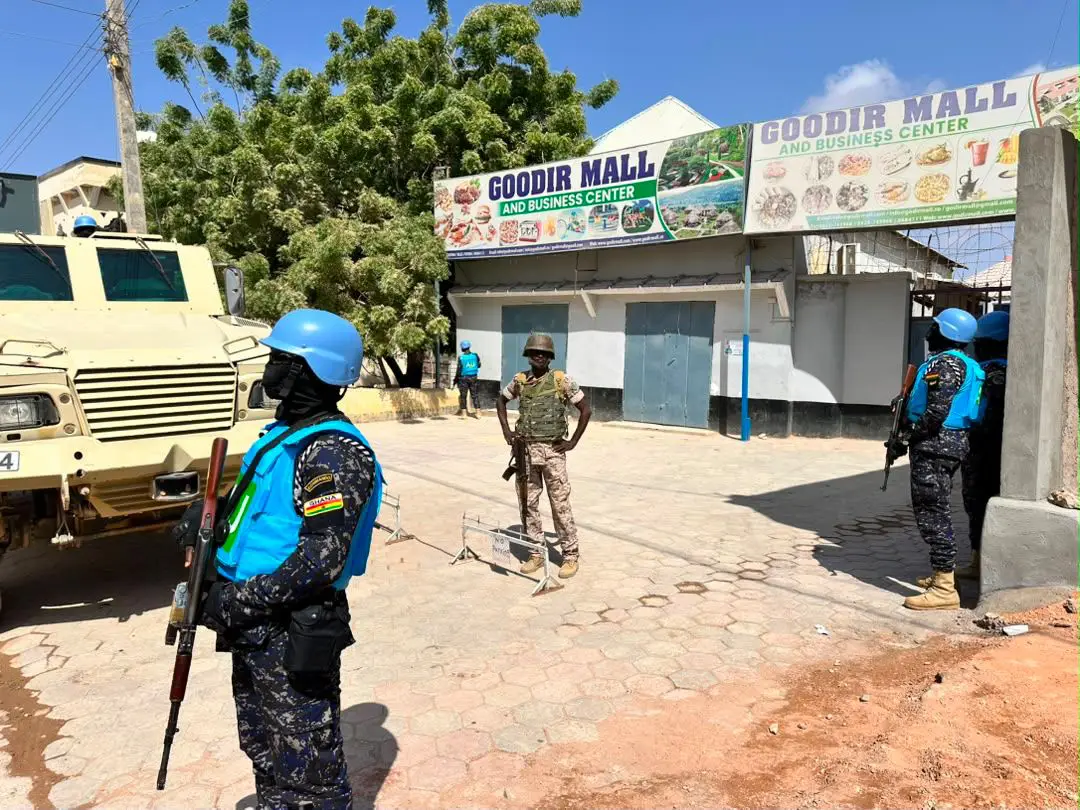
Experts and officials are grappling with the future of African peacekeeping operations amid a new reality of rising terrorism and shrinking international funding.
Financial support and personnel for United Nations peacekeeping operations dropped to a 25-year low in 2025, according to a May report by the Stockholm International Peace Research Institute (SIPRI). The U.N. deployed just 78,633 peacekeepers as of December 2025, which is 49% less than in 2016, and the lowest level since at least 2000. The numbers have been declining throughout the past decade, but 2025 saw the sharpest year-on-year drop at 17%.
“If things continue in this way, we could see a dramatic weakening of multilateral conflict management and the near-complete sidelining of institutions like the United Nations, due to a perfect storm of funding, political, and geopolitical factors,” Jaïr van der Lijn, director of the SIPRI peace operations and conflict management program, said in a statement.
“The result is likely to be more conflicts, and these conflicts are likely to have even graver impacts on civilians as states abandon long-established norms.”
Unlike U.N. peacekeeping, there are no automatic funding mechanisms for African Union missions, which rely on ad hoc donor support. Over several years, the AU has built up a $400 million Peace Fund, but it has disbursed only a few million dollars for early response and mediation support.
Jakkie Cilliers, founder of the South Africa-based Institute for Security Studies, warned that international budget cuts are likely to push Africa toward more fragmented and bilateral security arrangements. But, he said, now is the time for African countries to take greater ownership of their security future.
“Responsibility for Africa’s security rests first with national governments, not other countries,” he wrote in a June article. “And although structural drivers of conflict must be considered, poor governance is the central source of violence and instability in Africa. More effective and developmental governance is essential for long-term peace. The challenge is how to first stabilise violence-torn countries to enable better governance to take root.”
Amani Africa, an independent think tank based in Addis Ababa, is dedicated to researching and analyzing the AU with a focus on the Peace and Security Council (PSC), its policies, and processes. For years, Amani Africa has maintained that counterterrorism failures have been a result of misdiagnosing the root causes and responding with military-led operations.
“Conflicts on the continent have become increasingly complex, often rooted in political contestation, governance crises, and deep-seated socio-economic challenges that do not lend themselves to purely military solutions,” according to an Amani Africa report in April on the eve of the PSC’s 1,341st meeting, an open session on peace support operations (PSOs).
The council and session participants discussed operational challenges such as logistics, financial constraints, and the need for predictable and sustainable funding for AU-led missions. El-Ghassim Wane, former U.N. assistant secretary-general for peacekeeping, said reduced financial contributions have forced deep cuts in the U.N.’s current missions and now require the AU to adapt.
“AU Member States have been unable or unwilling to mobilize the level of resources needed to sustain peace operations, especially large-scale missions,” he said at the PSC session in April. “At the same time, U.N. support has fallen short of expectations.”
He went on to conclude: “The AU should prioritize smaller, targeted, time-bound operations aligned with its financial capacity and the current global fiscal environment.”
Cilliers similarly called for governments to tailor their security structures and budgets to address existing challenges.
“Defining the purpose of the military to defend against external, conventional attack is often ill-suited to African realities, where many of the most pressing threats are domestic,” he wrote. “The result is that training and the purchase of high-end military equipment, such as fighter jets, are often a waste of resources compared to the need to acquire helicopters and train for support to the police, rural safety and counter-insurgency.”
The U.N. has not deployed a new mission on the continent since 2015, and the AU has not done so since its missions to the Central African Republic and Mali in 2013.
“This is not due to a lack of situations requiring PSOs, but rather reflects the fact that the AU has become significantly behind the curve in mobilising timely engagement in situations directly implicating its peace and security mandate and the timely consensus and support required for deploying under its command, as well as in adapting to the evolving security threats on the continent,” according to the Amani Africa report.
Although responses to security crises in Africa increasingly are shifting away from previously established norms and frameworks of multilateral peace operations, SIPRI researcher Claudia Pfeifer Cruz insisted that the future doesn’t have to be dominated by unilateral and bilateral military-only arrangements.
“The collapse of multilateral conflict management is not inevitable. There is evidently widespread support for U.N. peace operations in principle,” she said. “However, to sustain multilateral conflict management, states will need to go beyond expressions of support — they will need to provide predictable funding and create enough political space to enable effective multilateral responses.”