

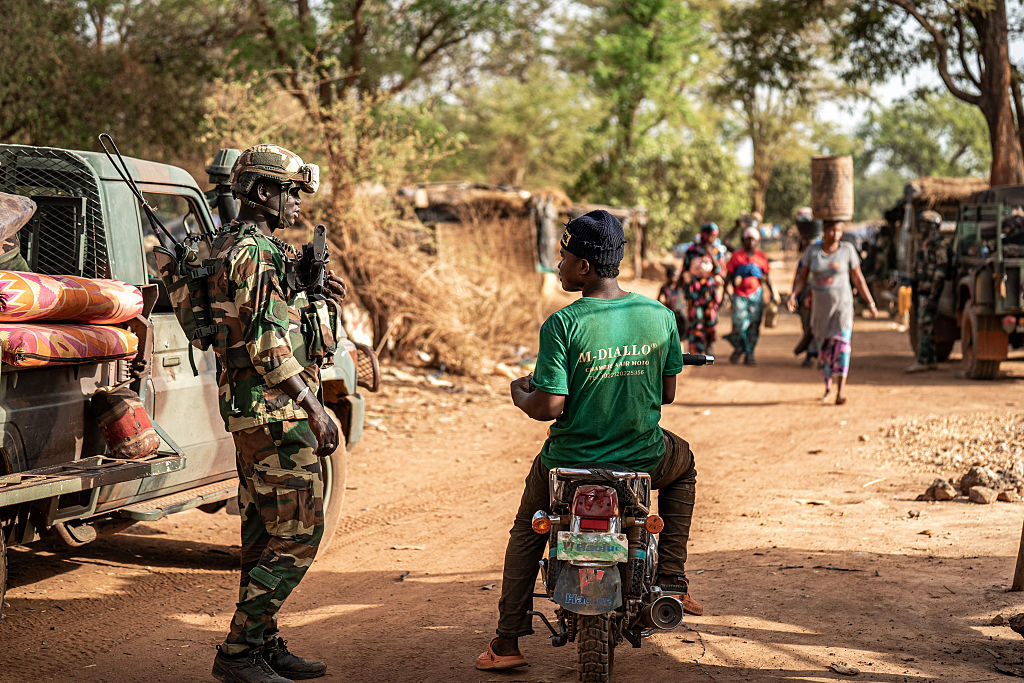
When terrorists attacked fuel tankers in the town of Diboli in 2025, just steps from Mali’s western border, the long-feared spillover of Sahelian violence appeared to be at Senegal’s doorstep.
The country’s national gendarmerie responded in April 2026 by dispatching three new rapid surveillance and intervention units in the Kédougou and Tambacounda regions that border Mali. But experts agree that nonmilitary approaches also are needed to bolster the resilience of border communities.
Boucar Baba Ndiaye spent more than a decade in community peace-building initiatives in the restive Casamance area in southern Senegal. The former country coordinator for the Justice and Security Dialogue in Senegal believes that his country can lean on its successes in Casamance as a blueprint for building trust in its eastern borderlands.
“This is not a question of reacting to an insurgency that has already taken root, but preventing one from emerging in the first place,” he wrote in an April 21 analysis for the Africa Center for Strategic Studies. “Senegal’s experience in Casamance offers instructive lessons for how trust-based engagement between communities and security forces can help contain emerging risks.”
One of Africa’s longest-running armed conflicts, the Casamance insurgency dates to 1982. Separated from the rest of Senegal by The Gambia, residents in the culturally distinct region have long complained of being neglected by government services and missing out on economic growth, leading some to support an armed separatist insurgency led by the Mouvement des forces démocratiques de Casamance (MFDC).
As part of Senegal’s political and security reform efforts there, Ndiaye in 2019 helped launch Justice and Security Dialogue forums, a conflict-resolution initiative designed to build cohesion between local communities and state security forces.
“[A] shift became evident within a few months of the initial dialogue sessions and reflected a growing sense of shared responsibility for local security,” he wrote. “As confidence improved, communities became more willing to engage proactively with security forces, providing information that helped prevent incidents rather than merely respond to them.”
A 2022 accord and a February 2025 peace agreement between the government and the principal MFDC faction introduced amnesty and reintegration measures and brought a tangible sense of de-escalation.
“Although not all factions have signed on, these developments — alongside sustained stabilization efforts — have significantly reduced insecurity across much of the region,” Ndiaye wrote.
Susanna Eusebi, a Dakar-based associate analyst at security and strategic intelligence firm Control Risks, said militant groups remain a dire threat to radicalize and recruit Senegalese people in communities around the border with Mali.
“Islamist militant groups are likely to be motivated to expand their presence in Senegal as part of a broader strategy to secure logistical access to the Atlantic coast,” she wrote in a September 2025 brief, adding that terrorist groups look to capitalize on persistent socioeconomic grievances in these border regions.
“Should the authorities in the coming months resolve disputes in a way perceived as favouring one group over another, Islamist militant groups could capitalise on feelings of injustice and abandonment to fuel recruitment, spread their ideology, and build momentum in these vulnerable areas.”
Dr. Bakary Sambe, president of the Dakar-based Timbuktu Institute, said engaging in dialogue and raising awareness about the threat of Jama’at Nusrat al-Islam wal-Muslimin (JNIM) in Senegalese borderlands are critical.
“The government should partner with religious leaders, traditional chiefs and local authorities to conduct campaigns that highlight JNIM’s violent tactics and intolerance, contrasting them with Senegal’s values of tolerance and cohesion,” he wrote in a 2025 article. “Traditional chiefs and reformist actors can play a pivotal role. Training these leaders in communication strategies will amplify the government’s legitimacy and reach, fostering a collective community response to JNIM’s infiltration attempts.”