
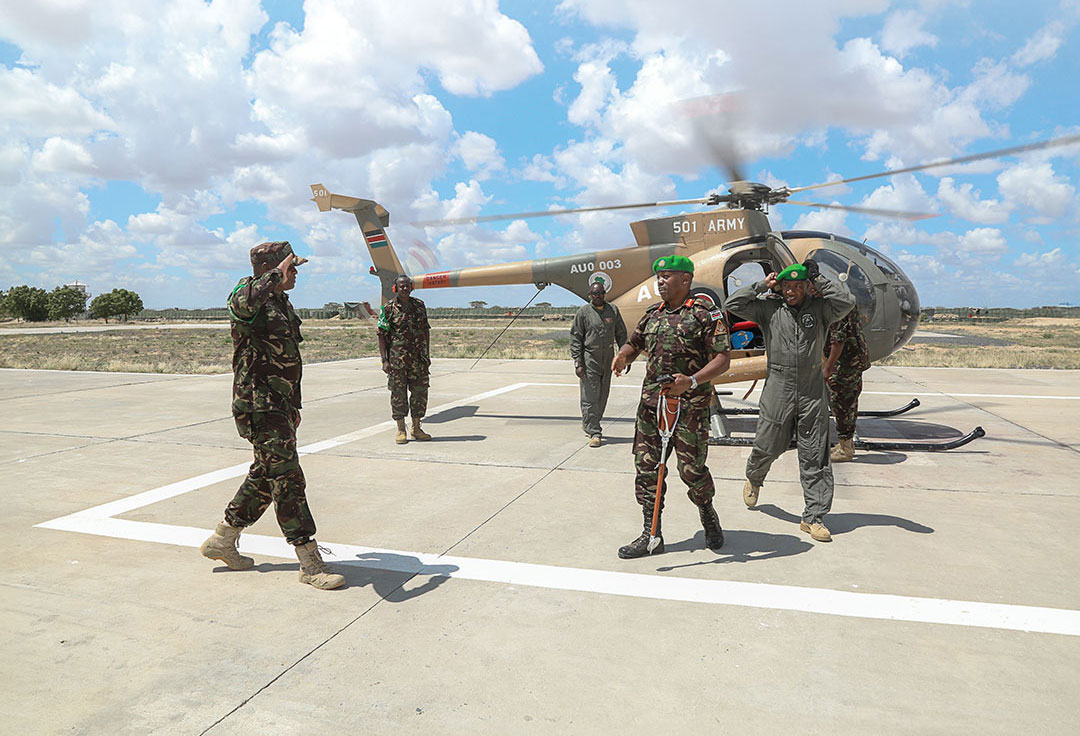
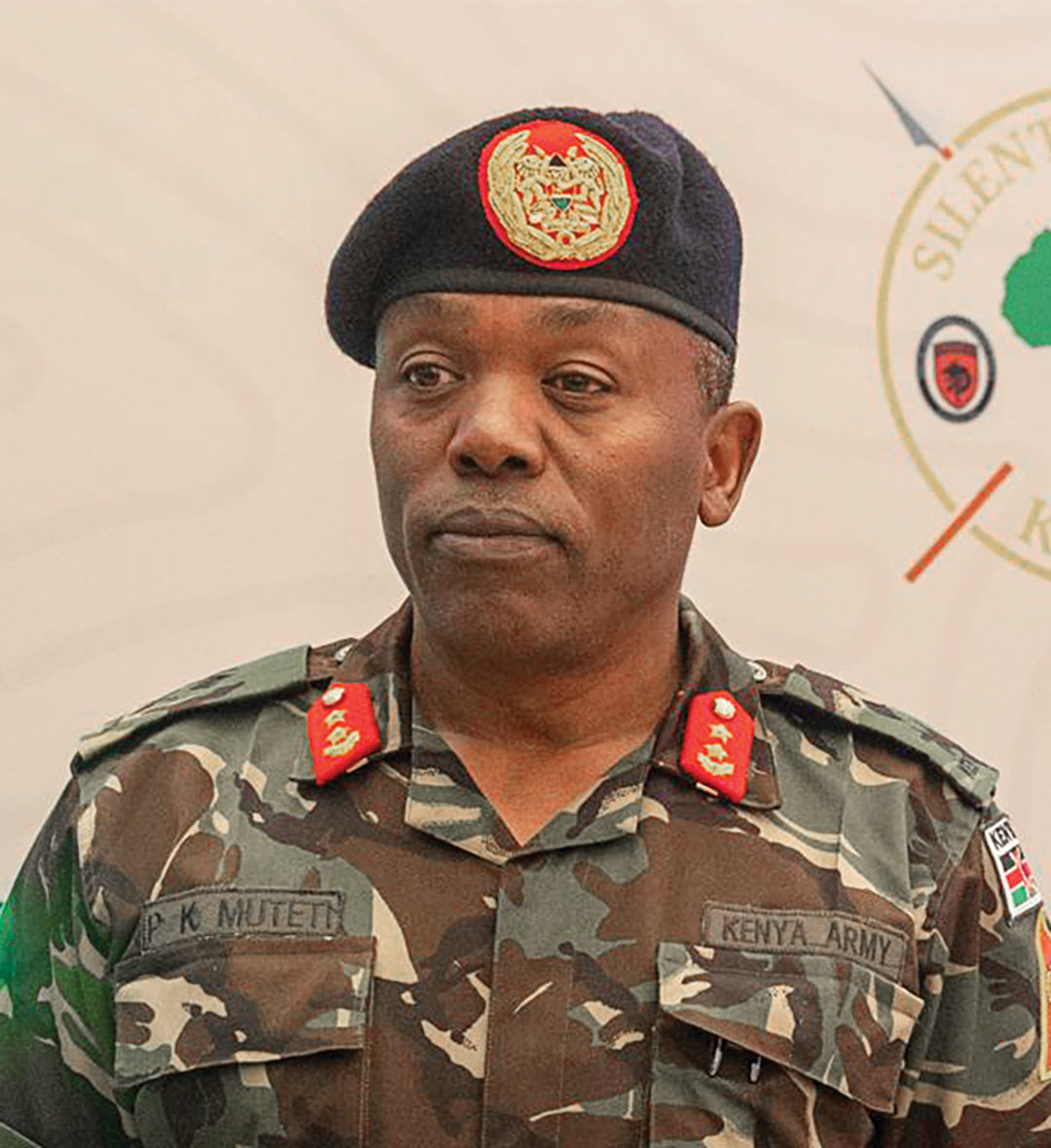
Maj. Gen. Peter Muteti was named deputy force commander in charge of support and logistics for the African Union Transition Mission in Somalia (ATMIS) in 2023 and held the same position in the AU Support and Stabilization Mission in Somalia (AUSSOM) until December 2025. During a 39-year career in the Kenya Defence Forces he has served in leadership roles including as assistant chief of defence forces responsible for force development, operational effectiveness and policy development. After being commissioned in the Infantry Corps in 1988, he held command appointments and was deployed to security hot spots in Kenya’s northern, northeastern and coastal regions. He served in peacekeeping missions in Sierra Leone and Namibia and has received awards that include the Chief of the Burning Spear Presidential Award for service to the nation. He plans to retire from active duty in 2026. He spoke to ADF during Silent Warrior 2025, a security symposium in Nairobi. This interview has been edited for length and clarity.
ADF: What has your time at AUSSOM taught you about the importance of interoperability among troop contributing countries (TCCs)?
Muteti: You cannot underestimate the value of interoperability. All the TCCs and the contingents come from different cultures, they are trained in different doctrinal underpinnings, and language can also be a barrier. The ultimate goal is delivering on the mission mandate and ensuring the success of the mission to enable the Somali Defense Force to assume its security responsibility. Operating among TCCs, really, what I have learned is you need a lot of patience, and unity is strength. Every one of the TCCs has their own uniqueness in terms of their background and culture, the way they live, and their national strategic interests, but at the end of the day I have realized that the biggest advantage we have is that most of the contingents operate independently within their own sector, and the communication occurs between themselves and the headquarters. In terms of integrating for joint operations with Somalis, there always has been a requirement for interpreters to know exactly how they operate. Their way of operation is different than the conventional mode that we have all been taught, so it requires an effort to ensure there is joint planning and everyone understands whether you speak in French, Amharic, English or Somali. It takes time to achieve joint operations effectiveness. Without that interoperability, it can be an issue.
ADF: You have said Somalia’s Danab Special Operations Forces play an important role in counterterror operations. How have you seen them develop during your time in Somalia?
Muteti: I have now served in Somalia for three years, which is a little longer than any senior leader in our particular mission. During my time, I have witnessed a lot of operations conducted by the Somali Defense Force. The Danabs are quite a special force among the other elements of the Somali military. They are trained, mentored, supported logistically and also are supported in terms of intelligence sharing by the Americans. That is why the Danabs have become quite an elite force. They have operated as part of the Somali Defense Force and became so critical and vital in offensive operations that it became necessary for every operation to include an element of the Danabs. The only issue is that the Danab brigade comprises only 2,000 people, which is small compared to what needs to be done to defeat al-Shabaab. Even if they were deployed all over the country, they would be spread so thinly that their effectiveness would diminish. But they have done quite a lot in terms of shaping operations and assisting in the liberation of territories.
ADF: The traditional counterinsurgency strategy is “clear, hold and build.” You have mentioned that Somali forces have been able to clear al-Shabaab terrorists from certain regions, but the process of holding territory and building has been a challenge. What do you think is needed to complete this process and defeat al-Shabaab?
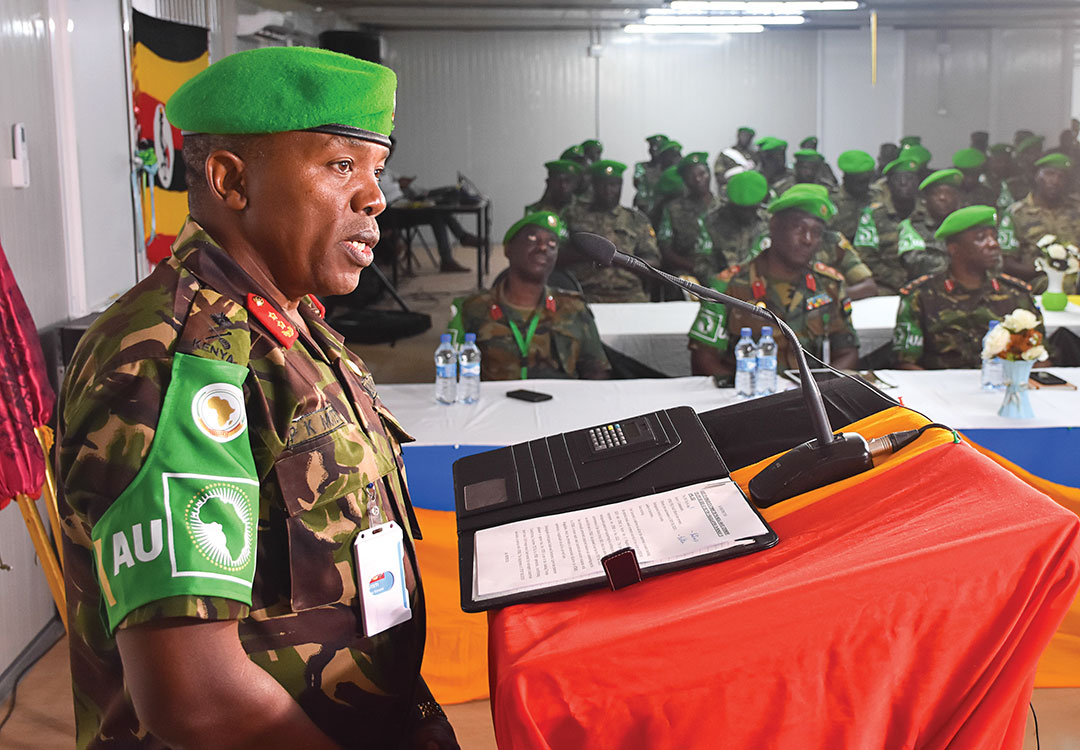
Muteti: Somalis have a culture of offensive operations. They are mobile. But once they do that, you find that they do not have the forces to hold territory and build. The build part is not Somali led; it requires support from international partners. But before the building can occur, there must be the clear and hold. And the hold element has been difficult. They have conducted offensive operations, but then they have not unlocked the potential that there could be within their communities, within their community defense forces and the forces that belong to the federal member states. It might not be a requirement immediately for the Somali Defense Force to be large enough to conduct offensive operations as well as hold territory and so on. But there are many different forces in Somalia, and at the end of the day, what they might want to do is integrate them to ensure that they unlock that potential. If this happens, the clans can look beyond their militias and be able to cooperate and synergize with other forces so that they are able to hold territory once the offensive is done.
ADF: How can Somalia, AU and other international partners work to dismantle the networks that fund al-Shabaab?
Muteti: I think that one of the things that the federal government has done, to their credit, is to embrace a whole-of-government, multidimensional approach. Al-Shabaab can’t be defeated only by military means. And I think that has been highlighted in most of the United Nations Security Council resolutions. They recognize the need to use other means, be they political, economic or diplomatic. There is a lot of effort by the international partners, and there is close collaboration. Recently, they enacted legislation to freeze all funding to al-Shabaab. I do not know how effective it has been, but at least there is an effort to freeze the funding. If that has an impact, then at least we can isolate what is coming from without and, inside Somalia, use joint operations to limit al-Shabaab from collecting taxes. A good proportion of al-Shabaab’s revenue comes from the taxes they are collecting either on the highways or levying on communities.
ADF: How close are the Somali National Army and other Somali security forces to being ready to take over full security responsibilities and allow for the departure of AUSSOM?
Muteti: The timeline for AUSSOM is from 2025 to 2029, so that gives the timeline during which the Somalis should be able to develop their own capability to assume security responsibility. I know politically they have made strides and are engaging international partners, regional partners — they are active in every forum. Security-wise, it’s all about implementing the Somali Security Development Plan, which includes steps for force generation and support from international partners. At the end of the day, it is Somalia’s ambition to generate troops and ensure that they can assume security responsibility by 2029 or even earlier.
ADF: Outside Somalia, there are a number of stubborn insurgencies in places such as the Sahel, Lake Chad Basin and Mozambique. What do you think is needed to end these insurgencies? Is more regional cooperation required?
Muteti: There are hot spots here and there. I believe all these insurgencies have their root causes. We must understand what they are, because many of the insurgent groups have political ambitions and, in those cases, they can only be terminated at the table through dialogue. We have to ensure that, on a regional level, there is more political commitment and dialogue. Just like al-Shabaab cannot be defeated only through military means, the same is true in the Lake Chad Basin, the Sahel and Mozambique.
ADF: You have had a career of service to your nation and to the broader continent in peacekeeping missions and other key roles. As you look back, what do you hope you accomplished during your career?
Muteti: When I joined, my oath was to the defense of our republic. That has driven my service over 39 years. Kenya is still secure, at least from external sources. We might not be so secure from terrorism because it is transboundary in nature, and it remains one of the pressing threats. As I look back, I find that yes, my contribution to the nation was not in vain. I have deployed variously and contributed to the development of leadership capabilities as a trainer and as a commander who developed the capabilities for troops to go out and prosecute operations. I have been out there as a peacekeeper, and I am proud to be associated with the peace in Sierra Leone. I also took part in the mission in Namibia, and I am happy today when I meet officers from Namibia and they look back and say, “We are thankful for Kenya having contributed.” I am proud to see Kenya where it is in terms of security, and I am proud of what I may have contributed in Africa and the world.
ADF: What are the greatest security challenges still facing Kenya and the East African region, and what are your hopes for how these can be overcome?
Muteti: Security is the bedrock of socioeconomic development. Without security you cannot really be talking about the strides you want to make in terms of economic growth and development. So, when I look at the region, I know it is troubled, particularly the Horn of Africa and Sudan. Broadly speaking, most of the problems appear to be related to democratic development. Kenya has made some strides in terms of democracy. We are able to accommodate each other, and the constitution is the country’s foundation. I would wish to see a region that is stable because the world is not going to wait for us as we continue to have insecurities and so on. I wish to see a region that is safe to live in, that is at peace with itself, that is competitive with the international world. That is the aspiration that future generations will be judging the current generation on. They will ask, “What did you do?” and “How did you prepare for the future?” So, when I look at the region, I would wish to see a stable Somalia, a stable Ethiopia, a stable Sudan, a stable South Sudan and a stable Kenya that can collaborate in socioeconomic development issues.