

China has refused to sign an agreement meant to improve efforts to combat illegal, unreported and unregulated (IUU) fishing. Beijing commands the world’s largest distant-water fishing fleet and is the world’s worst illegal fishing offender, according to the IUU Fishing Risk Index.
Seven African countries — Cameroon, the Gambia, Ghana, Guinea, Liberia, the Republic of the Congo and Somalia — signed the Mombasa Declaration during the 11th Our Ocean Conference in Kenya in June. Belgium, Chile, the Dominican Republic, France, Panama, Papua New Guinea, Peru and South Korea also signed.
The agreement supports the Global Charter for Fisheries Transparency, which aims to improve governance by modernizing digital vessel registries, publishing fishing licenses, authorizations, access agreements and quota allocations. It is also meant to ensure that all industrial fishing vessels have unique vessel identifiers and collect information on the beneficial owners of vessels and fishing companies to target and hold accountable illegal fishing violators.
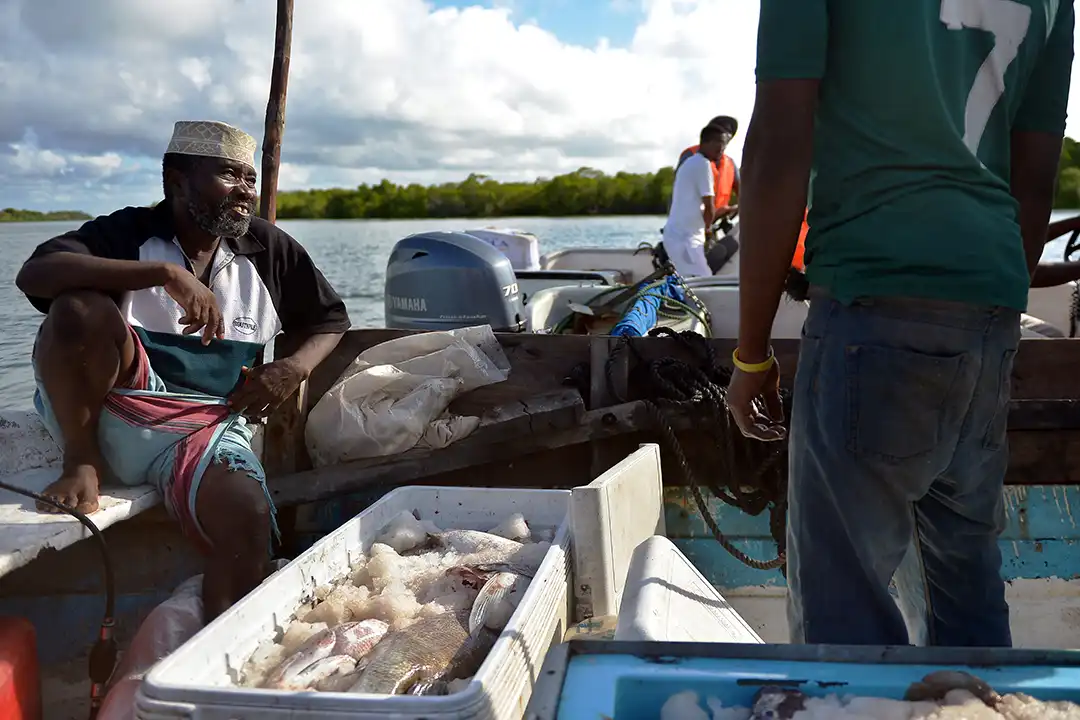
“In my country, our very existence depends on fish,” Emelia Arthur, Ghana’s fisheries minister, said in a report by The Associated Press (AP). “Over 60% of our animal protein comes from fish, and 10% of our population depends on the fisheries value chain for livelihood.”
Arthur added that the Mombasa agreement offers governments ways to “fight together for transparency in the fisheries sector.”
The conference was marred by claims that Taiwanese representatives were not allowed to attend due to Chinese pressure on Kenya. Although Taiwan is self-ruled, Beijing claims it as its own territory. China prohibits its diplomatic partners from maintaining formal ties with Taiwan and holds considerable leverage over Kenya, particularly regarding debt related to the Chinese-built Standard Gauge Railway.
Kenya spends more than $1 billion per year to service its railway debt to China. Kenya’s largest external debt holder is China Exim Bank, to which it owes $741 million in principal, $222 million in interest and $41 million in penalties for the 2025-2026 budget year, Kenyan Auditor-General Nancy Gathungu revealed in a 2025 report.
Chinese vessels have operated illegally in African waters for decades. Due mainly to illegal Chinese overfishing, West Africa, alone, loses up to an estimated $9.4 billion to illegal fishing annually and is considered the world’s hot spot for IUU fishing. Between 2015 and 2021, Kenya, Madagascar, Mozambique, South Africa and Tanzania lost up to $142.8 million annually due to illegal shrimp and tuna fishing, according to the World Wildlife Fund.
Chinese vessels commit myriad fishing violations, including bottom trawling, which involves dragging a net along the sea floor, indiscriminately scooping up all manner of marine life. This kills juvenile fish, leading to declining fish stocks and destroys ecosystems.
Beijing’s vessels also commonly fish illegally in countries’ exclusive economic zones and abuse local rules to enter African fishing registries under local flags. This is known as “flagging in,” or flying a “flag of convenience.” It helps a vessel’s owners dodge financial charges and other regulations. These are all violations the Mombasa Declaration is meant to combat.
The countries that signed the declaration are expected to begin implementing their commitments immediately and more governments are expected to sign the agreement, according to the AP. Catherine Chabaud, French minister delegate for the sea and fisheries, said international cooperation is essential in the fight against illegal fishing.
“Limited transparency in vessel ownership, tracking, and fishing activity and supply chains allow these illegal practices to thrive, making stronger access to reliable fisheries data and accountability mechanisms essential to protecting marine ecosystems and the communities that depend on them,” Chabaud said in an AP report.
Environmental groups lauded the effort. Tony Long, chief executive officer of Global Fishing Watch, said illegal fishing has continued due to weak oversight.
“For too long, illegal fishing has thrived in the dark,” Long said in a report by Namibian news outlet New Era Live. “When governments commit to transparency, they create an interconnected network where bad actors have nowhere left to hide.”