

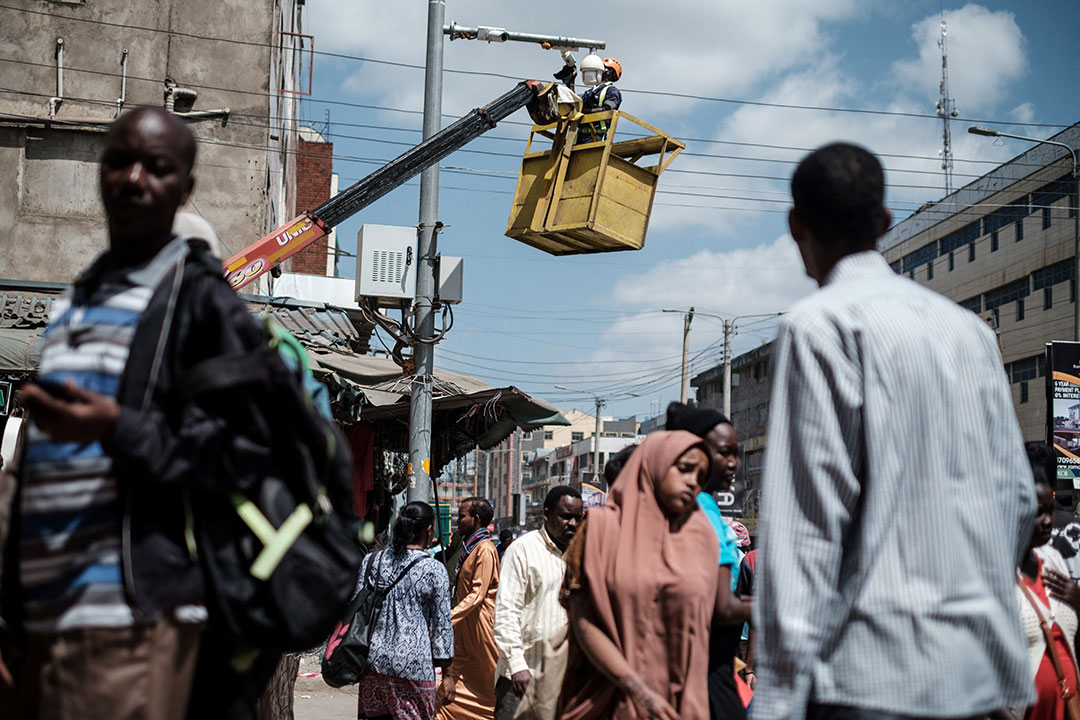
China is exporting surveillance technology to African countries that experts say is designed to monitor and control populations with little or no oversight or concern for privacy, personal security and human rights.
The Institute of Development Studies (IDS) looked at 11 African countries that have deployed thousands of Chinese cameras in public spaces and concluded that the technology poses significant risks to freedom and facilitates digital authoritarianism.
Tony Roberts, a digital research fellow at the institute, and Wairagala Wakabi, executive director of the Collaboration on International ICT Policy for East and Southern Africa in Uganda, led the team that published its findings on March 12. Their research indicates that African countries have deployed Chinese surveillance systems primarily to monitor activists and stifle political opposition rather than reduce crime.
“Studying only 11 African countries, researchers have already identified nearly $2 billion in surveillance-related contracts,” Roberts told Jeune Afrique for a May 28 article. “Across the continent, this market could reach $10 billion.”
Roberts said his group’s research revealed major ethical concerns in those 11 countries: Algeria, Egypt, Kenya, Mauritius, Mozambique, Nigeria, Rwanda, Senegal, Uganda, Zambia and Zimbabwe.
“These projects are systematically presented as serving the public interest — fighting crime, easing traffic congestion — but in no country have we observed any effort to measure their effectiveness,” he said.
Typical purchases in Africa have included between 2,000 and 5,000 smart cameras, the report stated. Artificial intelligence lets them target and monitor people from a command center, where huge, centralized data networks merge, something Chinese tech companies such as Huawei and ZTE refer to as a “city brain.”
Using facial-recognition software, AI can cross-reference camera footage instantly with databases such as identity registers, administrative files, driver’s licenses and telephone records. Experts warn that these digital nervous systems can constantly watch, aggregate and analyze citizen activity to predict, prevent and punish behaviors that authorities deem suspicious.
However, the IDS report said that all 11 countries it studied “currently fail to provide adequate mechanisms for citizens to obtain remedy or redress in case of smart surveillance errors or abuse.”
Bulelani Jili, a digital expert at Georgetown University who has researched China’s technology exports to African countries, said sprawling surveillance systems are just part of China’s suite of high-tech tools. China has dominated this sector on the continent since 2015 when it launched the Digital Silk Road, an extension of the Belt and Road Initiative.
“Chinese infrastructure is more geared towards monitoring urban spaces,” Jili told Jeune Afrique. “China is not just selling cameras: it offers complete packages combining loans, infrastructure, training and technical assistance.”
Experts say China’s systems are particularly attractive to African governments facing budget shortfalls. Private Chinese banks provide the funding to build and maintain their proprietary digital infrastructure, the IDS study said.
With more than $470 million invested, Nigeria has spent the most on Chinese surveillance tech and has the largest network of smart cameras among the 11 countries, the report stated. Guinea’s transitional council signed the latest agreement on March 13 for $56 million.
“These huge loans are conditional on the purchase of Chinese technology and services needed to build and transfer the ‘safe city’ systems,” the authors wrote.
The researchers highlighted an example in the Republic of the Congo, where surveillance cameras havespread throughout high-traffic public spaces in Brazzaville and Pointe-Noire. Against a backdrop of increased monitoring, the researchers noted several arrests of political opposition figures, journalists and human rights activists.
Marina Rudyak, a professor of Chinese foreign policy at Heidelberg University in Germany, said the proliferation of Chinese surveillance technology on the continent has sparked intense debates about ethical boundaries and citizen rights. But she warned that Chinese propaganda is carefully deployed to control narratives and stifle such dialogues.
“The Chinese government does not present these technologies as authoritarian tools, but as instruments of stability, security and development,” she told Jeune Afrique. “They fit within a model in which stability depends on controlling public space and the absence of social dissent.”