

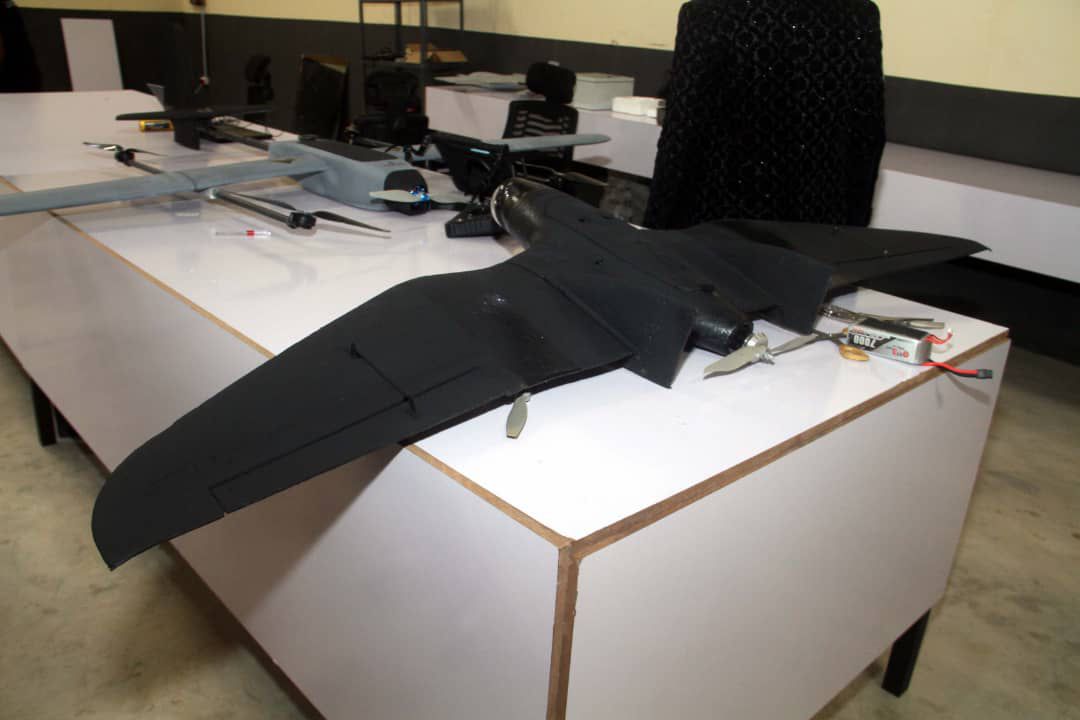
Nathan Nwachuku’s vision of Pax Africana is front and center on his company’s website: “Bringing lasting peace to the continent through African security sovereignty, a future in which Africa builds, deploys and controls its own defense technology.”
The 23-year-old Nigerian is CEO of Abuja-based startup Terra Industries, which signed a joint venture agreement in February with Nigeria’s state-run military-industrial corporation Defence Industries Corp. of Nigeria (DICON) to research and develop drones, robotics and cybersecurity systems.
After years of buying drones from China, Pakistan and Türkiye, Nigeria’s military has turned its attention inward, exemplifying a trend across the continent of governments investing in indigenous manufacturing. Costs and delays in acquiring and maintaining drones have only strengthened the case for local production.
Between 1980 and 2026, 34 countries procured 1,959 drones, according to 234 purchase records compiled by defense website Military Africa. More than half — 1,054 of the 1,959 — were acquired between 2020 and 2026. Today, nine African countries are manufacturing drones domestically with South Africa, Nigeria, Algeria and Ethiopia leading the way.
Moses Wambui, CEO of Kenyan research and consulting firm Insight Strategists Solutions Africa, said the continent’s nascent drone market has shifted from agriculture and healthcare to serving military combat and intelligence needs.
“The penetration rate of drones in Africa is around 14% of the whole drone market in the world,” he told Lagos-based News Central TV in a December 2025 broadcast. “The initial cost becomes an issue. You’re talking about an economy of around $8 billion.”
The proliferation of drones in the hands of armed groups has changed the calculus for African militaries. Cheap commercial drones modified for surveillance or attack roles have forced armies to invest in counterdrone systems, electronic warfare and autonomous ground equipment.
Nigeria is positioning itself as a leading defense manufacturing hub in the region, as government and private companies invest in local production to strengthen security and surveillance capabilities. Lagos-based Elite Logistics & Development Services launched military drone production and assembly in 2023.
More recently, Terra conducted a live demonstration of its interceptor drones and unmanned mine-clearing vehicles for military and government officials on April 27.
“Today is a day that we show our readiness for battlefield operations and actual forward deployment onto the frontlines,” Nwachuku told Reuters news service while standing outside his company’s 1,394-square-meter drone factory.
DICON chief Maj. Gen. Babatunde Alaya said Terra’s attack and surveillance drone systems are designed to aid counterinsurgency operations and fill capability gaps.
“There is no other company that is bringing these [drones] on board for our troops in the field to use for real-life challenges that we are having, for example, with improvised explosive devices that we are having in the northeast, now in the northwest,” he said in a news conference before the demonstration. “The highest casualties that we are sustaining are through improvised explosive devices.”
Terra’s Abuja factory is ramping up to an annual capacity of 30,000 drones, including long-range drones built for surveillance missions, quadcopters for first response and data collection, and small self-driving vehicles for ground surveillance and transport. The company said it exports drone systems to eight African countries.
It also has expanded manufacturing to Ghana with the construction of a 3,159-square-meter factory that Nwachuku says will be the largest on the continent and will be able to produce 50,000 drones a year at full capacity.
“Ghana just makes sense as a country,” he told defense technology website Tectonic for an April 20 article. “It’s one of the safest in Africa right now, and it’s also one of the fastest-growing economies [with a] strong currency, strong manufacturing base, really smart people and a high political will to want to lead the continent in terms of industrial development and sovereign defense.”
Nwachuku said his dream is to help industrialize Africa, but for that to happen, “we must solve the common denominator, which is insecurity.”
“The only way Africa can have lasting peace is by uniting to build sovereign defense, not by relying on foreign security architecture,” he said on Terra’s website. “We need to control our own destiny by building the tools and systems needed to protect ourselves. That’s how this continent defeats terrorism.”