

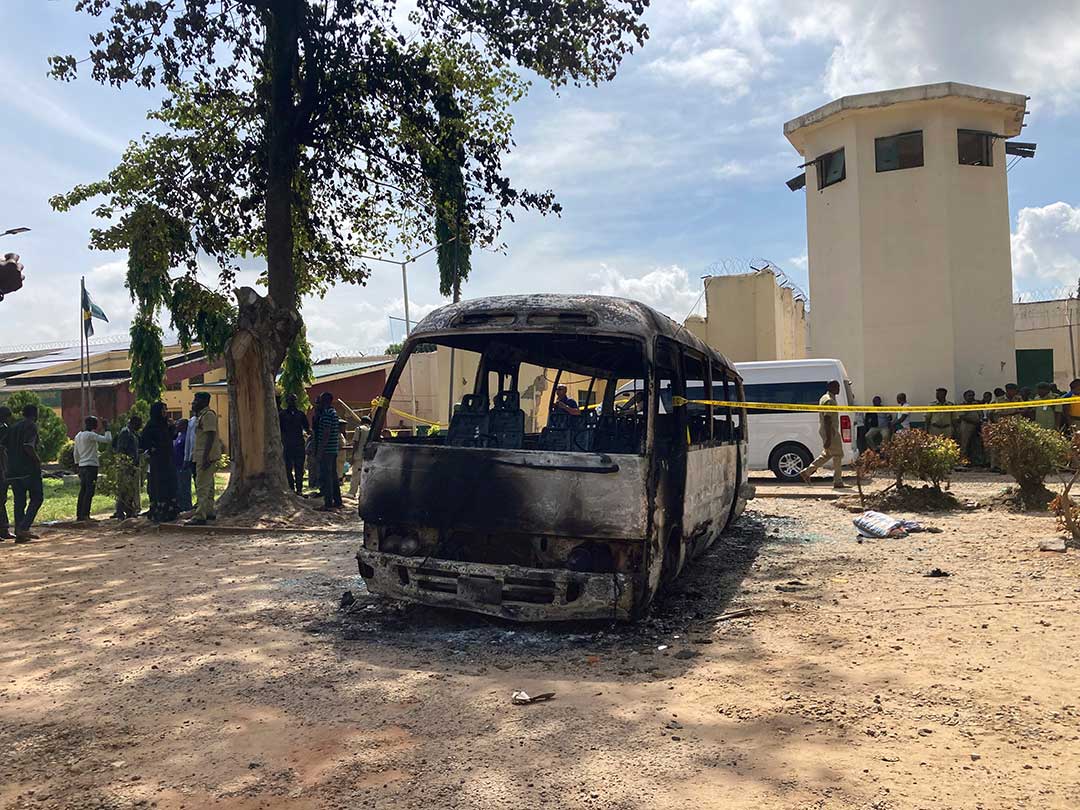
Islamist militants fighting for factions affiliated with al-Qaida and the Islamic State group (IS) are expanding across national borders in several regions and launching sophisticated attacks on state forces and civilians.
According to the Armed Conflict Location and Event Data (ACLED) project, violent IS activity in Africa increased to 86% of the group’s global attacks in the first quarter of 2026, up from yearly totals of 49% in 2024 and 79% in 2025. The continental areas with the highest number of deaths related to Islamist violence in 2025 were the Sahel and coastal West Africa, Somalia, the Lake Chad Basin, the Great Lakes region and Mozambique.
Around the Sahel and coastal West Africa, the al-Qaida-affiliated Jama’at Nusrat al-Islam wal-Muslimin (JNIM) was responsible for many of the 3,029 violent events resulting in 9,975 fatalities last year. JNIM has increasingly targeted urban centers in Burkina Faso and Mali. The Islamic State Sahel Province also operates in the region.
In April, JNIM and the Azawad Liberation Front (FLA) seized the strategic Malian city of Kidal, a severe blow to Malian forces and Russian mercenaries tasked with protecting the city. Days later, JNIM announced a “total siege” and full-scale blockade of Bamako, the national capital.
This will “likely force the Malian military to prioritize securing the capital and deprioritize other areas — further complicating efforts to regain control of the situation at a time when the trajectory of the conflict already appears difficult to reverse,” ACLED analyst Héni Nsaibia wrote on the organization’s website.
In October 2025, JNIM claimed its first known attack in Nigeria, in which it killed a Soldier and seized ammunition in Kwara State near the western border with Benin. The IS has also remained active in the country. In March 2026, the IS Sahel Province, or ISSP, killed 10 Nigerian Soldiers in northwestern Kebbi State. This was the group’s first attack in the country in more than six years, ACLED reported.
In Somalia, al-Shabaab was the perpetrator in many of the 3,545 violent events resulting in 8,813 deaths last year, according to ACLED. This year, the group has increased its presence in the Galgaduud and Mudug regions. The group seeks to reclaim the town of Xarardheere, which it controlled for 15 years until Somali forces freed it in 2023.
In early 2026, al-Shabaab received significant shipments of weapons and ammunitions, including drones, from Yemen’s Houthi rebels.
“This external support enables more sophisticated planning and execution of IED [improvised explosive device] attacks and ground operations,” ACLED researchers wrote in a May 2026 report.
Boko Haram and the Islamic State West Africa Province (ISWAP) were responsible for most of the 1,592 violent events and 4,850 deaths in the Lake Chad Basin last year, the data project reported.
ISWAP has conducted more complex operations since early 2025 and is increasingly using drones to attack military forces. Besides its battlefield capabilities, ISWAP “has the demonstrated ability to administer territory to function, in other words, as a parallel government in the areas it controls,” wrote Mustapha Bature Sallama, a columnist for the Modern Ghana news website.
Boko Haram is a competitive regional rival and has reclaimed Lake Chad territory from ISWAP, often in coordinated amphibious and motorized assaults. On May 4, the group killed 24 Chadian Soldiers and wounded 46 in an attack on a military base on the shores of Lake Chad.
The Allied Democratic Forces, also known as the Islamic State Central Africa Province, committed many of the 1,369 killings in 286 violent events in the Great Lakes region last year, ACLED reported. The group was not known to regularly target security forces directly until the first quarter of 2026, when it attacked military patrols and Soldiers protecting mining sites. The group threatens civilians with mass kidnappings.
IS Mozambique was widely responsible for the 531 deaths resulting from 299 violent events in the country in 2025. The group increasingly targeted civilians last year, particularly in southern Cabo Delgado and Nampula provinces. ACLED researchers predicted that that trend would continue. The group also commits kidnappings and forces mass displacement.