

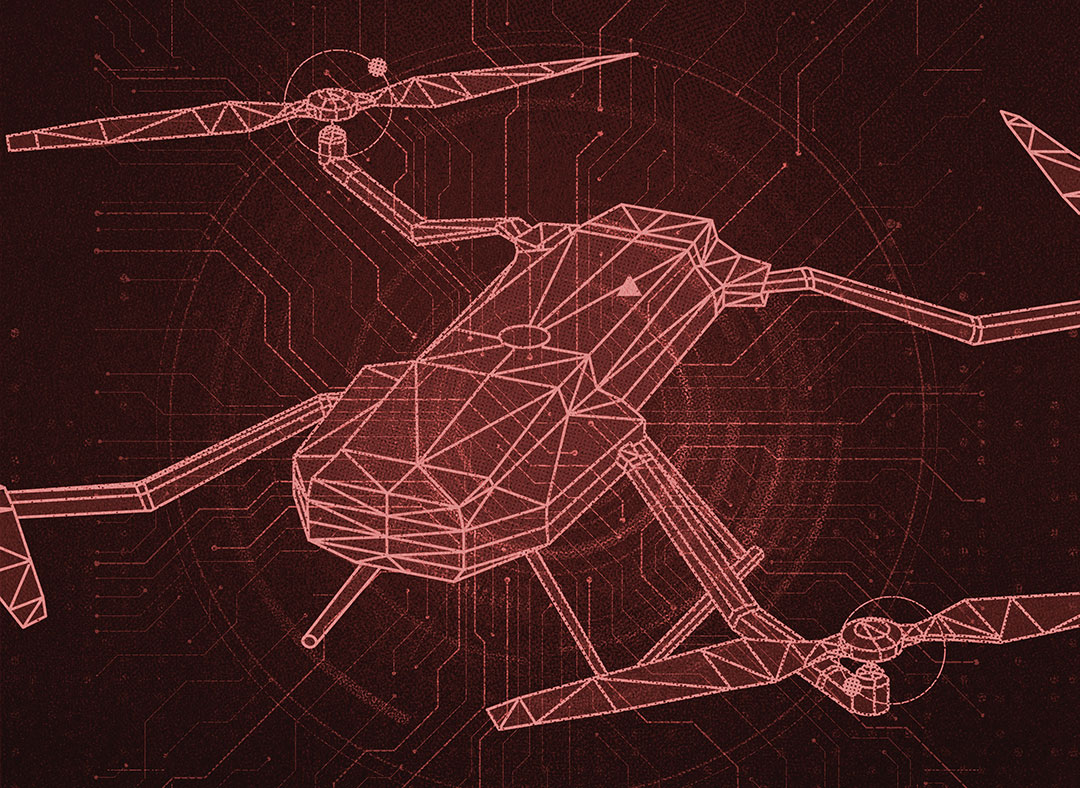
When Islamic State West Africa Province (ISWAP) extremists launched four simultaneous deadly attacks against Nigerian military forces in late October 2025, armed drones played a key role.
The attacks on positions in the communities of Dikwa, Gajibo, Mafa and Katarko killed five Soldiers and burned a military base.
Ultimately, Nigerian Soldiers drove back the attacks, killing 50 ISWAP fighters. However, the assault illustrated how drones have become an integral part of terrorist operations in Africa.
Although African governments have spent millions of dollars buying military-grade drones such as Turkey’s Bayraktar TB2 and Akinci, terrorist groups have spent significantly less on commercially available quadcopter drones that can easily be outfitted with explosives, turning them into flying improvised explosive devices, or IEDs. The quadcopters are being used against government forces in Burkina Faso, Mali, Niger, Nigeria and Somalia. Porous borders and family or ethnic connections across the region encourage the movement of the technology and technical know-how that underpin terrorist drone operations, experts say.
Drone attacks have accelerated rapidly since Jama’at Nusrat al-Islam wal-Muslimin (JNIM) launched its first kamikaze drone attack in 2023. In the interim, JNIM has made kamikaze drone attacks a key part of its battle strategy, launching dozens of them against civilian and military targets in Burkina Faso, Mali and Niger.
Morocco’s Policy Center for the New South reported more than 30 drone attacks in the Sahel between September 2023 and June 2025. The majority of those — 82% — came between March and June of 2025. Among those was a JNIM attack on a Malian military base in Boulikessi that killed more than 100 soldiers.
As terrorist groups increasingly rely on drones for kamikaze-style attacks on ground positions, they’re also able to keep their own fighters out of direct combat with military forces. As a result, the drone-based strategies now taking shape across the Sahel might preview future battles, according to John Sunday Ojo, a research fellow at the Institute of Security and Global Affairs.
“Several recent attacks were successful because of the adoption of drones by ISWAP,” Ojo told ADF. “In that region, we are heading for a kind of environment where land combat will not be able to curtail the war on terror. It will be a kind of remote warfare where the terrorists don’t even need to struggle to achieve their aims.”
A GLOBAL PHENOMENON
Ukrainian troops have led the way in deploying armed and unarmed civilian-style drones against invading Russian forces.
“They’re scrappy in the same way as the people who are building these things in their garages in Ukraine,” analyst Niccola Milnes told ADF. Milnes was a co-author of a study published by the Policy Center for the New South.
As Ukraine uses off-the-shelf drone technology to repel invading Russian forces, groups around the world are watching and may try to replicate their success, Don Rassler with the Combating Terrorism Center at West Point told ADF.
“The Ukraine conflict is a key learning laboratory,” Rassler said.
HOMEGROWN INNOVATIONS
In Somalia, Puntland authorities in 2024 intercepted five weaponized commercial drones sent from Houthi rebels in Yemen to terrorists in Somalia.
Al-Shabaab continues to use drones primarily for reconnaissance, but its rival in the north of the country, Islamic State-Somalia Province, has deployed them in combat against regional forces.
“Islamic State-Somalia is one of the groups people are worried about,” analyst Clara Broekaert at The Soufan Center told ADF. “They have the resources; they’re becoming a hot spot for foreign fighters and they recruit for skills.”

The growing relationship between al-Shabaab and Yemen’s Houthi rebels also is concerning, Rassler said. Houthis have been working to extend the range on their own commercial kamikaze drones.
“The Houthis have been seeking out and experimenting with unique forms of technology, such as hydrogen fuel cells,” he said. “These are warning signs of the places conflicts could go in the Sahel.”
In Mali, JNIM and the Front for the Liberation of Azawad (FLA) appear to be conducting a similar knowledge transfer. In mid-2024, Col. Hussein Ghulam moved from the FLA to JNIM and soon became connected to JNIM’s May 2025 drone strike in Dioura that killed 41 Malian soldiers.
“While it is not possible to confirm direct coordination between the two groups, the timing and geographic overlap suggest potential for knowledge transfer or mutual observation,” Milnes wrote with Rida Lyammouri for the Policy Center for the New South.
JNIM and other African terror groups have received little to no direct help from the core al-Qaida or Islamic State group organizations, which are facing substantial pressure from the governments in their home countries, according to analysts.
“It’s mostly homegrown,” Rassler said of African extremists’ drone innovations. “They don’t need to rely on Islamic State core for much guidance. They just need to go to YouTube or Instagram to mine data about what’s been going on in Ukraine.”
The rapid expansion of artificial intelligence could make it even easier for extremists to weaponize off-the-shelf drones.
“This is where AI changes everything,” Milnes said. “You don’t need to be a tech expert. You use AI to teach you how to use AI.”
In some recent attacks, terrorist groups have deployed AI-powered drones capable of locating and attacking their targets without a human operator. So-called offline drones can’t be jammed or redirected in the way that operator-directed drones can, making them more difficult to counter.
“If these trends continue, further adaptations, such as greater onboard autonomy or expanded coordination, could emerge over time,” Milnes and Lyammouri wrote.
One aspect of drone warfare has, so far, remained out of reach of extremists and militaries: swarms. Experts are concerned about the prospect that JNIM, ISWAP or other terrorist groups could one day launch a huge attack on a community or military outpost using dozens of self-directed, AI-coordinated drones.
“That’s a watch-out area,” Rassler said.
COST OF ASYMMETRY
For all their spending on marquee technology, such as Bayraktar TB2 drones, militaries across the Sahel have no specific operational mechanism to combat drones deployed by terrorist groups, according to Ojo.
“The cost asymmetry for drone warfare is incredibly high,” Broekaert told ADF. “[Governments] are pouring millions into systems that can be easily defeated.”
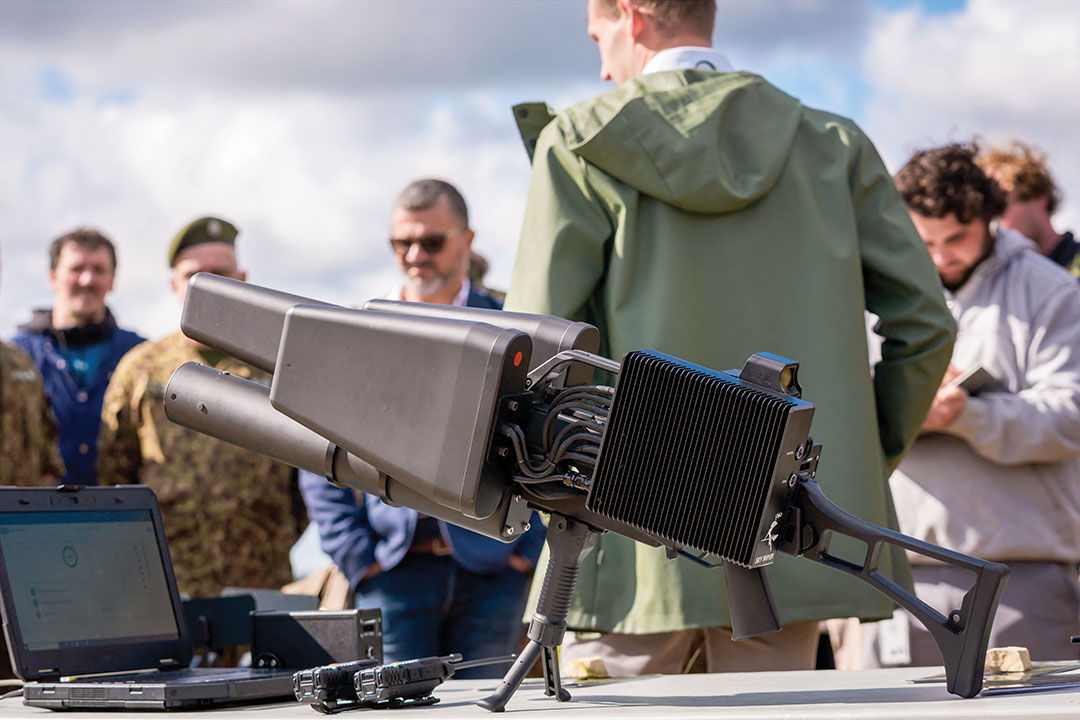
For example, militaries that use jammers such as Lithuania’s EDM4S SkyWiper antidrone system to disrupt the signal between drone and operator can be overcome by extremists using drones powered by offline AI systems.
Jamming technology also can be defeated by deploying drones with lengthy fiber-optic tethers — a technology that has become commonplace in Ukraine but remains untried in the Sahel or Somalia.
“That’s a scary development that we need to continue to watch,” Rassler said.
Ultimately, as terrorist groups step up their drone capabilities, they are outpacing the militaries tasked with reining them in, according to observers. Direct efforts by militaries to disrupt drones on the battlefield or to keep them out of civilian hands have had little effect, leaving militaries on the back foot.
The rapid evolution of technologies such as AI and 3D printing is likely to make it even harder for governments to keep up with terrorists’ drone innovations.
“These groups are running circles around them [militaries] right now with pretty cheap, homegrown, easy-to-modify commercial drones,” Milnes said. “And they’re upscaling pretty quickly.”