


Photos by Minusca
It was a rare moment of joy in the Central African Republic village of Sanguéré-Lim as fighters who once inspired terror stood in line to lay down their weapons.
The combatants from the Retour, Réclamation et Réhabilitation (3R) militia included teenage boys wearing football jerseys and grizzled men in knit caps. Upbeat music boomed on loudspeakers as a man hoisting a grenade launcher stood alongside a teen cupping two handfuls of bullets.
“Today, the armed groups have laid down their weapons and that changed everything,” Adama Yaouba, a resident of the village, told the United Nations. “Before, we never slept peacefully, always on our guard. But now I can sleep peacefully without worry. My children also feel safe and that’s what matters most to me.”
For a country that has been in conflict for more than a decade with 14 armed groups vying for control, the event was a reason to celebrate. It was part of a 2019 peace agreement and the latest achievement in a disarmament, demobilization and reintegration (DDR) process that has helped 5,540 combatants put down their weapons.
“Disarming armed groups promotes the protection of civilians,” said Wilfried Sawadogo of MINUSCA, the U.N. mission in the CAR. “It helps the population live in a secure and peaceful environment, enabling them to carry out economic and social activities.”
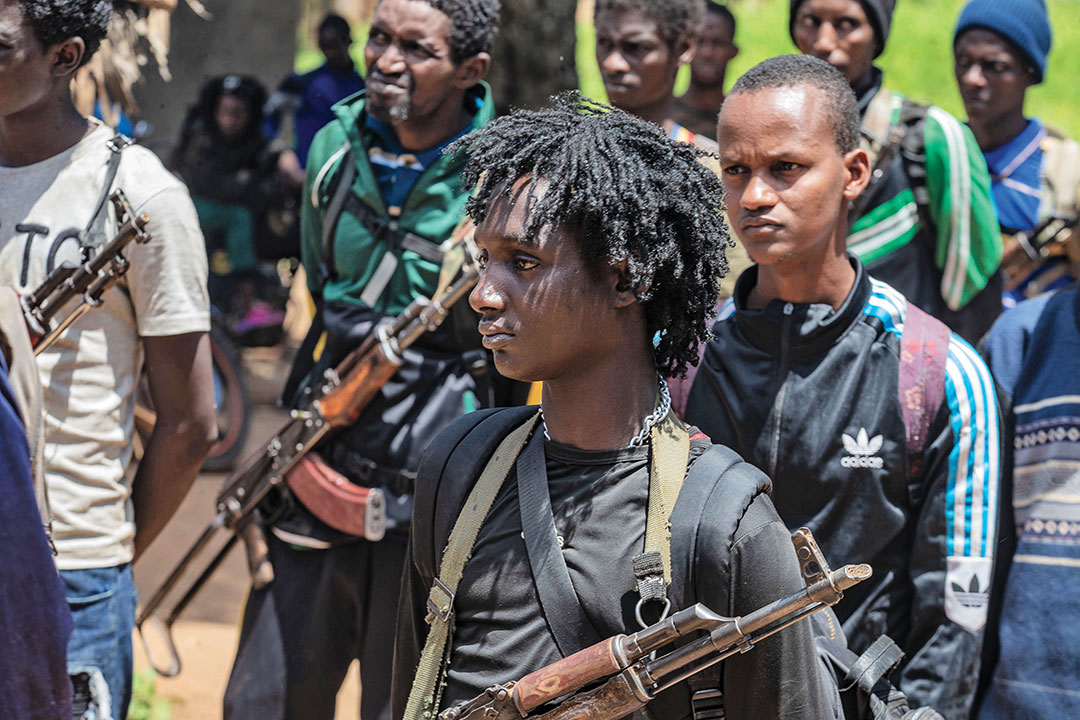
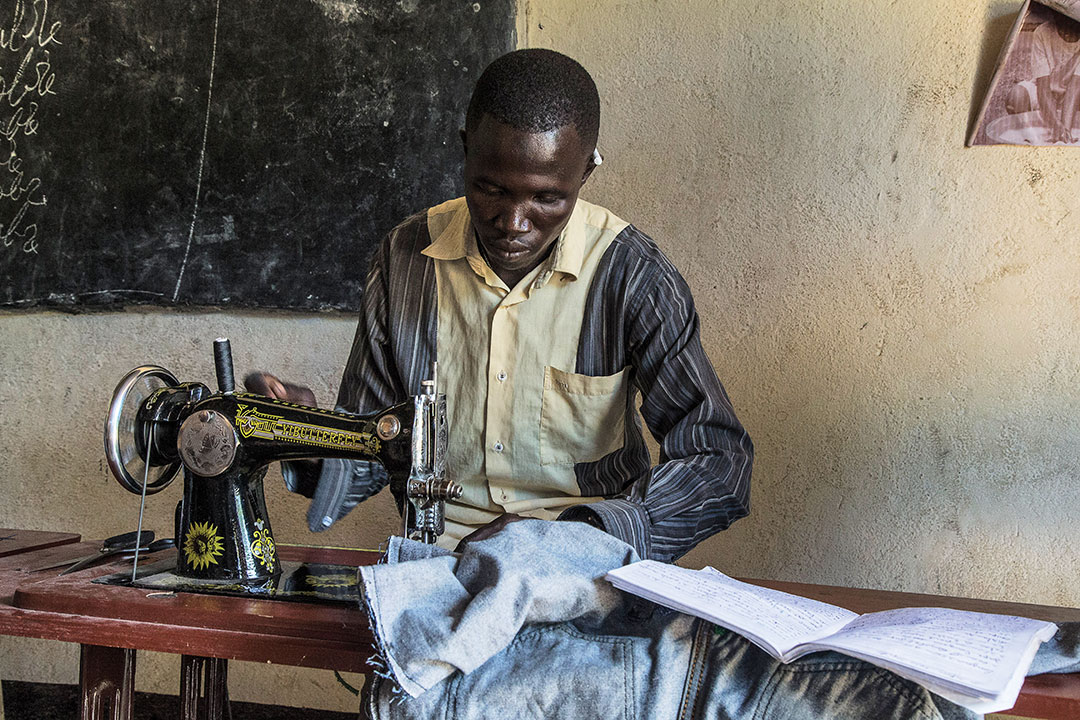
The program implemented by MINUSCA, the CAR government and others offers incentives and job training to fighters willing to return to civilian life. It provides a path to enlist in the armed forces for those who qualify. It helps communities accept ex-fighters returning home and offers counseling to address war’s mental trauma.
As the landscape of conflicts in Africa changes, DDR supporters believe it remains a vital strategy to restore peace. Critics, however, question whether it can succeed in increasingly fractured environments with no peace agreements and a wide variety of combatants operating in territory that crosses borders.
DDR strategies are changing to keep up, and experts know there is more to be done. Dr. Ibrahim Bangura is a DDR practitioner, instructor and researcher at Fourah Bay College, University of Sierra Leone. He is the editor of the book “Disarmament, Demobilisation and Reintegration of Ex-Combatants in Africa.”
“Wars have evolved, and DDR itself has evolved,” Bangura told ADF. “DDR has to be adapted for the context it’s used in. It has to be context-specific, otherwise you miss.”
‘A Lost Generation’
It has been clear for centuries that combatants who have known nothing but war need support and guidance as they return to civilian life. In ancient Rome, demobilized Soldiers were given farmland after leaders saw that many had become aimless and resorted to crime.
The U.N. warns that, without assistance, ex-combatants risk becoming a “lost generation” that is “suffering war trauma, becoming addicted to alcohol and drugs, and dependent on weapons and violence as the only means to make their way in the world.”
This is a key reason why more than half of civil wars that end in a negotiated truce soon return to war.
The Stages of DDR
Disarmament involves the collection, documentation, control and disposal of ammunition, small arms, explosives, light weapons and heavy weapons. It also includes programs for managing, storing and disposing of arms.
Demobilization is the formal and controlled discharge of active combatants from the armed forces or other groups. In its first stage, it might include processing combatants in temporary centers or massing troops in camps, cantonment sites, barracks or assembly areas.
Reinsertion is the short-term transitional assistance of up to one year that is offered to ex-combatants to meet their immediate, basic needs. Once demobilized, fighters often are unable to earn a living while they complete vocational training. Reinsertion could include an allowance, clothes, medical services, food, employment, short-term education and training.
Reintegration is the process by which ex-combatants gain civilian status and begin to sustain themselves through employment. Reintegration is a social process with an open time frame and takes place at the community level. It often requires long-term support.
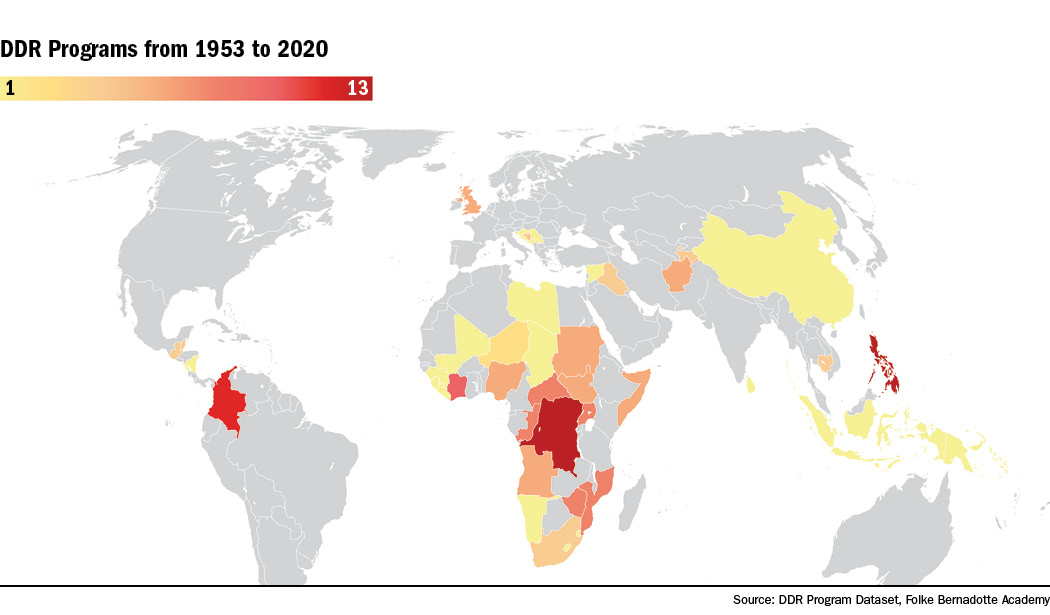
One of the first modern DDR efforts was in Colombia after a 10-year conflict known as La Violencia that ended in 1957. The program was only a limited success –– about 3,500 people were demobilized while some armed groups refused to participate –– but it offered a model that could be replicated.
Between 1953 and 2020 there were 149 DDR programs and processes across 54 nations. Countries used the programs after ceasefires or peace agreements and during active wars. They have tried to disarm militias, paramilitaries, terrorists, ethnically aligned armies and many other groups.
In 2005, the U.N. formalized its approach through an Interagency Working Group on DDR. The program has been a core component of interventions in conflict-plagued regions since then. The U.N. has regularly updated its guidance and now includes second- and third-generation DDR models that expand the scope of the programs to include a wider group of combatants and support to help the broader community accept reintegrated fighters.
Continentwide, two-thirds of countries have implemented DDR programs. There are some success stories. Côte d’Ivoire disarmed and demobilized 69,505 combatants between 2012 and 2015. In Liberia, 101,495 combatants were demobilized from 2003 to 2008. Sierra Leone demobilized 71,043 ex-fighters in three phases stretching from 1998 to 2004.
But the continent also has seen some of DDR’s greatest failures. A decade-long, seven-nation DDR program in the Great Lakes region cost $500 million and disarmed 300,000 combatants only to see violence erupt to new heights in places like the eastern Democratic Republic of the Congo.
For three decades Africa has been a “living laboratory,” testing what works and what doesn’t in DDR, wrote Anatole Ayissi of the U.N. Regional Office for Central Africa in Gabon. “The good news is that thinking on DDR in the UN and other institutions is not static,” Ayissi wrote. “It is, in fact, almost constantly under scrutiny, with considerable attention given to reforming its practice to align with rapidly evolving conflict dynamics in Africa.”
Innovative Approaches
DDR best practices are being updated in response to a challenging landscape. When successful, DDR is an interconnected, whole-of-society effort that includes the military, police, political leaders, humanitarian groups and economic actors. Experience shows that these programs tend to work best when they are part of a broader peace plan, implemented by a trusted third party and supported with sufficient funds for a long duration.
Bangura said the most successful programs are designed to meet the specific needs of the country in which they take place.
“There’s no silver bullet,” Bangura said. “It’s just about adaptability and ensuring that whatever you do is context specific.”
Innovative approaches are being used in DDR programs to improve efficacy:
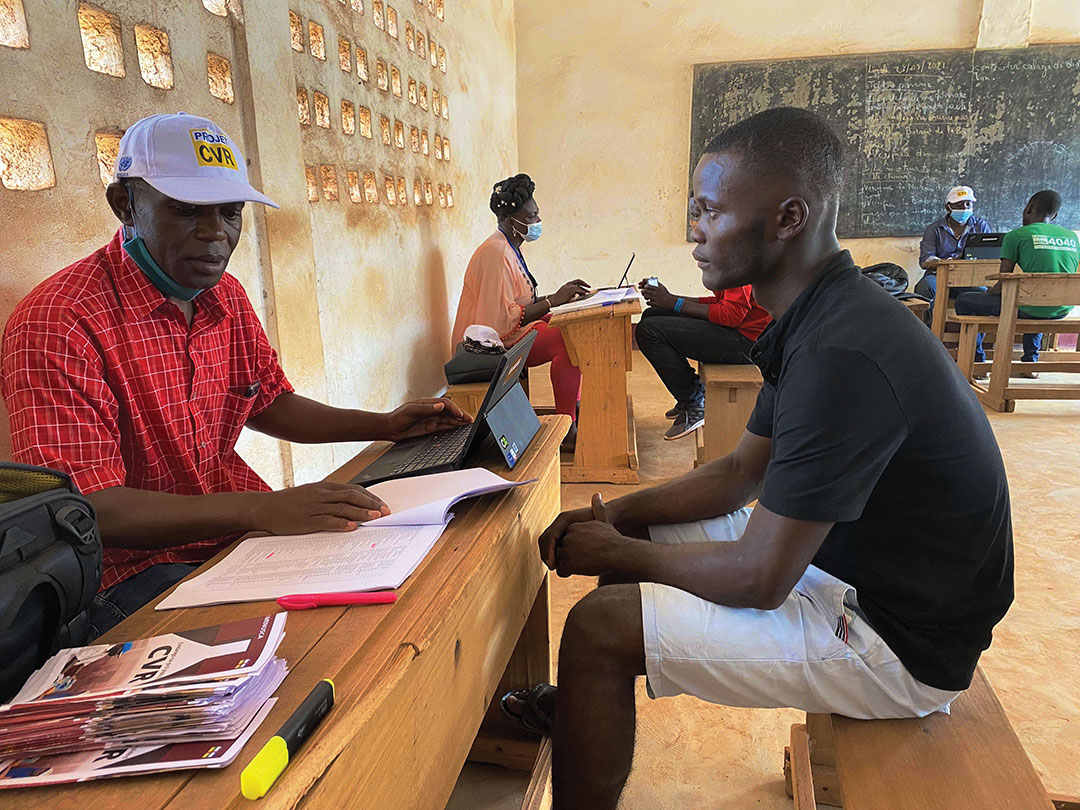
Community effort: One innovation is community violence reduction. This practice used in the CAR takes a communitywide approach to ending conflicts. Through programs such as short-term vocational training, teaching civic values and support for startup businesses, it tries to get the entire community to take ownership of DDR.
Bangura said quick-impact projects such as the construction of wells, schools or health clinics that improve life for all citizens can help them overcome fear or resentment of ex-combatants and embrace DDR long term. There also is a need for transitional justice so community members can see that ex-combatants are remorseful and have paid for their actions.
“These kind of things help, and also using social capital within communities helps,” Bangura said. “Religious leaders, traditional and other leaders — if they take ownership of such projects, it’s easier for you to succeed, but if they feel marginalized and ostracized, they’ll reject the combatants.”
He also said advance work must be done to prepare communities before ex-combatants are reintegrated. Some community members revolt at the prospect of housing returning fighters and even threaten to pick up weapons themselves to settle scores. “You don’t just send ex-combatants into communities; you have to do the groundwork way ahead,” Bangura said.
Focus on healing: DDR programs should emphasize psychological and emotional treatment, Bangura said. One estimate found that 80% of people with conflict-related mental disorders do not receive treatment. These lingering wounds can play a major role in continuing the cycle of violence. “These are traumatized people, deeply wounded by war,” he said. “So, they may have picked up arms, but they were also victims of society.”
There is increased awareness that this must be a long process, especially with fighters who were part of ideological movements or who have carried guns since their youth. “The support is usually short term,” Bangura said. “They go, they give them three months of training or six months of training, give them small cash and they say ‘OK, goodbye’ and within weeks you go back to zero.”
An African model: There is a recognition that African nations will direct future DDR programs. The U.N. is decreasing its peacekeeping presence worldwide, and there appears to be less interest from international groups in supporting DDR programs. This might be an opportunity for African practitioners to craft programs that meet the unique needs and contexts of their countries, Bangura said.
“The more these countries come to understand that they can no longer afford to wait for the U.N., and they need to take ownership in terms of solving their problems, the better it will be for them,” he said. “Homegrown solutions help to promote trust, healing and reconciliation.”
New Challenges
DDR today is more challenging than ever. Its practitioners often face a complex landscape with multiple groups, no peace declarations and conflicts that spill across borders. Here are the biggest challenges to 21st-century DDR programs.
No Peace
Modern conflicts are less likely to be ended by a political settlement or peace agreement. A simmering state of hostility makes starting DDR difficult because combatants are unwilling to disarm if they feel a need to protect themselves.
Many Actors
DDR practitioners today deal with an array of involved parties. These include militias, terrorists, organized crime groups and “spoilers” who might not be party to the conflict or its peace agreement. All the groups have their own incentives and structures. The fractured nature of many conflicts makes it difficult to develop a program that will attract all armed groups and address their interests.
Regionalized Conflicts
Many conflicts today cross borders. Armed groups can include foreign and domestic supporters and allies. Some also are connected to international criminal rings.
Hostility From Communities
Civilians understandably are fearful of ex-fighters returning to their communities. They may resent fighters who receive benefits after they have committed atrocities. Ex-fighters in DDR programs typically choose between returning to their communities of origin or finding new communities where they will not be recognized. Both options carry challenges.
Lack of Funding and Political Will
DDR programs are costly and time-consuming. The typical lifespan of a program’s disarmament phase is one to two years, but it can stretch on for more than a decade. The DDR program in Bosnia-Herzegovina, for example, lasted 12 years. Lapses in funding or political will can undermine efforts. “In the traditional sense, DDR is a political arrangement,” said DDR expert Dr. Ibrahim Bangura. “Where there’s political will and interest it succeeds; where there’s no political will and interest it does not succeed.”
DDR ‘Means Stability and Lasting Peace’
A Conversation with Pierre Ubalijoro, director of the DDR section for the U.N. Mission in the Central African Republic
ADF STAFF
ADF: Once combatants lay down their arms, what are the next steps?
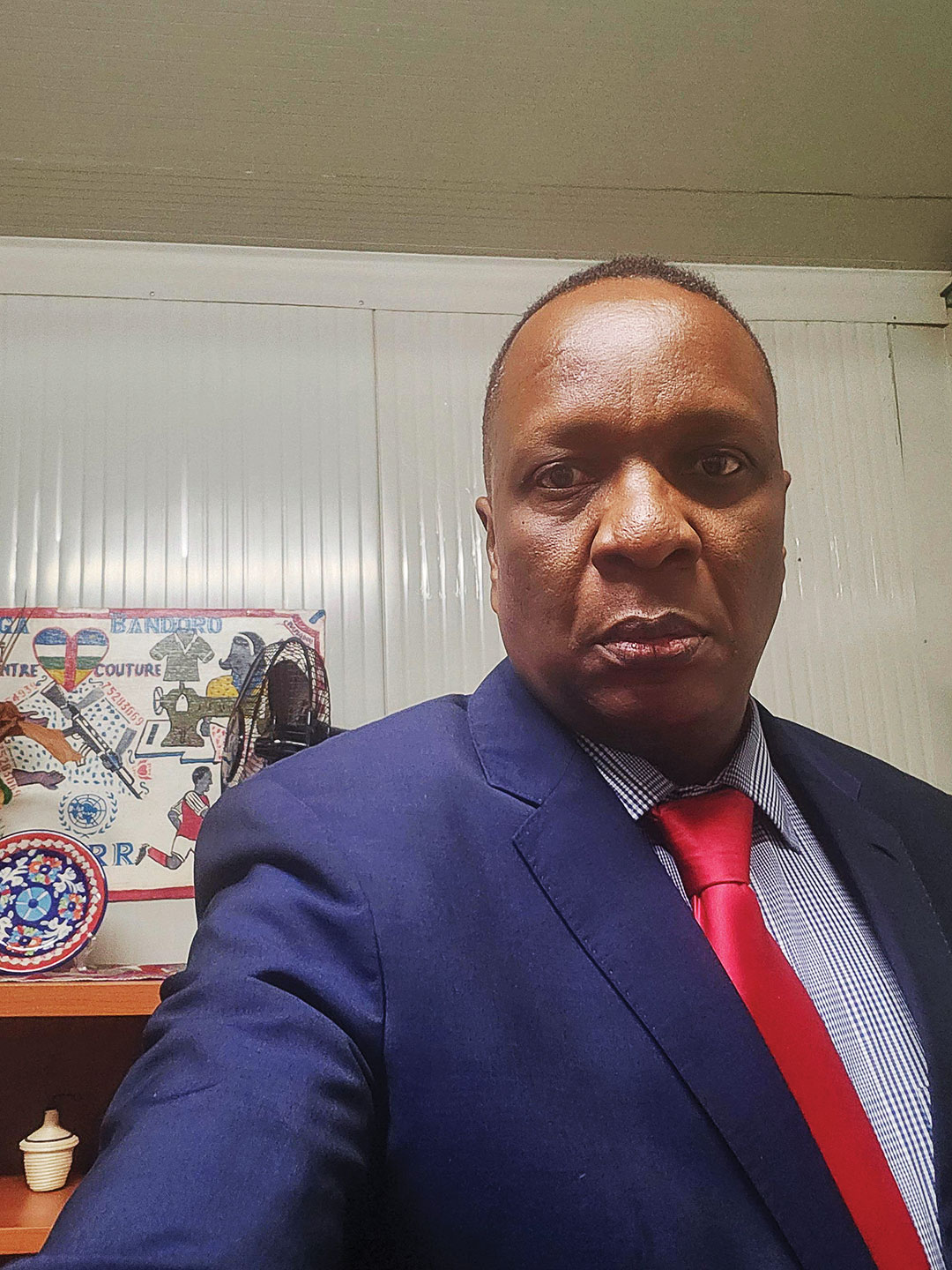 Ubalijoro: Some individuals, after being demobilized, are enrolled in World Bank-funded reintegration programs that include civic education during the first month, and then the next five months are vocational training in fields such as agriculture, carpentry and other income-generating activities. They also receive psychosocial support, medical screening and reintegration kits. Some eligible individuals may be integrated into the national security forces. As of mid-2025, we have supported the government to disarm and demobilize over 5,600 combatants.
ADF: What does it mean for civilians in the Central African Republic to see combatants leaving the battlefield?
Ubalijoro: It means a lot because once the combatants hand in the weapons, then there is space for economic recovery. That’s when other international partners with a development agenda start trickling in. This constitutes a form of relief. We as a mission support the communities with a project known as Community Violence Reduction [CVR], which enhances community resilience. We build schools, we drill boreholes and we do cash-for-work projects. We pave the way for other partners with substantial development resources to come and assist the communities to live a more peaceful life, uninterrupted by armed violence and extrajudicial killings.
ADF: In the CAR, there once were 14 active armed groups. How does that add to the complexity of a DDR program?
Ubalijoro: The DDR process in CAR is complicated by the fragmentation of armed groups. While 14 armed groups signed the APPR-RCA [Political Agreement for Peace and Reconciliation in the Central African Republic] Peace Framework in 2019, three of them later withdrew and formed what is known as the Coalition of Patriots for Change. The presence of nonsignatory factions still active in mining zones and transhumance corridors adds complexity. Despite these challenges, 11 out of the 14 original signatory groups have officially dissolved, and the return of UPC and 3R [armed groups] into the APPR framework has reinvigorated DDR efforts. In line with its mandate, MINUSCA [the U.N. mission in the Central African Republic] has increased support to CAR authorities to conduct disarmament and demobilization operations in many areas. Right now, we have around eight operations in the pipeline prior to the holding of the [December 2025] elections.
ADF: As a DDR program progresses, how do you determine whether it is successful?
Ubalijoro: It’s a process that is politically driven. Sometimes it can take a long time; sometimes it can be short, depending on the political will. Success is measured by the sustainable demobilization and reintegration of ex-combatants into civilian life or national institutions without relapse into violence. Key indicators include improved security of communities most affected by armed groups, reduced armed violence, socioeconomic integration and, most important, acceptance by host communities.
ADF: When you talk about host communities, naturally some civilians will be nervous and resistant to the return of ex-combatants. What can be done to aid this process?
Ubalijoro: It’s a complex process. CVR projects are essential because their aim is to foster acceptance. These projects include reconstruction of schools, health centers, boreholes as well as promoting dialogue and joint economic activities. In the town of Sam-Ouandja, for instance, CVR projects have led to reduced arms circulation and resumption of farming. If you go there today, you can see that there is an era of renaissance and improved trade due to road repairs. These initiatives help communities see tangible benefits and reduce stigma toward returning ex-combatants.
ADF: Two-thirds of African countries have had a DDR process at some point in their history. Are there any instances from recent history you would point to in which DDR has been successful and played an important role in ending a conflict?
Ubalijoro: Several African countries have successfully implemented DDR programs. For instance, Liberia disarmed over 100,000 combatants post-civil war. Rwanda reintegrated child soldiers through what were called Kadogo Schools. Sierra Leone linked DDR to national reconciliation and youth employment. In CAR, the DDR program is following a similar path with thousands of combatants, successfully disarmed, demobilized and reintegrated, and now leading a meaningful life.
ADF: Looking ahead, what do you see as the possibilities of DDR in the CAR and what it could mean long term?
Ubalijoro: A successful DDR program would enable the CAR government not only to reclaim territorial control, but also to reduce violence and open trade and agriculture corridors, transhumance corridors. It would lay the foundation for economic recovery and decentralized governance. Moreover, with the MINUSCA mandate extended to November 2026, DDR is central to CAR’s peace and development strategy. In my view, a successful DDR program means stability and lasting peace for the CAR.