

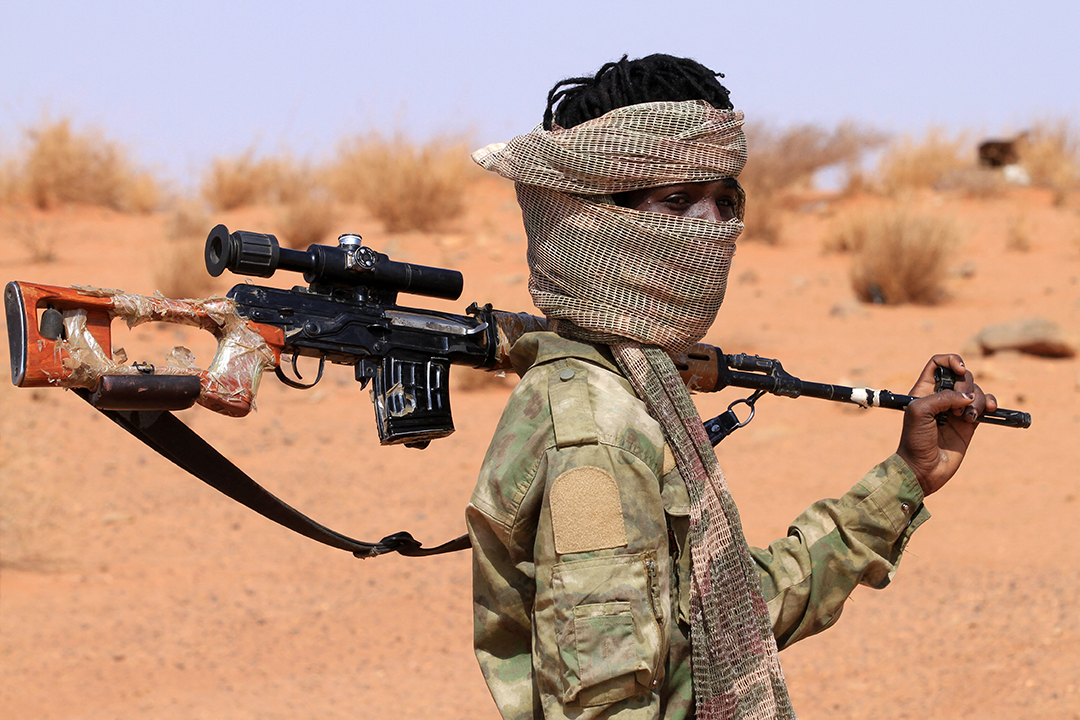
In July and August, more than 800 Rapid Support Forces (RSF) fighters and commanders defected from the Sudanese paramilitary group and declared their allegiance to the Sudanese Armed Forces (SAF), potentially shifting the balance of power in the country.
After years of failed international efforts to reach a peaceful settlement to the war, SAF leader Gen. Abdel Fattah al-Burhan, has put his support behind a homegrown proposal for a national dialogue aimed at ending the fighting.
In July, al-Burhan met with leaders of the Democratic Bloc, alongside a joint gathering of the National Umma Party and the Democratic Unionist Party-Original. Leaders of those groups called for a national dialogue, and al-Burhan pledged to create the right conditions for it, according to analysis by Al-Estiklal newspaper.
Al-Burhan said in August that he would not set the agenda for discussions or manage their process. He did, however, offer temporary immunity and suspend criminal proceedings for those involved in the dialogue. It’s unclear who will organize the dialogue and who will participate.
Sudanese political analyst Dr. Ibrahim Abdel-Atti told Al-Estiklal that al-Burhan’s immunity offer could encourage the return of opposition figures living outside Sudan or others facing politically motivated charges. However, a verbal pledge alone is not enough to guarantee their safety, he added.
While work moves forward on a national dialogue, the fighting continues.
The SAF announced in July that it had gained control of the Exports Road and several communities in North Kordofan. The road links Khartoum with North Kordofan’s capital, el-Obeid, and has been a key RSF supply line.
“That advance reopened a direct land connection that had been cut for much of the war and removed the RSF from several of its most important positions north of el-Obeid,” Sudan War Monitor analysts wrote recently.
Meanwhile, RSF fighters took control of Army positions in Blue Nile State on Sudan’s southeastern border with Ethiopia and South Sudan in mid-September, according to Sudan War Monitor. Blue Nile contains the Roseires Dam, one of Sudan’s main hydroelectric power plants.
Al-Burhan has refused to accept any outcome that returns the RSF and its commander Gen. Mohamed Hamdan “Hemedti” Dagalo, to its pre-conflict position of power. Al-Burhan has described such an ending to the conflict as “peace without substance.” He has said that any peace process must start with RSF fighters leaving Sudan’s urban areas.
Unless that happens, military action remains the only alternative, Malik Agar, al-Burhan’s deputy chairman of the Transitional Sovereignty Council, told Al Jazeera recently.
Lt. Gen. Yasir al-Atta, al-Burhan’s assistant commander-in-chief and a member of the ruling Transitional Sovereignty Council, told Egypt’s Al-Shorouk newspaper that the military would insist on al-Burhan remaining in power while political parties rebuild.
In the meantime, defecting RSF commanders such as Al-Nour Hussein Al-Dodo have reported that RSF leaders face arrest or execution if they do not carry out orders. He predicted more defections in the coming months.
“The changing military balance may now be beginning to shape the terms of Sudan’s next political phase,” Al Jazeera wrote in a recent analysis. “For the RSF, the challenge is therefore not only to hold territory. It is to prevent battlefield pressure from becoming an internal crisis of cohesion.”