

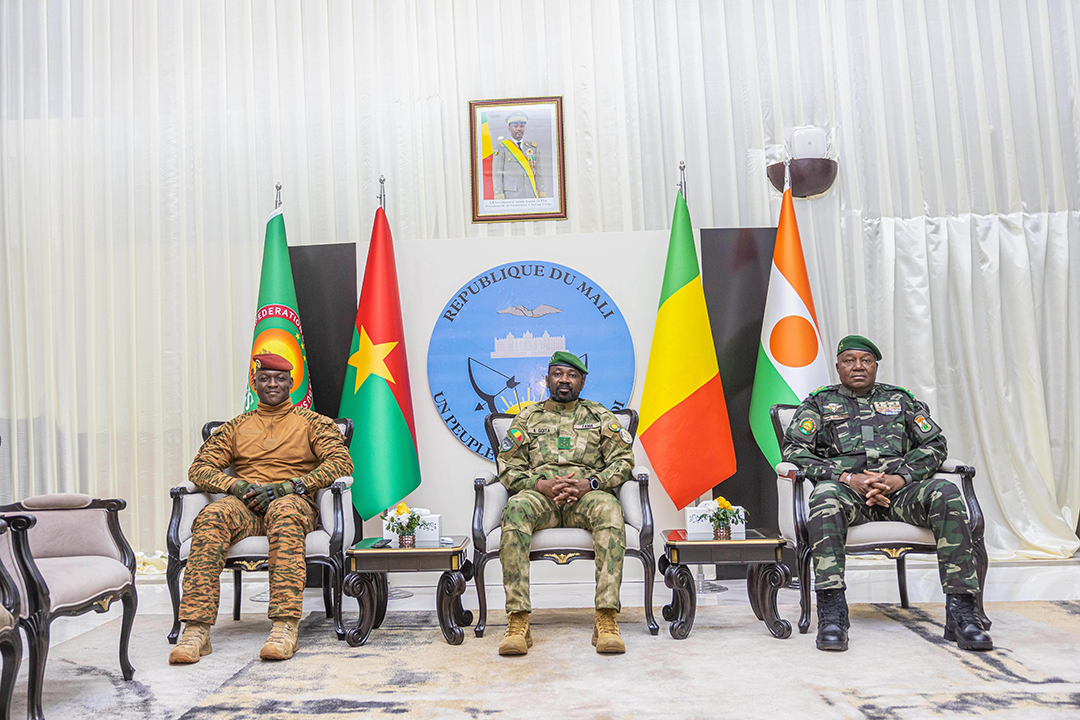
When terrorists attacked Bamako and Niamey earlier this year, the military leaders of Niger and Mali did not turn to their own troops or their newly created Alliance of Sahel States standby force. Instead, they asked for assistance from Africa Corps mercenaries. Security experts say this reveals a dependence on Russia by junta leaders who claim to be seeking independence from foreign powers.
“The major concern lies in what this level of dependence does to the cohesion and sovereignty of Russia’s vulnerable client states,” researcher Zikora Ibeh wrote in a September 11 article for International Politics and Society magazine. “As Niger’s mutiny shows, a troubling fragility exists at the core of the Sahelian confederacy. …
“As their armies continue to bear the brunt of expanding jihadist and separatist violence, these states are becoming far too weak and vulnerable to fulfill the barest obligation of a government, i.e., guarantee territorial integrity, protection of lives and property and provision of basic welfare, let alone regional defence.”
Since 2021, Mali has paid at least $1 billion to Wagner Group mercenaries and Africa Corps personnel. Payments by Burkina Faso and Niger are not publicly disclosed, but Ibeh said the countries recently have moved towards resource nationalism, suggesting “that mining concessions could be used as leverage for military deals.”
Jacob Boswall, a security analyst who tracks militant activity for the BBC’s media monitoring service, said Russia’s model of military partnership on the continent has proven to prioritize the extraction of mineral resources over providing security to civilians.
“Wagner — and now Africa Corps — have always had a very transactional interest in Africa,” he said in a September 5 BBC article. “If they can get mineral resources in exchange for providing protection and defence, then they will. We see that in Mali with gold … and then in Niger, it really is uranium [that] seems to be the main resource that Africa Corps is protecting.”
Since Burkina Faso, Mali and Niger brought in Russian fighters, terrorist attacks have risen. In 2024, the Liptako-Gourma tri-border region alone accounted for more than half of all global terrorism-related deaths.
Ibeh noted that Africa Corps personnel rarely leave their operational base in Bamako following a series of battlefield defeats, preferring to use drones to mitigate operational losses. In April, the Russians retreated from the northern Mali stronghold of Kidal, leaving an entire city and its surrounding communities at the mercy of terrorists and separatists.
“Africa Corps has really lost credibility,” Ulf Laessing, the Bamako-based West Africa program lead at the Konrad-Adenauer Stiftung think tank, told Al Jazeera. “They didn’t put up a fight … they left behind a lot of equipment, a whole drone station. This gives the impression that they don’t really care.”
Like the Wagner Group before it, Africa Corps has a lengthy record of civilian atrocities and human rights abuses, and has been unable to improve security in contested areas. Ibeh warns that Russia’s security failures in the Sahel have thus far only further entrenched the three junta regimes’ dependence on the mercenaries for survival.
“What this portrays is a severely fragile ecosystem that increases the propensity of chronic dependence by the weak and unstable Sahelian juntas on Russian bayonets,” she wrote. “But alongside this propensity lies a risk of nations dependent on Russia for their security transforming into de facto Russian protectorates.”