

ADF STAFF
In June, soldiers from Mali and Niger graduated from special forces training in Isparta, Türkiye, becoming the latest example of the Turkish military’s growing influence in Africa.
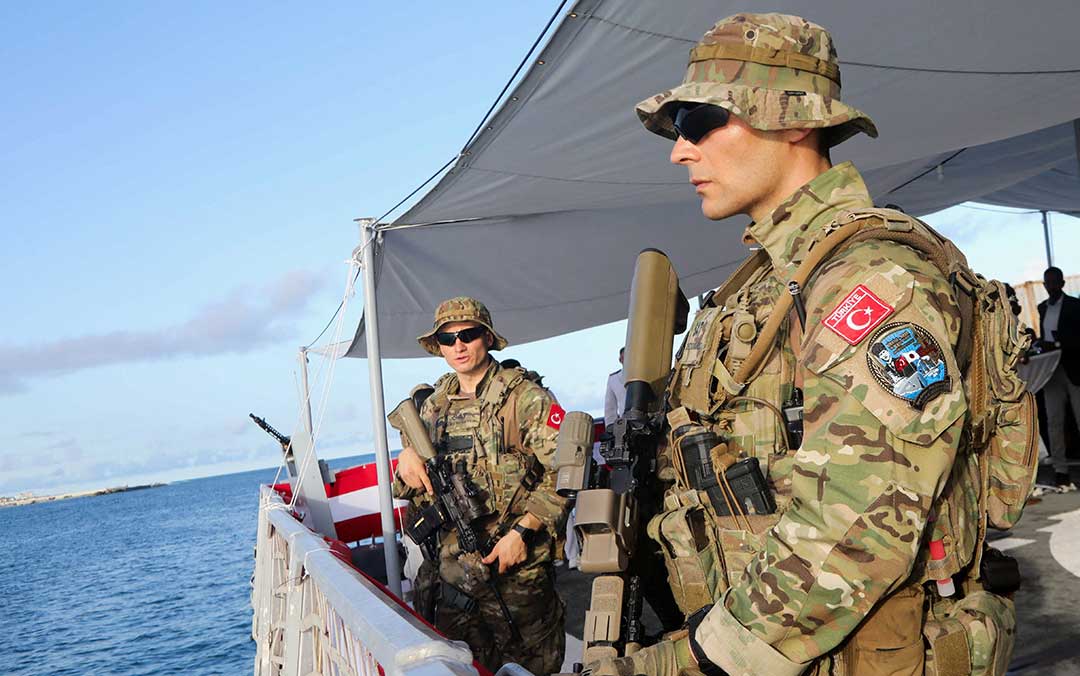
Over the past decade, Türkiye has expanded its presence on the continent through training and arms sales. The so-called “Somalia model” takes its name from Türkiye’s arrival in Mogadishu in 2017 to help the Somali military fight al-Shabaab. Somalia’s Camp TurkSom, which includes a training academy, is Türkiye’s largest overseas military base.
Türkiye’s influence grew rapidly after its 2019-20 intervention in Libya on the side of the internationally recognized government in Tripoli against Russian-backed military forces based in the country’s east.
The success of Turkish drone technology in Libya made Ankara a sought-after partner, according to Nebahat Tanrıverdi Yaşar, a security analyst with the German Institute for International and Security Affairs.
In the years since, Türkiye has sold its Bayraktar TB2 and Akinci drones to countries from Angola to Tunisia. But the value of Türkiye’s security agreements in Africa goes well beyond arms sales, Yaşar told ADF in an email.
“The scope of these agreements, including those related to military training, extends far beyond tactical training to encompass organizational structure, logistics, military intelligence, defense industry cooperation, and professional capacity building,” she wrote. “Compared to one-off arms sales, this approach builds deeper, more enduring relationships.”
In Somalia, for example, Türkiye has focused much of its training on junior officers, some of whom are learning Turkish.
“You invest in the up and coming of the Somali security force, and you’ll have some sort of long-standing ties going forward,” Omar Mahmood, East Africa analyst at the International Crisis Group, told Radio France Internationale.
Türkiye has embassies in nearly every country on the African mainland. It established a drone base in eastern Chad in 2024 and maintains a military presence in Libya to support the government in Tripoli.
In Chad, the Turkish military operates a drone base at the Abéché military base near the Libyan border. The base previously had been home to French troops who vacated it in 2024. Türkiye has similarly stepped into the security gap in the Sahel after junta leaders in Burkina Faso, Mali and Niger ended their relationship with the French and U.S. militaries.
In that position, Türkiye provides a NATO-standard alternative to Russia’s Africa Corps, which has been accused of widespread human rights violations across all three Sahelian countries as they fight terrorist and insurgent groups.
“Training is highly valuable to Türkiye because it establishes something that mere arms sales cannot: long-term institutional relationships,” Yaşar told ADF. “Officers are trained at Turkish institutions, foreign militaries become familiar with Turkish military doctrine and equipment, and Ankara gains sustained access to its partners’ security sectors.”
That relationship creates what Yaşar describes as “an institutional ecosystem” centered on Turkish technology. Thirty Turkish defense manufacturers attended the Bamako International Defense and Security Exhibition in Mali in 2025.
“Having amassed extensive experience in counterterrorism operations, Türkiye excels at organically integrating drone-derived intelligence and precision-strike capabilities with special forces, commando units and other ground combat elements,” Yaşar told ADF.
The Somalia model’s “no strings” approach appeals to governments, such as those in the Sahel, looking for greater autonomy. However, it has led to criticism of Türkiye’s policy, particularly after its drones were used against civilians and rebels alike in Ethiopia and Sudan.
“There is, therefore, a tension within the Turkish model,” Yaşar told ADF. “Strengthening state capacity without simultaneously strengthening accountability may reproduce existing governance problems or even increase the coercive capacity available to governments.”