

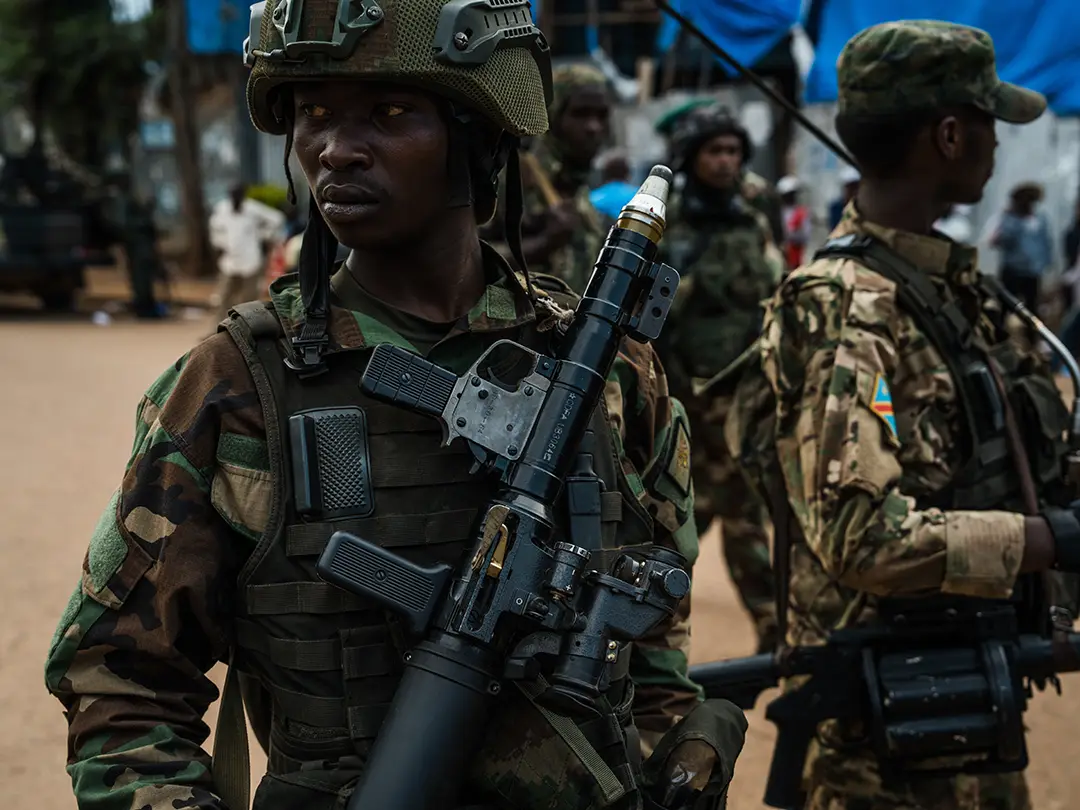
Beijing’s official stance of neutrality and nonintervention in the paramilitary M23’s rebellion against the Congolese government is increasingly being challenged by the reality on the ground: a proliferation of Chinese-made weapons on both sides.
China has several billion-dollar investments in cobalt, coltan and copper mines in the eastern Democratic Republic of the Congo. It also supplies weapons to the DRC and neighboring Rwanda, which has been accused by the United Nations of backing the M23 militia.
“China presents itself as a mediator in the region, and its embassy denies any arms sales to armed groups,” independent news website Beto wrote in a July 18 editorial. “Its professed neutrality is a commercial position, profitable for both sides while Congo burns.”
Government officials in the DRC reportedly are incensed over the flow of Chinese weapons and military equipment into the hands of M23 fighters after being sold to Rwanda. Defense analyst Jean-Jacques Wondo said there have been numerous examples of the Congolese military (FARDC) recovering Chinese weapons and military equipment from M23 fighters in eastern DRC.
“The M23 weapons seized by the FARDC are almost all of Chinese manufacture,” he told Beto in 2022.
Wondo has spent years tracking these weapons: Kalashnikov-style light machine guns, assault rifles, mortars and 40-millimeter anti-tank rocket launchers. There also is photographic evidence of a Chinese-made 107-millimeter gun in use by M23 as well as a Chinese variant of a Russian guided artillery shell. There is also evidence of M23 fighters operating a Chinese Yitian armored vehicle near Goma, the North Kivu province capital they have held since January 2025.
In the past two decades, the Rwanda Defence Force has purchased Chinese artillery, anti-tank missiles and armored vehicles, according to the Stockholm International Peace Research Institute. An independent panel of U.N. experts in 2022 concluded that Rwanda has armed the M23 militia, which by appearance looks more like a well-equipped army than the kind of ragtag armed groups roaming eastern DRC.
“These weapons do not come directly from Beijing,” the Beto editorial said. “They originate from the Rwandan arsenal, largely supplied by China, which then flows into the hands of the M23. Rwandan forces are equipped with Chinese equipment at almost every level, including air defense systems from the state-owned Norinco group.”
In a recent article, intelligence analyst Mustapha Bature Sallama noted that M23 fighters also are outfitted in Chinese-made uniforms, bulletproof vests and tactical helmets. Wondo and Beto have connected much of the recovered M23 gear to Chinese state-owned export company Xinxing, which describes itself as Beijing’s officially recognized and exclusive exporter of military supplies and logistical equipment.
“Whether through the deliberate diversion risk Beijing has long been aware of in its Rwanda sales, or through more direct channels involving state-owned exporters like China Xinxing, the weapons recovered from M23 positions tell a story that China’s diplomatic statements have yet to reconcile,” Sallama wrote in a July 13 article for Modern Ghana website. “For a conflict that has already displaced millions and claimed the two provincial capitals of Kivu, the question of who is arming the M23, and with whose knowledge, deserves far more scrutiny than it has so far received.”
Despite plentiful evidence of its involvement in the M23 conflict, however indirect, China insists that it adheres to a policy of noninterference in other countries’ internal affairs. This approach to diplomacy and business has backed China into a corner, said Zhou Yuyuan, a professor at the Shanghai Institutes for International Studies.
With China recently eclipsing Russia as the largest arms dealer on the continent, researcher Peter Smith believes Beijing’s approach to conflicts like the M23 revolt in eastern DRC could become an untenable position.
“Although China has shown little interest in previous African conflicts, its vast commercial interests in the continent at present could result in greater levels of future involvement,” he wrote in a 2024 post for global conflict analysis blog Between the Lines. “Given the substantial mark it has left by arming various actors throughout Africa, these conflicts could intensify greatly moving forward, further forcing China to pick sides as it seeks to protect the substantial investments it has made to date.”