

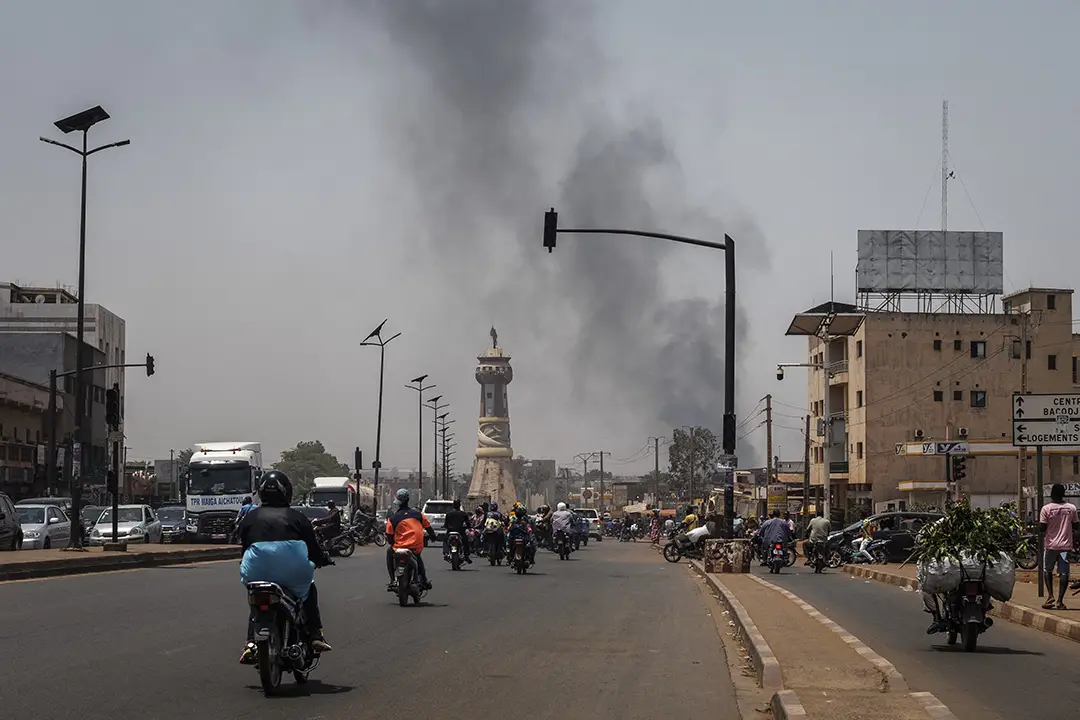
The terrorist attack in April that killed Mali’s defense minister in his home added fuel to the notion that Jama’at Nusrat al-Islam wal-Muslimin could one day take control of the country.
Over the last year or more, the group also known as JNIM has launched an economic blockade on the landlocked country that largely crippled the capital, Bamako. Its alliance with the Tuareg-based Azawad Liberation Front (FLA) drove government forces and Russian mercenaries out of the north of the country during the same operation that killed Defence Minister Sadio Camara.
The attack that killed Camara in Kati, home to the country’s main military base just outside Bamako, struck at the heart of the junta since many of its key leaders live there. A brazen attack so close to the capital raises the prospect of the junta, which has ruled the country since 2020, eventually falling, say analysts.
“This large-scale attack exposes the vulnerability of the military junta led by Assimi Goïta,” analyst David Doukhan wrote for the International Institute for Counter-Terrorism. “The capture of Bamako obviates the need to capture larger territories and could decide the fate of the bloody conflict in Mali.”
JNIM has around 6,000 active fighters, but it unites multiple jihadist groups with the goal of creating a regional caliphate that would erase decades-old national borders. It also has begun to spread beyond Mali into Benin and northwestern Nigeria. Mali’s fellow members of the Alliance of Sahelian States have failed to deploy forces under the group’s regional defense agreement created soon after they left the Economic Community of West African States. That has left JNIM largely free to pursue its own goals.
While JNIM is allied with FLA in the north, many analysts say the prospect that JNIM could take control of Mali is a distant one without aid from competing terrorist groups such as Islamic State — aid it’s unlikely to get. However, should it happen, it could upend the security dynamic across the region, according to Nigerian national security analyst Fulan Nasrullah. That’s because it’s unlikely JNIM’s rank and file would be satisfied with controlling Mali alone, Nasrullah wrote.
“A [JNIM] that governs an entire state — and remains expansionist and bent on reshaping the regional order by force — is a challenge that no country in the region currently has the capabilities to meet,” Nasrullah wrote recently for security website War on the Rocks.
JNIM would become even more dangerous if it acquired the manpower, money and weapons of a national military, Nasrullah said.
The best safeguard against that risk is for regional powers such as Nigeria and Senegal to unite with their neighbors bordering Mali, including Guinea and Benin, according to Nasrullah.
“This means expanding intelligence-sharing and helping local militaries create well-trained, specialized units to function as mobile, quick-reaction groups to blunt cross-border insurgent mobility, instead of undermanned and undertrained special operations formations,” he added.
In the meantime, JNIM remains a growing threat to Mali and the surrounding nations.
“Mali has not yet fallen,” Doukhan wrote. “But it is trembling and closer than ever to total collapse.”