

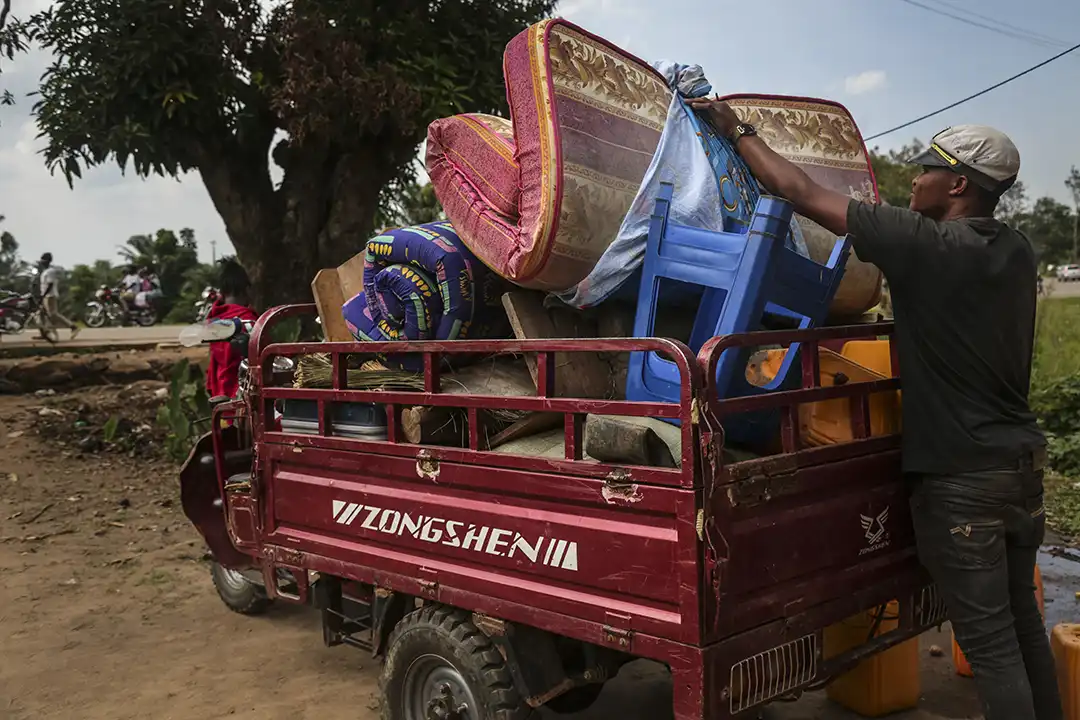
After years of losses to the joint military forces of the Democratic Republic of the Congo and Uganda, the Islamic State Central African Province (ISCAP) is resurgent and launching attacks throughout northeastern provinces of the DRC.
Tryphen Mabikinyambey, a member of the provincial parliament representing the town of Bafwasende, said ISCAP fighters recently attacked 12 villages in the Bambodi sector of Tshopo province.
“The rebels feel at home there. They are at ease. We have already reported their presence, yet there has still been no appropriate response from the authorities,” he told HumAngle Media for a June 5 article. “The population is being emptied from the tribal group. There is no response from the national, provincial or local authorities.”
The first three years of Operation Shujaa, a joint military offensive launched in 2021 by the DRC and Uganda, were marked by tactical successes that drove the militants out of their strongholds in the Rwenzori Mountains and greatly diminished their activities in the DRC’s North Kivu province. By the end of 2024, security had improved enough for curfews to be lifted in parts of the notorious “triangle of death” area between the towns of Beni, Mbau and Kamango. ISCAP, also known as the Allied Democratic Forces, had broken into small groups seeking refuge elsewhere. At first the militants found haven to the north in Ituri province, but by late 2025 a resurgent ISCAP was expanding into neighboring Haut-Uele province.
“When they are tracked down, they search for calm areas. And these places are in the Mambasa territory [in Ituri] and Bafwasende,” Mabikinyambey said.
ISCAP attacks have intensified since October 2025, killing more than 260 civilians and forcing thousands of families to flee. A United Nations report condemned multiple massacres and systematic war crimes, including the sexual enslavement of women and girls.
African Security Analysis, an independent risk management company, said ISCAP is no longer content to operate in its traditional zones of influence in North Kivu, Ituri and their many densely forested corridors. It is probing a wider geographic area, including those with lesser military presence and weaker governance.
“ISCAP appears to be dispersing into less saturated spaces where it can regenerate freedom of movement, impose fear, access economic networks and demonstrate continued relevance within the Islamic State’s Central Africa propaganda architecture,” it wrote in a May 26 assessment. “An enemy that disperses is not necessarily retreating. In this case, ISCAP is evolving.”
Nirvaly Mooloo, a researcher who focuses on Central Africa and the Lake Chad Basin for the Institute for Security Studies, said that rampant war crimes and abuses against civilians demand a more coordinated response.
ISCAP “is intensifying attacks against civilians, expanding its geographic reach and exposing the limits of a military strategy that has failed to weaken it,” she wrote in a June 1 analysis. “Despite nearly five years of joint Congolese-Ugandan efforts under Operation Shujaa, areas cleared of fighters are routinely re-infiltrated in weeks.”
Mooloo called on political, administrative, military and community leaders to work with civil society actors and address the security, governance and social grievances that drive ISCAP recruitment. While Shujaa has had significant military successes and has brought together the Congolese and Ugandan governments, Mooloo believes that the operation needs a strategic reset.
“First, affected areas need a more sustained state presence, particularly mining zones and transport corridors,” she wrote. “The primary aims must be to disrupt illicit taxation systems, strengthen civilian protection and re-establish security and service delivery.
“Second, regional cooperation must move beyond military coordination to include disrupting the cross-border networks sustaining the group.”