

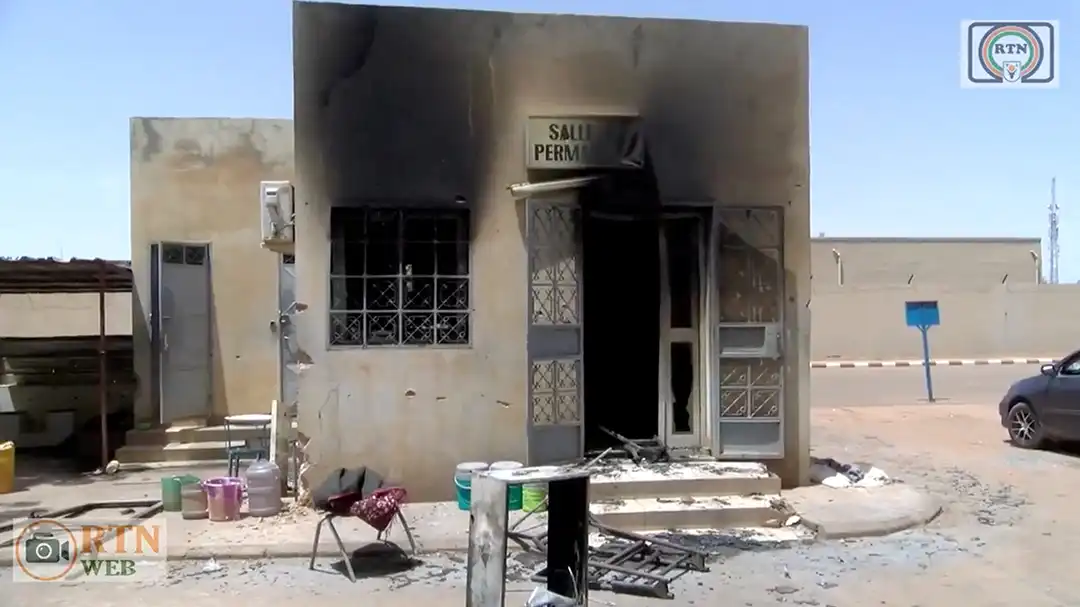
Recent terrorist attacks by Jama’at Nusrat al-Islam wal-Muslimin and Islamic State Sahel Province in western Niger reveal the rapidly deteriorating security situation in the country’s western Tillaberi region where the two groups are competing for control.
Terrorists with Islamic State Sahel Province (ISSP) attacked and looted Nigerien military bases in Inates and Banibangou on June 15. A few days later, on June 18, al-Qaida affiliate Jama’at Nusrat al-Islam wal-Muslimin (JNIM) attacked Niger’s international airport, which is also home to the military’s Air Base 101 and Russia’s Africa Corps.
ISSP’s attacks killed at least 51 Soldiers at Inates and 34 at Banibangou. The Banibangou attack came one year after an ISSP attack on the same base that killed at least 71 Soldiers. JNIM’s airport attack, which killed 11 Soldiers and two civilians, mirrored ISSP’s assault on the same facility in late January.
The timing of the attacks demonstrates the groups’ effort to “outbid” each other to attract more public support, recruits, and resources, according to Héni Nsaibia, West Africa senior analyst for ACLED, the Armed Conflict Location & Event Data project.
“These attacks carry messages,” Nsaibia told ADF. “JNIM trying to do the same that Islamic State did earlier speaks to that competition.”
The JNIM attack also fits a broader pattern across the Sahel of JNIM, ISSP and other terror groups targeting major population centers and critical infrastructure, according to Nsaibia.
Niger’s western Tillabéri region has become the battleground where the JNIM and ISSP rivalry is playing out. With ISSP dominant in the north and JNIM dominant in the south, the central region around Niamey has become the flashpoint where each group is trying to establish itself as the dominant force. Tillabéri is part of the Liptako-Gourma region, where Burkina Faso, Mali and Niger meet. It has been the heart of terrorist activity for many years, elevating all three to the Global Terrorism Index’s top five nations for terrorism.
“This outbidding is taking place primarily in operational zones where both JNIM and ISSP are not strong enough to engage in direct conflict with each other, as has happened in other parts of the Sahel,” analysts Liam Karr and Alexandre Colas de Francs wrote recently for Critical Threats.
The rivalry also extends to Niger’s Dosso region bordering Benin and Nigeria where each group has staked out territory — JNIM in the west, ISSP in the east — and launched attacks into the neighboring countries.
The military juntas that rule Niger and its Sahelian neighbors overthrew democratically elected governments in the name of reining in terrorist activity. Since then, however, the security in all three countries has deteriorated. In some cases, a heavy-handed approach by Russian mercenaries has turned local populations against the government.
After the Nigerien junta expelled international counterterrorism forces in 2023 and 2024, ISSP quickly expanded in the Tillabéri and Touha regions as Niger’s military struggled to keep up.
“Niger is spread thin when it comes to its military because it faces multiple threats both within the country and along its borders,” Nsaibia said. “The military has trouble facing all of these combined challenges. I think these latest attacks speak to that.”