

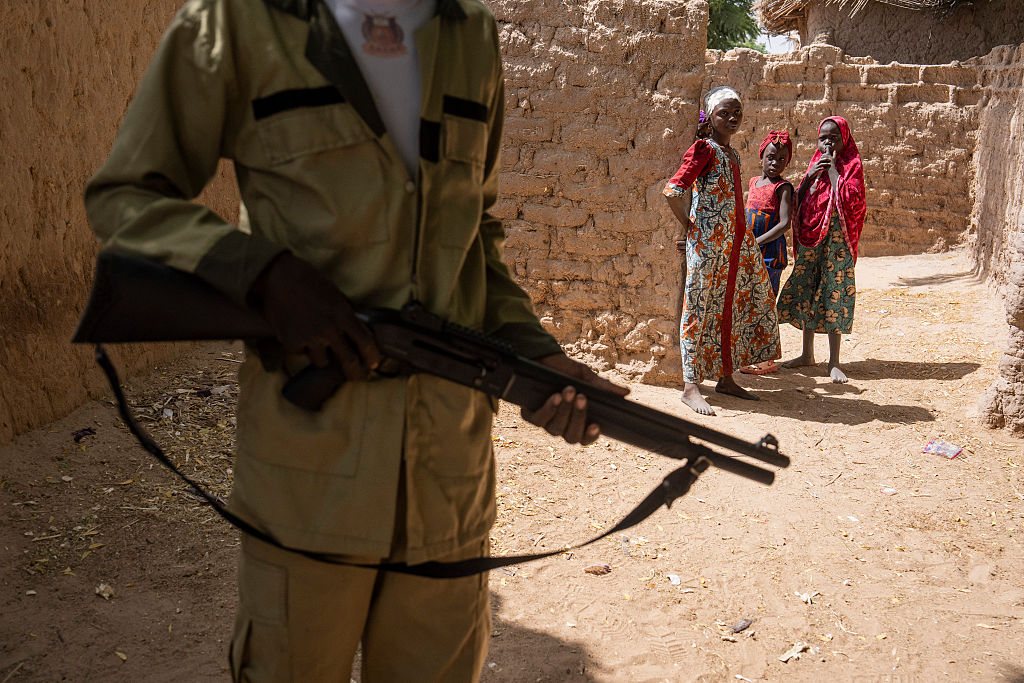
Sahelian terrorist groups and criminal gangs are leveraging an expanding insurgency corridor in Nigeria’s Kebbi-Kainji-Borgu triangle to expand their influence, recruit new fighters and fund illicit activities.
The region straddles the Nigerian states of Kebbi, Sokoto, Niger and part of Kwara in central Nigeria. It also stretches into Niger’s Dosso region and Benin’s Alibori department. Analysts say groups including Boko Haram, the Islamic State Sahel Province (ISSP) and the al-Qaida-affiliated Jama’at Nusrat al-Islam wal-Muslimin (JNIM) are leveraging geopolitical changes, lax regional cooperation and weak border security coordination to expand their territories.
Violent events involving jihadist groups in Benin’s Alibori and Borgou departments, Niger’s Dosso department, and Nigeria’s Kebbi, Kwara, Niger and Sokoto states rose by 86% in 2025, according to the Armed Conflict Location and Event Data (ACLED) project. Related deaths in these areas increased by 262%. Terror groups operating in these areas have increasingly publicized their actions as they expand into West Africa.
“These strategic communications, which follow the expansion efforts of JNIM and ISSP, point to growing competition and outbidding between the groups, demonstrating that both are positioning themselves to maintain their presence and influence in the borderlands,” Héni Nsaibia, a senior analyst with ACLED, wrote on the organization’s website.
Nsaibia added that violence likely will intensify and increase pressure on nearby population centers, while increasing the likelihood of military operations and militia formation if the pattern continues.
Terrorists and armed groups use forests such as the Alawa, Kainji and Kamuku national parks and the Kwiambana game reserve as strategic havens due to their vastness, isolation, difficult terrain and limited access. They connect multiple states or border neighboring countries and often are used for kidnappings for ransom, extortion, illegal logging and mining, and various kinds of smuggling. Their natural cover shields bad actors from military pressure.
“There are parts of these forests where, during the day, you can’t even see properly. Sometimes, you need a torchlight during the day,” Malik Samuel, a senior researcher at the think tank Good Governance Africa, told the German broadcaster Deutsche Welle. “Even when security forces carry out air surveillance, it is difficult over densely forested areas. Forests serve as bases and camps for these groups to terrorize communities and then retreat back” to the forests.
According to James Barnett, research fellow at Hudson Institute, relationships between the terror groups and criminal gangs are complex and overlapping, with some collaboration between terror groups including Boko Haram, JNIM, Lakurawa and Mahmudawa groups along the Kebbi-Kainji-Borgu triangle.
“A lot remains unclear about the extent of cooperation between different armed groups in the Kainji axis, but it seems that they have largely managed to deconflict, which is worrying,” Barnett told DW. He added that he does not expect each group to eventually “rally under a single flag anytime soon, but the dynamics there are very worrying.”
Around the triangle, violence has displaced farmers, which drives food insecurity, particularly in Nigeria.
“These [areas] have become no-go areas for farmers,” Samuel told DW. “Nigeria is largely an agrarian society, and most people are subsistence farmers. If they are not able to access their farmland because of insecurity, then food insecurity follows.”
He added that high levels of malnutrition in northern Nigeria are not due to “a sudden absence of food, but because of the systematic denial of farmers’ access to their land by these violent actors.”
ISSP and JNIM also have used the forested W-Arly-Pendjari park complex that cuts across Benin, Burkina Faso and Niger, and borders Ghana, Nigeria and Togo, to launch recent attacks.
“A lot of JNIM’s activity in Benin initially was kind of related to its operations in Burkina Faso and a means of getting more movement and ability to expand and further encircle Burkina Faso,” Barnett told DW.
ISSP and JNIM have expanded recruitment efforts to populations living around the park complex and along the Niger and Mekrou rivers, where they also co-opt local bandits. According to Nsaibia, ISSP gained acceptance by leveraging existing kinship networks and providing protection to communities facing criminal violence, particularly in Nigeria’s Sokoto State.