

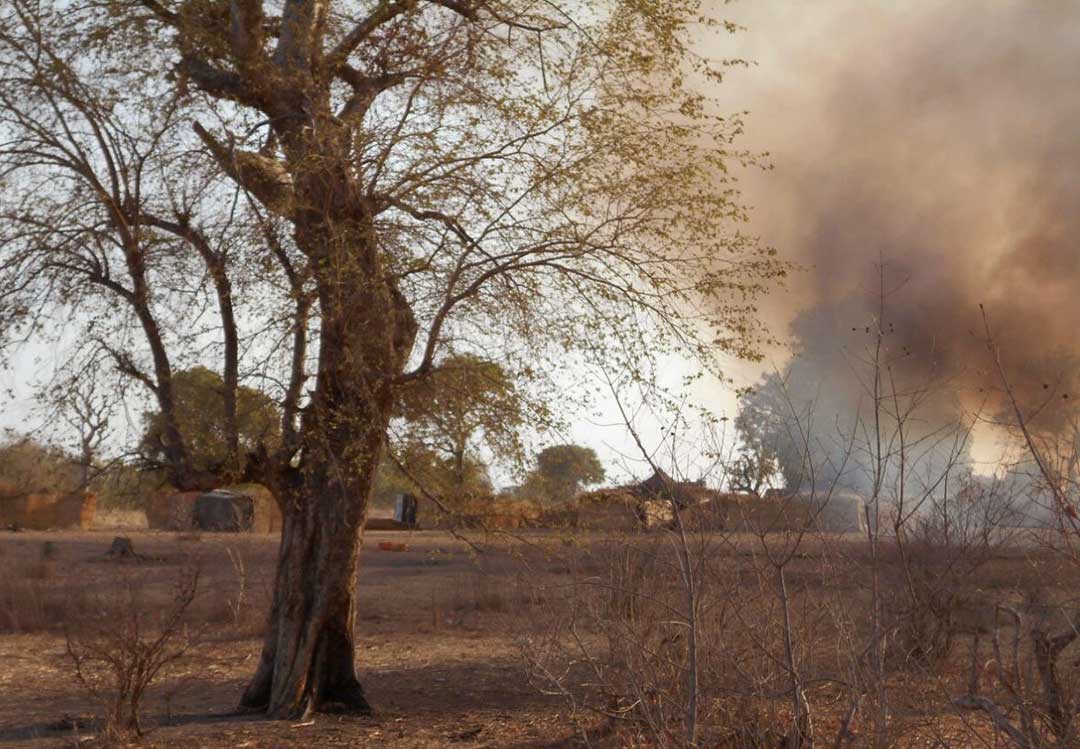
Covering 60,000 square kilometers, the Sambisa Forest in northeast Nigeria was once a thriving wildlife reserve, popular with tourists. Today, the animals are mostly gone, replaced by two warring militant groups and the Soldiers who pursue them.
Jama’tu Ahlis Sunna Lidda’awati wal-Jihad (JAS) and Islamic State West Africa Province (ISWAP) have fought for control of the forest since Boko Haram split into the two factions in 2016. Recent reports indicate their battles are intensifying.
With its sheer size and dense vegetation providing cover for hideouts, Sambisa is desired as a strategic location for launching attacks and controlling smuggling routes.
“For JAS, the conflict began as a fight for survival,” Malik Samuel, a senior researcher with Good Governance Africa, told ADF. “Despite their rivalry, both factions have shown remarkable recovery and retain the ability to take on state forces, including the Nigerian military and the Multinational Joint Task Force.”
Citing local sources, Borno-based security analyst Zagazola Makama reported multiple battles in and around Sambisa Forest, with both sides claiming to have inflicted heavy casualties.
“While these claims remain unverified, they point to the intensity of the rivalry between the two groups, which has evolved into a parallel conflict alongside their broader insurgency against state forces,” he wrote in a May 2 report on his website.
Since Boko Haram launched its insurgency in 2009, the conflict has spilled into neighboring Cameroon, Chad and Niger, and resulted in the deaths of more than 40,000 civilians and the displacement of more than 2 million people, according to the United Nations.
While JAS is known for kidnapping, looting and deadly attacks on civilians, ISWAP focuses on territorial control, collecting taxes and acting as an alternative local government, albeit one with a vicious disregard for human life. The Sambisa Forest and the islands of Lake Chad have long been strategic strongholds for both factions.
“The latest reports suggest that despite ongoing counterterrorism pressure, the insurgents continue to maintain active communication networks and operational capabilities within these enclaves,” Makama wrote. “The infighting between Boko Haram and ISWAP is increasingly seen as both a challenge and an opportunity — a challenge due to the unpredictability it introduces, and an opportunity as it may weaken the overall cohesion of insurgent forces in the region.”
With Nigerian and multinational joint forces focused on blunting ISWAP’s campaign against military installations, JAS has had time and space to regroup, according to Taiwo Adebayo, a researcher focusing on Boko Haram at the South Africa-based Institute for Security Studies.
“Security strategies must be rebalanced to treat JAS as an independent, adaptive threat, rather than merely ISWAP’s weakened rival,” he wrote in a 2025 analysis.
Samuel foresees a long-term stalemate between the rival militant groups.
“It’s difficult for ISWAP to access JAS’s stronghold in Barwa, where [their leader] is based,” he said. “That makes a Sambisa-like operation to eliminate JAS leadership challenging. Second, the proximity of both groups on the islands makes confrontation inevitable, as they compete over territory and resources.
“Outside the islands, however, JAS is no match for ISWAP due to ISWAP’s superior numbers, territorial reach and coverage and experience, bolstered by the presence of foreign terrorist fighters.”