

The 15th iteration of Obangame Express (OE26) returned in April to Cameroon, the country that first hosted the maritime security event in 2010. The largest multinational maritime exercise in West and Central Africa, OE26 worked to build cooperation to fight sea crimes such as illegal fishing, piracy and all manner of trafficking in the Gulf of Guinea.
More than 30 nations, including 22 from Africa, participated in the U.S. Africa Command-sponsored exercise, designed to improve information sharing and maritime domain awareness, as well as tactical and operational readiness.
“With piracy, illegal fishing, various forms of trafficking and attacks faced on the maritime environment, our response must be commensurate with the challenges: concerted, structured, and sustainable,” said Vice Adm. Jean Mendoua, chief of naval staff of the Cameroon Navy. “Cameroon, faithful to its international commitments, will continue to play its full role in this collective dynamic.”
Other participating countries included Angola, Belgium, Benin, Brazil, Cabo Verde, Republic of the Congo, Cote d’Ivoire, Democratic Republic of the Congo, Denmark, France, Gabon, The Gambia, Ghana, Guinea, Guinea-Bissau, Equatorial Guinea, Italy, Liberia, Mauritania, Morocco, the Netherlands, Nigeria, Portugal, Sao Tome and Principe, Senegal, Sierra Leone, Spain, Togo and Tunisia. The three-week exercise ended May 1.
Throughout the exercise, participants worked together from Maritime Operations Centers across the five Yaoundé Architecture for Maritime Security (YAMS) zones in the Gulf of Guinea and from ships at sea. Enacted in 2013, the Yaoundé Code of Conduct plays an important role in helping West African navies maintain situational awareness and fight maritime crime in the Gulf of Guinea. Participating navies conducted complex, real-time scenarios, such as piracy interdiction and search and rescue operations.
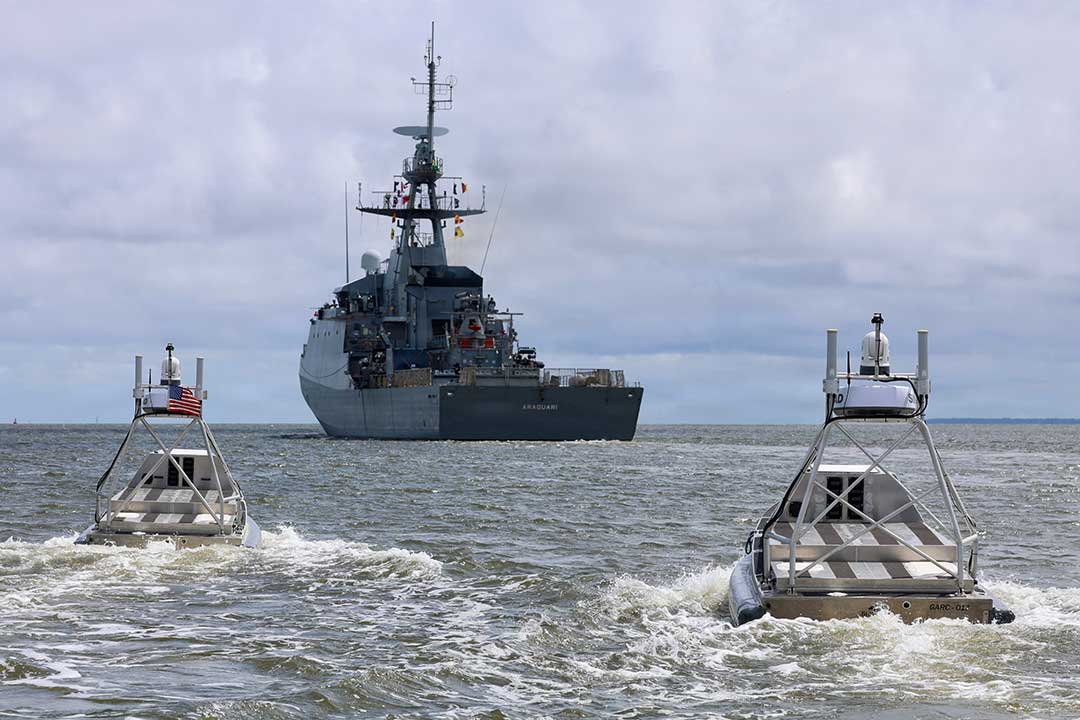
In Cameroon, the U.S. Navy deployed Global Autonomous Reconnaissance Craft during a live robotic and autonomous systems demonstration. The boats are 16-foot unmanned surface vessels, or drones, built for high-speed operations in contested maritime regions. The craft have intelligence, surveillance, reconnaissance, communications and mine countermeasure capabilities.
“Maritime security is not just a naval concern; it is a vital component of national and regional stability,” said Rear Adm. Jason Naidyhorski, U.S. 6th Fleet vice commander. “With 90% of all global trade traveling by sea, safeguarding these waters is a shared strategic interest for all of us. When maritime trade sails freely, economic development and prosperity flourish.”
According to the Center for Strategic and International Studies, the Gulf of Guinea has almost 20 commercial seaports and carries 25% of African maritime traffic.
In Senegal, naval forces from 17 nations executed visit, board, search and seizure (VBSS) drills led by Senegal’s Special Forces Marine unit. Boarding teams trained in realistic boardings at sea, evidence handling and search procedures, including fisheries inspection.
“In the face of the proliferation of increasingly complex, hybrid and transnational maritime threats, it has become essential for states to develop robust, credible and interoperable VBSS capabilities in order to ensure the protection of their strategic interests and the maintenance of order at sea,” Lt. Cmdr. Alimamy Mbaye Bassene, executive officer of the École de la Marine Nationale for the Senegalese Navy, said in a defenceWeb report.
Before OE26 began, the U.S. Navy built a VBSS shoot house and upgraded a small arms range at Senegal Navy Bel Air Base in Dakar, where the VBSS training was held. Subject matter experts from participating nations also led classroom instruction on maritime law and interdiction, command and control techniques and medical readiness.
Nigeria’s flag officer commanding the Eastern Naval Command, Rear Adm. Chiedozie Okehie, said the exercise offered “a vital platform” for improving collaboration, streamlining information sharing and building naval efficiency. Nigeria deployed 10 warships and two helicopters for the exercise. These resources were used during VBSS drills, search and rescue operations, anti-piracy drills and simulated pursuit operations.
“This year’s exercise is relevant because it comes at a time when the Gulf of Guinea is witnessing new attention as a critical maritime corridor for energy security, international trade and stability,” Okehie said in a report by Nigeria’s Arise News channel. “For Nigeria, our maritime environment remains central to national security and provides a timely opportunity to reinforce renewed efforts to protect critical infrastructure and counter crude oil theft and other maritime crimes.”