

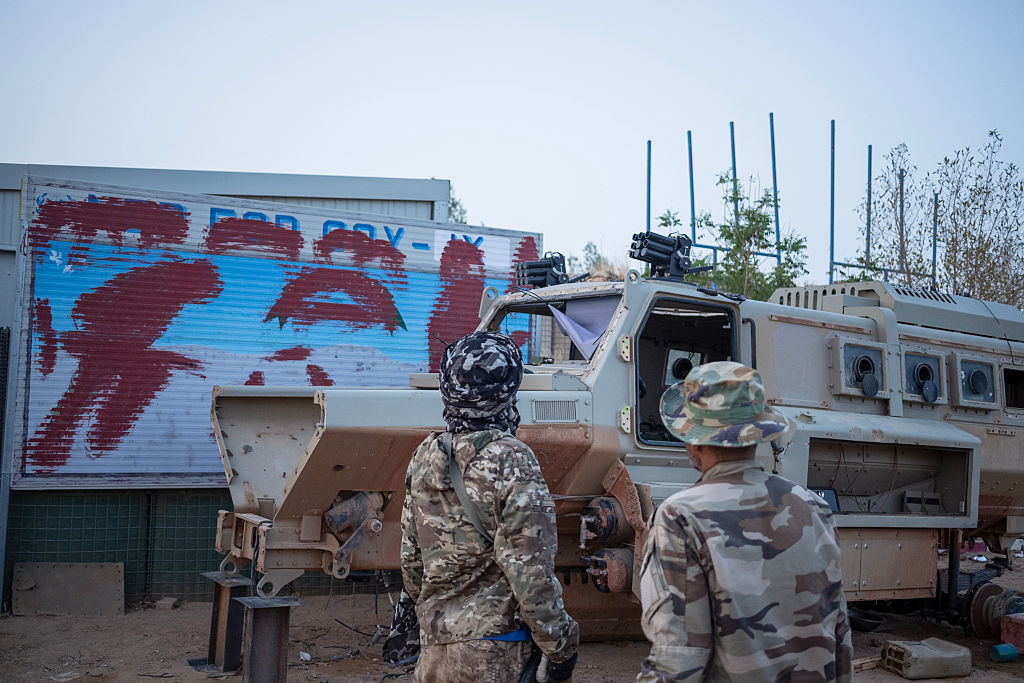
Since inviting Russian mercenaries into Mali in 2021, the country’s ruling junta has focused its attention on subduing northern Tuareg rebels. Analysts believe the decision has let terror groups Jama’at Nusrat al-Islam wal-Muslimin (JNIM) and Islamic State Sahel expand their presence in the country and threaten Mali’s economy with blockades.
Aided by Russia’s Africa Corps, the Malian military’s heavy-handed approach has killed thousands of people suspected of being rebels or terrorists simply because of their ethnicity. Those killings — many of them summary executions — have, in turn, helped those same groups recruit new members.
“While they were concentrating their efforts against the rebels in small towns in the desert, JNIM was getting stronger and stronger around Bamako,” analyst Wassim Nasr told ADF in an interview. “They thought it would be a good idea to take back the north and feed propaganda. It backfired.”
The junta reopened hostilities against the Tuaregs in January 2024 when it abandoned the 2015 Algiers Accords, a peace agreement between Mali’s then-democratically elected government and what became the Azawad Liberation Front (FLA). Months before, in November 2023, the Malian military had retaken the Tuareg stronghold of Kidal with the help of mercenaries from Russia’s Wagner Group.
The campaign against Tuaregs and other groups in the north came even as terrorists with al-Qaida-backed JNIM and Islamic State Sahel gained ground in the central part of the country, ultimately surrounding the capital and blockading truck traffic entering from Senegal and Côte d’Ivoire.
The Malian junta invited Russian mercenaries into the country after ending Mali’s relationship with France, whose Barkhane and Serval counterterrorism operations lasted for more than a decade. Operation Barkhane had helped the government reestablish control over the northern provinces, laying the foundation for the Algiers Accords.
The junta also expelled a United Nations peacekeeper mission, MINUSMA, at the end of 2023. In its place, Russian mercenaries and Malian Soldiers launched brutal campaigns against suspected terrorists. The most high-profile of these was a three-day attack against the central Malian community of Moura, where Wagner Group fighters executed hundreds of Fulani men.
The Moura massacre and subsequent attacks on communities suspected of harboring terrorists turned the civilian population against both the junta and the Wagner Group, pushing more people to join JNIM, Islamic State Sahel and the FLA. Meanwhile, the junta is doing nothing to gain the public’s trust, Nasr said.
“They haven’t built a school,” he added. “They haven’t built a road. The sole project they have is ‘We hate France. We hate the West.’”
Wagner’s campaign of brutality ended in the northern community of Tinzouatin in July 2024, when Tuareg fighters ambushed a joint Malian-Wagner force, driving them into territory controlled by JNIM, who also attacked them. In the end, nearly 50 soldiers and more than 80 mercenaries were dead.
“This is when Wagner stopped being Wagner and the label changed,” Nasr said. In the weeks that followed, Wagner announced it was leaving Mali. The new Africa Corps, staffed by many Wagner veterans, took its place.
“While the long-term goals of FLA and JNIM are unclear, the partnership is, for now, effectively further weakening the government,” analysts with the Soufan Center wrote recently.
Mali continues to pay Africa Corps an estimated $10 million a month for its services. Those services, however, have become more limited. Africa Corps prefers to remain within its bases, operating drones in support of Malian patrols.
“They go out still, but they are less confident,” Nasr said.
In late April, when Africa Corps joined Malian soldiers in an attempt to hold Kidal against a joint JNIM-FLA assault, the mercenaries fled, leaving Kidal in the hands of the FLA. A separate assault on the same day killed Mali’s defense minister.
Facing defeat on the battleground, Africa Corps has shifted its primary purpose to protecting the junta as JNIM expands its control beyond Bamako, according to Nasr. That includes protecting Bamako’s international airport and getting fuel and other resources through JNIM’s blockades. The junta shows no signs of negotiating with JNIM or FLA. Instead, Mali’s leaders depend on mercenaries for their survival, Nasr noted.
“They don’t have a choice. They are at odds with everybody. They are cornered,” Nasr said. “They keep paying because Africa Corps is their life insurance.”