

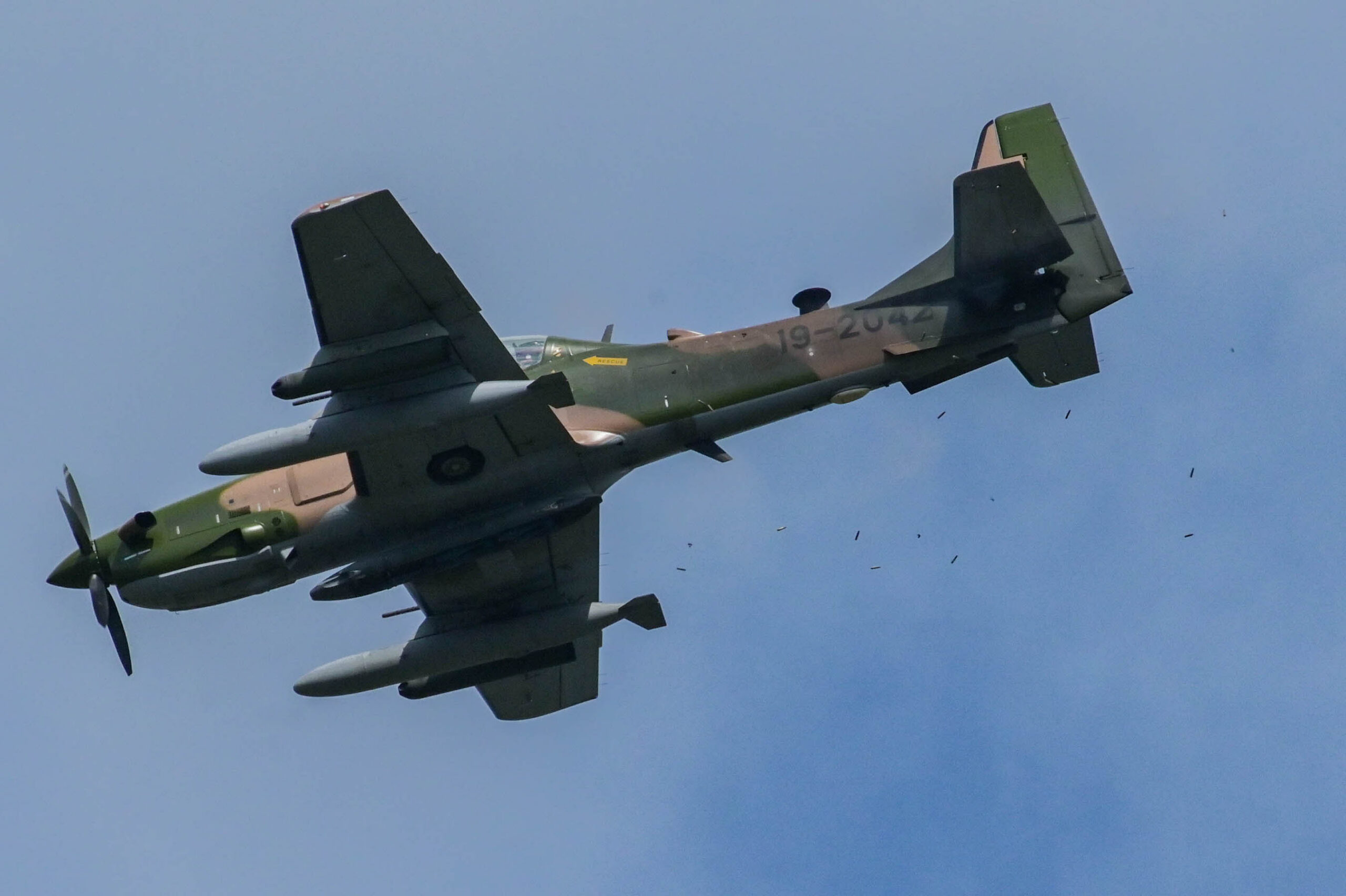
This year, Togo is expected to receive four Embraer A-29 Super Tucano light attack aircraft worth $82 million. Designed for low-intensity conflicts, the Brazilian aircraft is expected to bolster Togo’s fight against the al-Qaida-affiliated Jama’at Nusrat al‑Islam wal‑Muslimin (JNIM) terror group, which has expanded its operations from Burkina Faso and other parts of the Sahel region toward coastal West Africa.
The A-29 deal includes pilot training and technical maintenance assistance. The aircraft, known for their effectiveness in counterinsurgency operations in difficult terrain, will operate mainly out of the northern Niamtougou Fighter Base to increase surveillance and firepower in an area of savannahs and forests where terrorists lurk. The aircraft performs well at forward operating bases and in rugged terrain with poor runways.
It is not clear when the four turboprop Super Tucanos will be delivered, but the purchase represents “the most significant modernization of the Togolese Air Force in decades,” and “a deliberate and accelerating transition in Togolese military doctrine: from passive border monitoring toward an active, precision-capable counter-insurgency strike posture,” wrote researchers with the African Security Analysis website.
A-29s are used in several African countries, including Nigeria, which received a dozen Super Tucanos in July 2021. By August 2024, the Nigerian Air Force had logged 10,000 flight hours on the aircraft, which it uses in counterterror operations against Boko Haram and other groups. Nigeria received the planes from the United States in a $500 million deal that included spare parts to support several years of operations, contracted logistics support, munitions and a multiyear construction project to upgrade infrastructure at the Kainji base in Niger State.
Super Tucano Features
The A-29 features a reinforced airframe and self-sealing fuel tanks to repel small-arms fire from the ground, the kind of munitions commonly employed by JNIM. It includes a 1,600-horsepower engine that can carry a 1,550-kilogram payload across five “hardpoints,” which are structural points on military aircraft that carry external loads, usually on the wings or fuselage.
The Super Tucanos are a move away from the Socata TB-30 Epsilon training aircraft that Togolese forces have used since the 1980s. The Epsilons offered basic air-to-ground capability, but lacked endurance and sensor integration, Military Africa magazine reported.
The A-29’s sensors include optronic pods, which are electro-optical and infrared sensor systems used for reconnaissance, surveillance and targeting operations. These pods will help Togolese crews identify and track targets at long distances.
“This capability fundamentally alters the tactical dynamic in the Savanes region, where JNIM units have exploited the limitations of Togo’s existing reconnaissance and strike assets to conduct hit-and-run operations with relative impunity,” according to African Security Analysis.
The JNIM Threat
Among other areas, JNIM operates from the southeastern Burkina Faso province of Kompienga, which borders Togo. Due to the porous border, the Togolese prefecture of Kpendjal has been increasingly targeted by terror attacks, although violence began spreading away from the borderlands last year.
In a study for the Konrad Adenauer Foundation, security specialist Mathias Khalfaoui said in August 2025 that JNIM’s expansion into Togo was “becoming clear.” There have been no major JNIM attacks reported this year in Togo, but more than 60 people, including 54 civilians and eight Soldiers, were killed in 15 terror incidents between January 1 and July 30, 2025.
Togolese political scientist Madi Djabakate told Agence France-Presse that the northern Togolese prefectures of Kpendjal and West Kpendjal are particularly vulnerable due to an absence of state forces.
“Civil servants posted to these areas perceive their assignment as a punishment, given the harsh living conditions and the absence of public services,” Djabakate said.
A shift in JNIM’s terror playbook unfolded in April 2025, when the terrorists used for the first time a kamikaze drone in a Savanes region attack that injured six Soldiers. The group is also known to conduct suicide bombings, and use improvised explosive devices and advanced military equipment seized from national forces, particularly those from Burkina Faso, Mali and Niger.