

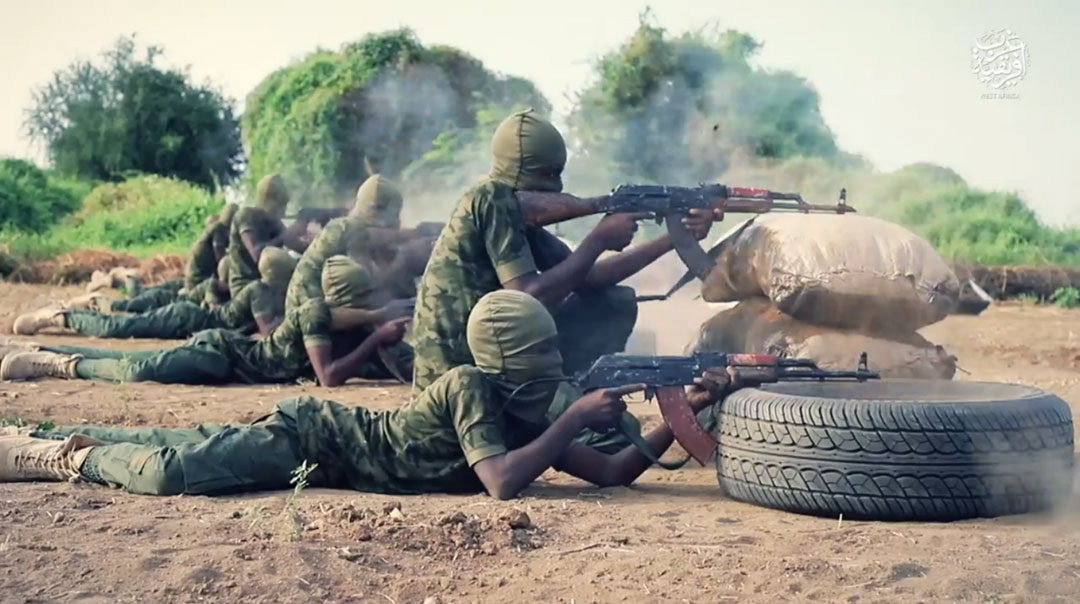
Yusuf was 5 years old on the night that Islamic State group terrorists on motorcycles raided his village and took him to raise as one of their own. By the time he was 10, he had fought against the Nigerian Army and the rival terrorist group known as Boko Haram.
After five years of combat with the Islamic State West Africa Province (ISWAP), the 15-year-old had been hardened to the sight of death and destruction. He explained how young children are indoctrinated into combat:
“You want to wear the uniform,” he told British newspaper The Times for a March 13 article. The paper gave him a pseudonym for his protection. “You want to belong. You want to be seen as a hero.”
But the life of a child combatant is extremely harsh, and in many cases, short. ISWAP leaders are rigid and unyielding, Yusuf said, adding that he was aware that a person could be beheaded for disobedience.
With an estimated 10,000 fighters, ISWAP is by far the largest IS faction. Recruitment relies heavily on mass abductions and forced conscription of men, women and children.
Referred to as “Cubs of the Caliphate,” child combatants are seen as an easy source of manpower and frequently are used in IS propaganda videos. Experts say ISWAP has hundreds of training camps for children on Lake Chad’s countless islands, which sit along the borders of northeastern Nigeria, southeastern Niger, southwestern Chad and the Far North region of Cameroon.
The United Nations recorded thousands of cases worldwide of children used in combat from December 2024 to December 2025.
“The recruitment and use of children persisted at very high levels, with 7,402 children recruited and used by State and non-State actors,” according to the most recent report on Children and Armed Conflict, which the U.N. published in December 2025. “The violation was often compounded by other grave violations, such as killing and maiming, abduction and sexual violence.
“Abduction was the fourth-highest verified violation in 2024, affecting 4,573 children. The Democratic Republic of the Congo, Nigeria and Somalia had the highest numbers of both abducted and recruited and used children.”
Yusuf said he underwent combat training as soon as he could carry an AK-47 assault rifle. ISWAP fighters instructed children on the use of a number of weapons, including vehicle-mounted heavy machine guns and rocket-propelled grenades. Men from the Middle East and North Africa taught his instructors how to use improvised explosive devices and drones, Yusuf said.
He recently had a change of heart, yearning to rejoin society. He spoke with a former ISWAP fighter who had left the group and who encouraged him to do the same. Yusuf left the group in February with the help of the Nigerian military.
The man he spoke with was Ali Ajaban, a former senior ISWAP commander who left in 2021 and now works with the Nigerian government against the insurgency. He had been an instructor for child recruits during some of his five years as an ISWAP member.
“We use children to fight because if you begin training them at a young age they are fearless,” Ajaban told The Times.