

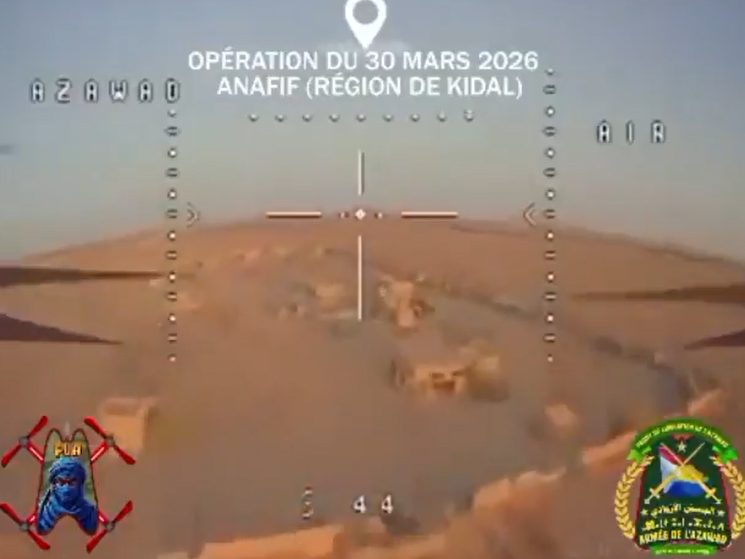
The recent attack on a Malian Army base near the community of Aguelhok was the latest example of insurgent groups in the country using armed drones against government and paramilitary forces.
The attack by the Azawad Liberation Front (FLA) in early April targeted a military base near the community used by the Malian Army (FAMa) and fighters working for Russia’s Africa Corps.
The attack was the latest in a series of FLA assaults on regional military bases. In late March, the group attacked a joint FAMa-Africa Corps base in nearby Anéfis. A few days before, they launched their first attack on the Aguelhok base.
A few weeks before that, the group struck Camp Firhoun ag Alinsar in Gao with 25 armed kamikaze drones. A week before that the FLA hit a FAMa-Africa Corps outpost in the Adghar-Takalot area south of Kidal. That attack destroyed an armored vehicle and killed or injured Malian Soldiers and Russian mercenaries.
The FLA claims to have struck Malian and Russian forces seven times during March.
The FLA has gained attention for its use of drones on the battlefield. The group used an armed Chinese-made Flydragon FDG410 surveillance drone to take down a Malian Army helicopter in Tessalit in February 2025. They were the first Sahelian nonstate group to adopt fiber-optic technology with drones in 2025, which first appeared among Ukrainian Soldiers fighting the Russian invasion of their country.
Jama’at Nusrat al-Islam wal-Muslimin (JNIM) and Islamic State Sahel Province likewise have deployed commercial-style armed drones in their own attacks against government and mercenary forces. JNIM’s drone use increased after former Malian Army Col. Hussein Ghulam moved from FLA to JNIM in 2024, bringing his extensive knowledge of drone operations with him.
Attackers have deployed commercial-style first-person-view (FPV) drones, including some armed drones that filmed attacks on military vehicles, buildings and fleeing Soldiers at the sites. These videos often are posted to social media.
Pairing FPV drones with easily acquired explosives creates a “devastatingly effective” low-cost weapon, according to analyst Shahryar Pasandideh, writing in his Substack publication Universal Dynamics.
The April attack on Aguelhok happened despite the presence of jamming technology designed to disrupt the link between the drone and its operator. That suggests the FLA may have used drones tied to their operator by fiber optic cables, which would protect them from signal jammers, according to analysts with the website West Africa Maps.
According to analyst Rueben Dass writing for the legal website Lawfare, the FLA “is learning from other conflicts and applying the lessons in their war in Mali.”
While the FLA has used drones primarily in northern Mali, drones create the potential for strikes elsewhere, according to Castor Vali Security Information Services, a risk analysis firm focused on Africa.
“Though the FLA has not carried out attacks deep inside territory controlled by the Malian government, drones offer them the capability to conduct precision attacks away from the frontlines — they are light, and don’t require multiple people to transport and operate them,” Castro Vali analysts wrote in a study of drone use in the Sahel.