

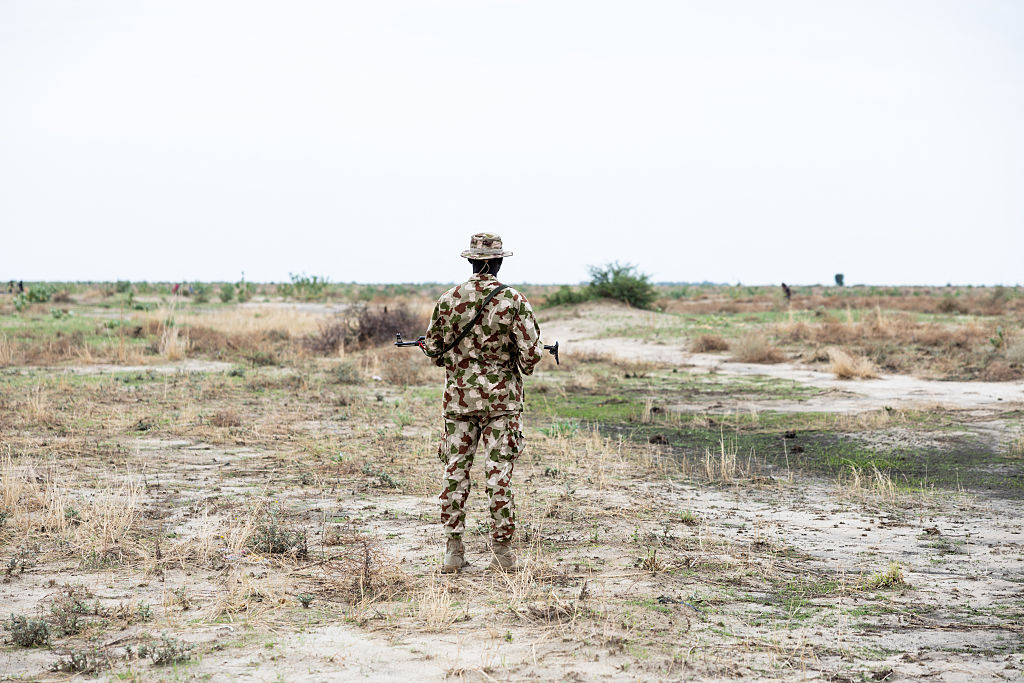
A region in northeast Nigeria has been dubbed “the Timbuktu Triangle” by terror groups as they aspire to tighten control and establish a caliphate.
New reporting from Borno and Yobe states shows that residents live in fear as they face whippings, taxation and even execution if they violate rules put in place by occupiers.
“It feels strange when a day passes without gunfire in the Timbuktu Triangle,” a health worker named Kande told The Africa Report magazine. “Damboa and its neighboring communities are soaked in blood.”
Islamic State West Africa Province (ISWAP) fighters began to occupy the savannah region in recent years after internal squabbles led fighters to exit strongholds in the Sambisa Forest and the Mandara Mountains. The 11,000-square-kilometer triangle runs from Maiduguri to Dankalwa to Damboa. It has been fertile ground for terror groups because of its tall grass and thick brush that can conceal bases.
Although the military is visible on main roads and population centers, terror groups hold power in smaller communities. In interviews with nine people from the region, The Africa Report found that fighters held makeshift Shariah courts where people were convicted of crimes such as spying, breaking social rules and not paying taxes.
“Punishments can be harsh, including beatings, floggings, or shootings. In some cases, victims are left badly injured in the bush as a warning to others,” according to The Africa Report.
The lethality was on display on April 9 when ISWAP and Boko Haram launched coordinated attacks on a military base in Benisheikh and two nearby villages. The base attack killed a brigadier general and other Soldiers. On April 26, ISWAP terrorists invaded a football pitch in Guyaku in nearby Adamawa State, killing about 30 people before burning homes and a church.
The incidents are part of a deadly wave by ISWAP and Boko Haram. In the first quarter of 2026, attacks surged by 25%, resulting in one of the bloodiest three-month periods since 2015. This comes after Nigeria tallied the largest rise in terrorism deaths globally in 2025, increasing by 46% from 513 to 750.
Amid the violence, the Armed Forces of Nigeria (AFN) is reporting some success. Nigeria’s Defence Headquarters announced that it had killed 216 terrorists and arrested 284 suspects, including “ring leaders” in April. Military operations rescued 188 kidnapping victims and uncovered a cache of arms and ammunition in the same month.
“No criminal or terrorist organization, regardless of its financial resources, geographic spread, or ideological ambition, is beyond the AFN,” Director of Defence Media Operations Maj. Gen. Michael Onoja said at a briefing in Abuja. “The Nigerian public is urged to continue partnering with the AFN by providing timely and credible intelligence through available reporting channels.”
In an interview with The Africa Report, Maj. Gen. Abdulsalami Abubakar credited coordinated offensives, air support and a growing relationship with the United States, which is providing training and intelligence. “We are leveraging our current partnership with the United States,” he said.
Nigerian forces are fighting a two-pronged campaign: defeating terrorists on the battlefield and winning the ideological fight to assure civilians. After years of insecurity, people in the area have doubted the military’s ability to protect them and have fallen victim to relentless ISWAP propaganda, which paints the terror group as their defenders. In late January, Nigerian troops with Operation Hadin Kai scored a victory when they ventured deep inside the triangle to destroy three terrorist detention facilities and liberate more than 70 captives. Operations like this help build public support, security experts say.
Retired Gen. Christopher Musa, Nigeria’s Minister of Defence, insisted that the country is at a “turning point” in its war against terror groups but cautioned that it would be a long fight.
“Asymmetric warfare is the most difficult operation because the enemy is within,” he told Arise News. “We’re fighting a war, and we’re fighting a determined enemy who is getting support from the outside and who has nothing to lose. The worst enemy you can fight is from within and who feels they have nothing to lose.”