
Russian cargo aircraft were tracked making at least 167 flights to five Algerian air bases between March 2025 and April 2026. Many of Moscow’s aircraft using the bases are connected to the United Aircraft Corp., Russia’s state-owned maker of military jets.
According to Defense News magazine, these flights roughly coincided with the deliveries of several types of Russian-made warplanes to Algeria, where the jets have been seen and heard thundering over the countryside near the Oum El Bouaghi Air Base. The shadowy Kremlin fleet is known as “Air Wagner” in reference to Russian mercenaries engaged in African conflict zones. The fleet’s flight patterns suggest it provides logistics for Africa Corps, Wagner’s successor.
“Algiers appears to be a convenient staging ground for West African operations, and one that may be under less scrutiny than some other staging grounds previously used by Russia for supplying its mercenaries on the continent,” wrote Linus Höller, a Defense News correspondent.
Russia is Algeria’s top supplier of weapons and Algiers is currently receiving Russian Su-57 fighter jets and Su-35 fighters while continuing to operate a fleet of about 60 Su-30 multirole fighters and around 40 MiG-29 air-superiority fighters, the report said. The Kremlin uses air bases in Algeria and other parts of the continent to avoid sanctions levied after Russia attacked Ukraine. Russian weapon sales fund its war.
Many of the Russian aircraft operating in Algeria appeared to attempt to evade detection by falsifying their itinerary and switching off their Automatic Dependent Surveillance-Broadcast (ADS-B) transponders. However, Defense News tracked Russian aircraft heading to Guinea and other African countries after leaving Algeria. Moscow is heavily involved in Guinea’s mining sector, and the country is a transit point for deliveries of Russian weapons into the Sahel.
Algeria is one of several stops on Russian flights around the continent, many of which are likely tied to shipments of new weaponry.
“I think this is a pretty reasonable explanation for these flights,” Margaux Garcia, a senior analyst with the global nonprofit security organization C4ADS, said in a Defense News report.
Two of the Russian airlines involved in these operations, Gelix and Aviacon Zitotrans, are technically civilian run but operate on behalf of the Kremlin’s State Property Management Office and are directly subordinate to Russian President Vladimir Putin.
“The use of charter airlines gives the Kremlin more capacity and easier access to civilian aviation procedures than flying government- or military-owned planes abroad, not to mention a layer of obfuscation and plausible deniability,” Höller wrote.
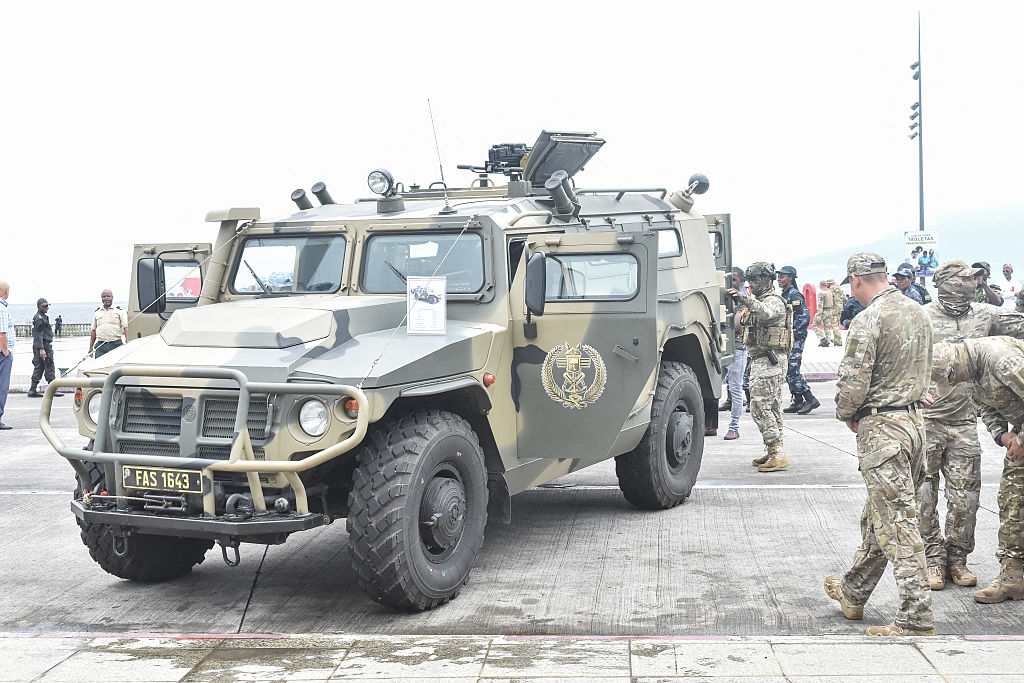
In January 2025, sanctioned Russian cargo ships delivered about 100 Russian military vehicles, including light tanks and armored vehicles from Guinea to Mali. Russian combat and troop transport helicopters, and Sukhoi and L-39 fighter jets were delivered to Mali in 2023, the French newspaper Le Monde reported.
Since inviting Russian mercenaries into Mali in 2021, both Malian and Russian forces have committed atrocities against civilians as Bamako’s ruling junta battles Tuareg rebels and the Jama’at Nusrat al-Islam wal-Muslimin (JNIM) and Islamic State Sahel terror groups. JNIM has imposed a blockade on fuel to Bamako, the national capital, since September 2025.
Russian mercenaries, now known as Africa Corps, are also active in junta-led, uranium-rich Niger. In late 2025, Russia began moving 1,000 metric tons of uranium through an airlift in Niamey, Niger’s capital. In early December, an aircraft that reports directly to a heavily sanctioned Russian military flight unit left Niger with uranium before flying to Libya. The aircraft’s transponder was turned off during portions of the journey, according to Italian newspaper Il Foglio.
The aircraft, which has also operated out of Mali, was twice tracked flying from Libya to Burkina Faso before landing back in Libya on December 7 and 8. Russian mercenaries support Burkina Faso’s military junta while Moscow has long leveraged Libya as a gateway to help extend its influence in northern and sub-Saharan Africa. The plane refueled in Syria before returning to Russia.
“These aircraft have a maximum range of about 5,000 kilometers, so they must make several stops on such long journeys between Russia and the Sahel,” an open source intelligence expert who tracks Russian flights in the Sahel told Il Foglio. “But we don’t know whether the uranium was unloaded at some point during these stops or whether it was all transported to Russia.”
According to Defense News, the Russian aircraft have also used Algeria, Guinea and occasionally Mauritania as stops on flights to Brazil, Bolivia, Colombia, Venezuela, Mexico and Cuba before returning to Russia. The aircraft also sometimes flew from Algerian military air bases to Emirati airports before returning to Russia.