

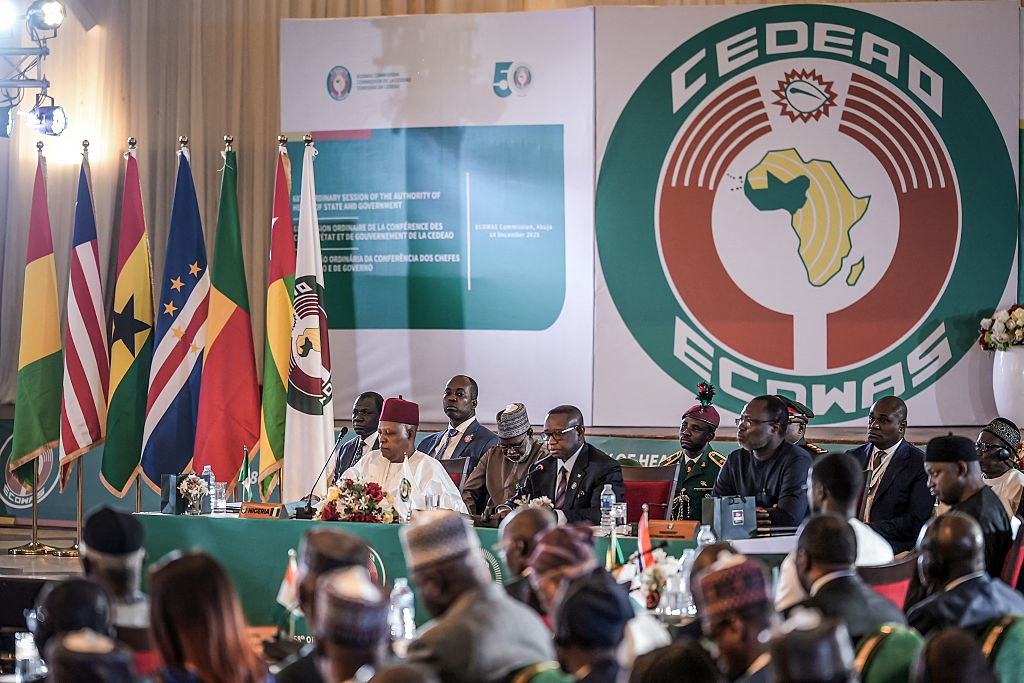
As the Economic Community of West African States prepares to establish a regional force to combat terrorism and security threats, researchers say that identifying a reliable financing source will be critical.
In February, chiefs of staff of ECOWAS endorsed the plan, which falls within the framework of the group’s Standby Force as provided for by the African Union. Officials announced the initial plan in August 2025, with a goal of 260,000 troops and an annual budget of $2.5 billion. The chiefs now have opted for a counterterrorism brigade of 1,650 Soldiers to form the core of the force. Benin, Côte d’Ivoire, The Gambia, Ghana, Nigeria and Senegal reaffirmed their commitment to providing troops, according to the South Africa-based Institute for Security Studies (ISS). Contingents will be stationed in their respective countries, ready for deployment.
ECOWAS has discussed the creation of such regional forces since 2004. In December 2022, ECOWAS reached an agreement to establish a regional peacekeeping force aimed at countering terrorism and reinstating democratic governance after military coups. ECOWAS officials also have said they want to use a regional force to help stop terrorist and secessionist groups from taking over any West African territory. They have pointed to the successes of their earlier ECOWAS Monitoring Group, which intervened in Liberia, Sierra Leone and Guinea-Bissau in the 1990s and Côte d’Ivoire in the early 2000s.
ECOWAS has tried several times over the years to establish a united military force but has lacked “the resources, funding and political will to turn this ambition into reality,” the ISS reported.
ECOWAS Commission President Omar Alieu Touray said that other security efforts in the region, including the G5 Sahel Joint Force, the Accra Initiative, the African Union’s Multinational Joint Task Force and United Nations operations, have led to a “fragmentation” of responses.
The key to a successful regional armed force will be predictable, sustaining self-funding, experts say, pointing to the G5 Sahel Joint Force and the Accra Initiative as examples of regional groups that have not been sustainable.
The Accra Initiative was established in 2017 by Benin, Burkina Faso, Côte d’Ivoire, Ghana and Togo. Mali and Niger were added as observer states. It was intended, according to the West Africa Network for Peacekeeping, as a regional force to take “full responsibility” for its own security after the progressive incursions of violent extremist groups in the Sahel. The network said the initiative was a “stopgap measure” after ECOWAS was unable to deploy a Standby Force. It also was, African leaders said, an attempt to find “African solutions for African problems.”
The initiative had some successes but ultimately was limited by its short-term missions — a typical assignment lasted only four or five days — and its restricted geographic reach. Since 2020, the West Africa Network says, there have been no major cross-border operations “due to the lack of funding and logistical support.”
In a 2014 summit, Burkina Faso, Chad, Mali, Mauritania and Niger established the G5 Sahel Joint Force to coordinate regional cooperation in developing policies and security in West Africa. The chiefs of staff of the member countries tasked the force with battling terrorist groups in the region, including Boko Haram. The task force lost its momentum when Burkina Faso, Mali and Niger withdrew from ECOWAS in 2025 after military coups.
If the current ECOWAS initiative is to become successful, analysts said, it will have to overcome two major challenges: funding and the type of infighting that led the three coup-ruled countries to split from the group.
“Those challenges will persist,” Dakar-based Beverly Ochieng of the intelligence company Control Risks told Al Jazeera. “They’ll also have to think about this as not just a military response but a holistic operation that’ll include social interventions to halt the influence of these groups that allows them to recruit members.”
Officials say the latest ECOWAS initiative must learn from the shortcomings of previous multinational missions. A report by the West Africa Network concluded that such missions must be sustainably funded, flexible and versatile. For instance, when political alliances changed for the Accra Initiative, it needed to “adapt, re-imagine and position itself to strategically maintain its influence and relevance,” the network said. “However, this was not done.”
The G5 experience showed that such African missions need to be self-funding, as “dependence on external funding is risky and unpredictable,” the network said. Regional forces need predictable and sustainable funding to deal with such expenses as administration, communications, information systems, equipment and logistics.
Any such regional mission also needs to go beyond warfare and get at the causes of extremists’ encroachment, analysts said.
Maman Sambo Sidikou, a former executive secretary of the G5 Sahel Joint Force, said interventions to stop terrorist groups “must not be anchored on a primarily military solution as it could be expensive and unsustainable.”