

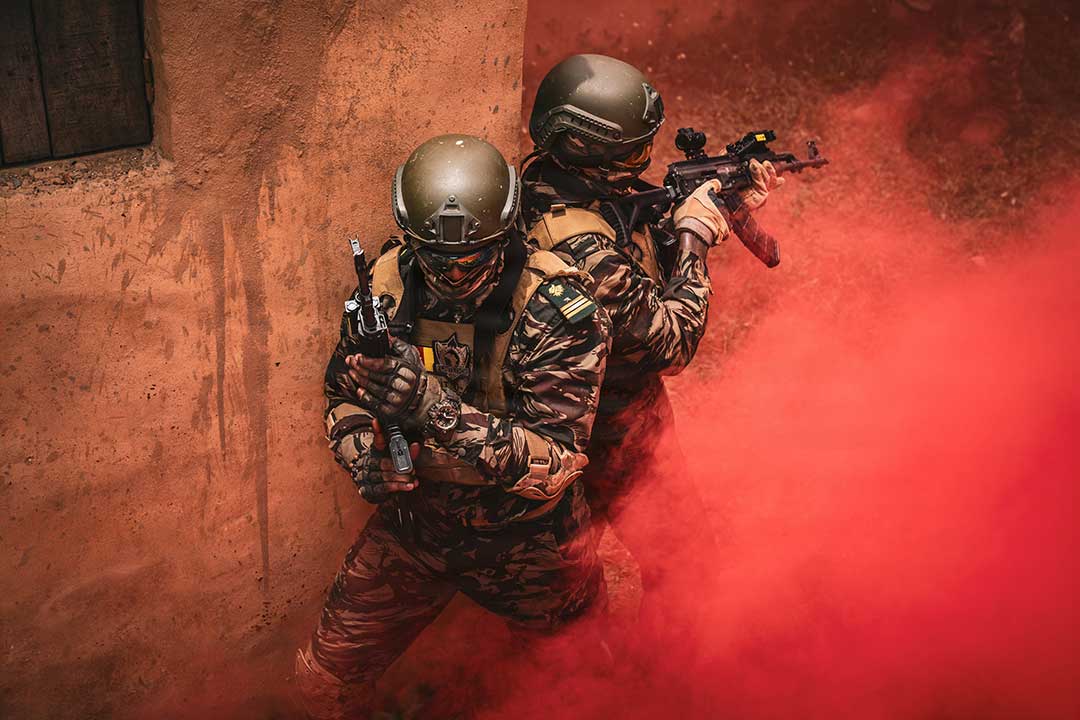
The campus of the International Counter-Terrorism Academy in Jacqueville, Côte d’Ivoire, looked like a scene from an action movie, as armored vehicles swarmed across the ground and drones buzzed above in a highly coordinated search for attacking insurgents.
West African forces and their international partners conducted a dramatic combat demonstration, putting lessons learned to the test and marking the conclusion of Exercise Flintlock on April 30. The purpose of the two-week training also was on display, as the threat of powerful, expanding terrorist groups is a stark reality in the region.
“Terrorist threats know no borders and can only be contained through a shared will,” Armed Forces of Côte d’Ivoire Deputy Chief of Defense Maj. Gen. Aly Dem said during the April 30 closing ceremony. “For where uncertainty prevails, decision must emerge; where threats hide, clarity must prevail; and where the adversary seeks to divide, unity of action must stand firm.”
About 1,500 service members from more than 30 nations took part in the 21st iteration of Exercise Flintlock from April 14 to 30, with training sites in Côte d’Ivoire and Libya. Flintlock started in 2005 and is United States Africa Command’s (AFRICOM) largest annual special operations exercise on the continent.
U.S. Special Operations Command Africa commander Maj. Gen. Claude Tudor said the focus of Exercise Flintlock was to deepen interoperability and reinforce technical capabilities to counter terrorist networks across West Africa.
“Flintlock sends a clear message to any who seeks to destabilize this region: Our united network is our greatest asymmetric advantage,” he said during the closing ceremony. “It is built on shared values, mutual respect and the rule of law.”
AFRICOM Deputy Commander Lt. Gen. John Brennan said the purpose of the exercise was to “forge stronger bonds between all those participating, underscoring a shared commitment to degrading regional terrorism.”
In the Sahel, terrorist organizations affiliated with the Islamic State group and al-Qaida have taken control of large areas, exploited porous borders and sought to expand south into West Africa’s coastal nations.
A key security leader in West Africa, Côte d’Ivoire led operations centered on a command and control headquarters in Jacqueville, directing special exercise operations units to achieve tactical objectives.
The April 28 combat demonstration was the culmination of days of training in the classroom, highlighting tactics and coordinating with local law enforcement. Other classroom subjects brought to life included checkpoint procedures, close-quarter battle drills, marksmanship training, small drone operations and vehicle operations.
“One of the objectives of the exercise is to incorporate the multinational comprehensive operations planning process at decentralized command and control units, something we practiced in academics to ensure they are ready when we move to the scenario,” one of the Flintlock 26 planners said. “Developing this shared understanding across the multinational force is a critical aspect that will foster the information sharing needed between simulated cross border command and control entities to deliver desired effects.”
Training events took place in and around designated sites in Côte d’Ivoire, where units were challenged to adapt their individual proficiencies into team-based execution. The field exercise phase of Flintlock 26 emphasized synchronization across partner forces, interoperability and collective readiness.
“It’s been a great way to learn from other nations,” a Nigerian Navy Special Boat Service operator said. “There’s always a debrief after each event. There we receive feedback and an opportunity to exchange what we know.”
African military leaders who attended praised the integrated field exercise and the multinational forces who worked together on a complex simulated mission. By combining tactical disciplines, exercise participants showed off an enhanced ability to coordinate movements, communicate effectively and respond to evolving security threats.
“Beyond the scenarios, Flintlock has above all strengthened an irreplaceable strategic asset: trust among the forces engaged,” Dem said. “The knowledge gained here must not remain confined to mission reports. It must flow into our units, enrich our doctrines and strengthen our capabilities so that every effort becomes operationally relevant, every lesson helps save lives, and every bond of brotherhood translates into more effective coordination in service of our peoples.”